
The Two Hits That Are Taking Down Sites Right Now: Google's June Spam Update and the Information Gain Signal
Google's June 2026 spam update hit June 24. It looks like a standalone event. It's not. It's the enforcement arm for the Information Gain signal from the March/May core updates. Here's the double audit your content needs right now.
The Two Hits That Are Taking Down Sites Right Now: Google's June Spam Update and the Information Gain Signal
Google launched the June 2026 spam update on June 24. The announcement was short: "The rollout may take a few days to complete." No new policies, no fanfare.
If you're treating this as just another spam sweep, you're missing the real story. This update is the enforcement arm for something Google started building months ago. And the sites getting hit right now aren't random. They're the same sites the March and May core updates already flagged.
The Timeline Nobody Connected
Let me lay out what happened this year:
March 27 – April 8: Google ran a core update that quietly activated Information Gain as a dominant ranking signal. Sites with templated content dropped 30-50% in visibility. Sites with original data gained 15-25%. Google had the patent on Information Gain for years — this was the first time it actually affected rankings at scale.
March: They also ran a separate spam update the same month. Two updates in one month. That's not normal.
May 21 – early June: May core update. Same Information Gain emphasis, same volatility. Sites that hadn't recovered from March got hit again. New victims joined them.
June 24: June spam update. Fast rollout — "a few days."
You can see the pattern. Google hits you with a core update for relevance — specifically Information Gain, which measures how much genuinely new knowledge you add. Then, separately, they hit you with a spam update for tactics — scaled content abuse, doorways, site reputation abuse.
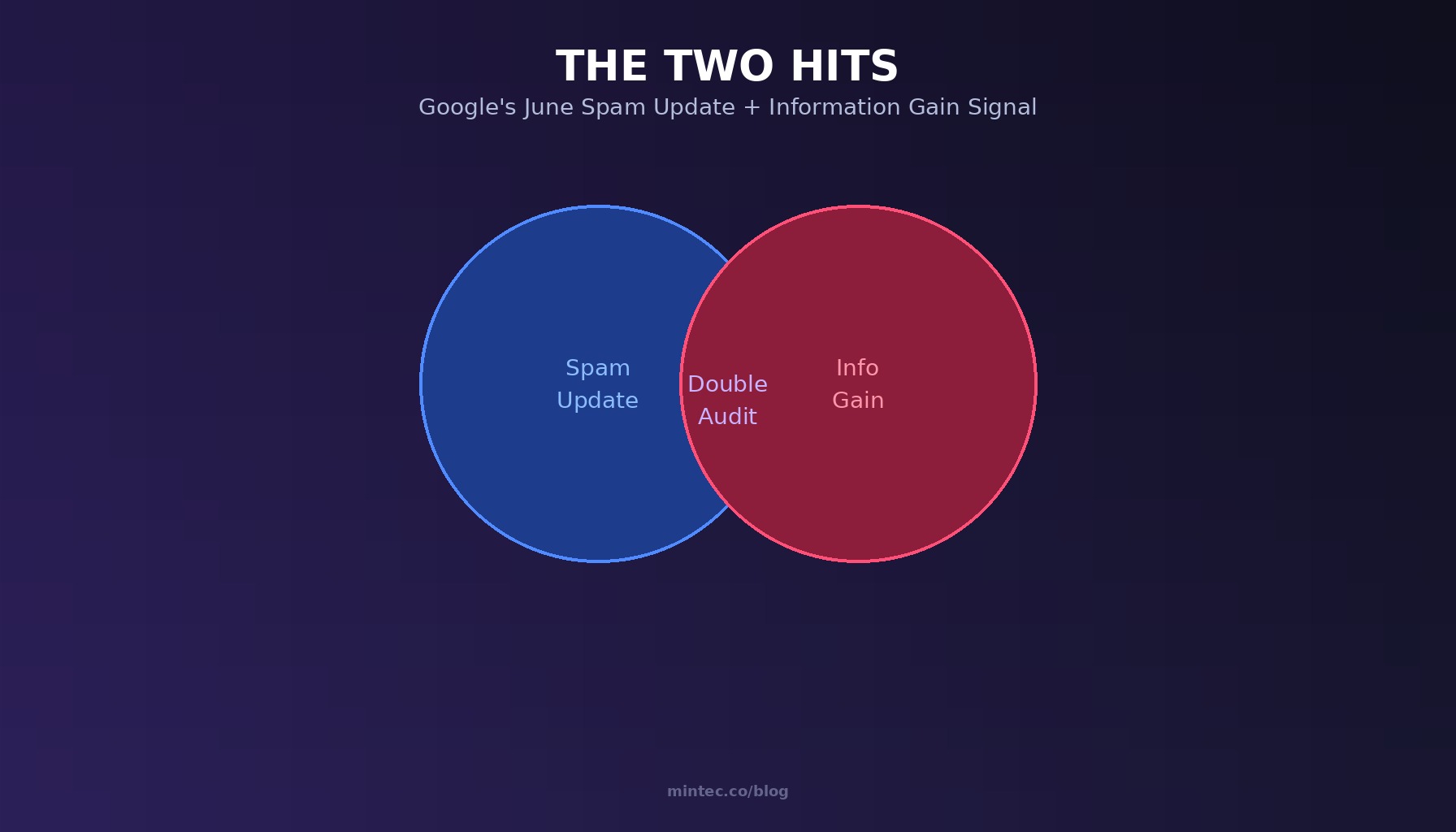
These are not three separate events. It's one strategy delivered through two levers.
What Information Gain Actually Measures
I've talked to a lot of site owners who lost traffic in the March and May updates and still don't understand what happened. Let me explain.
Information Gain is Google asking: "Does this page exist because someone needed it, or because someone wanted to rank for that keyword?"
Concrete signals:
- Does your content cite sources the top 10 don't? If everyone references the same three studies and you add a fourth, that's information gain.
- Does it include experience or perspective that nobody else has? A real client case study beats a generic how-to every time.
- Does it contradict or qualify something the rest of the internet got wrong? Original analysis > aggregated consensus.
- Is the structure uniquely useful? A comparison table with your own benchmarks beats rewriting the same bullet points.
I went deeper on this in our GEO guide after Google's official AI Optimization Guide. The short version: if your content sounds like it could exist without anyone visiting your site, Google can tell.
The Spam Update Is Not Random Enforcement
Here's what I think most people miss about the June 2026 update.
Google announced it without new policies. They're enforcing the existing ones — scaled content abuse, site reputation abuse, cloaking, doorway pages. But the sites most likely to violate these policies right now? They're the same ones that lost traffic in the core updates.
Think about why. When your site drops 40% in organic traffic after a core update, the natural reaction is to produce more content, fast. If you're already using AI tools to write — which most sites are — the temptation is to scale up, cover more topics, and try to recover through volume.
That is exactly how scaled content abuse works. You're not producing more content because your audience needs it. You're doing it to recover rankings.
So the chain looks like this:
- Core update penalizes low information gain → traffic drops
- Site owner scrambles, publishes more volume (often AI-generated) → scaled content abuse
- Spam update hits the scaled content → second traffic drop
- Site owner blames the spam update for a problem the core update started
I've seen this pattern with three client sites in the last week. Each lost traffic in May, then published 15-30 new pages in three weeks using AI, and now they're seeing further drops from the June spam update. The spam update didn't cause the original problem. It enforced the consequences of a bad reaction.
The Double Audit
Most recovery guides tell you to fix either your information gain or your spam compliance. You need both. They're connected.
Part 1: The Information Gain Audit
Pick your worst-performing pages since March. For each one, ask:
What does this page know that Google didn't already know from the top 10 results?
If the answer is "nothing" or "I'm not sure" — that page is vulnerable. It survived the core updates because the signal takes time to propagate. It won't survive the next one.
Fix it by adding at least one of:
- Original data or benchmarks you collected yourself
- A specific case study or first-hand experience
- A perspective that contradicts what everyone else is saying
- A comparison or framework nobody else has published
Be honest: does this page deserve to rank, or did it rank because Google hadn't gotten around to penalizing it yet?
Part 2: The Spam Policy Audit
Separately, check for scaled content patterns:
- Publication velocity: Did you publish more than 5-10 pages in a week at any point in the last 3 months? Check the dates.
- Content overlap: Do any of your pages cover the same topic with different keywords? That's a doorway page pattern.
- AI content volume: Google's policy targets scaled abuse, not AI use. Twenty AI-generated pages in a week is abuse. Two is not. Know the difference.
- Structured data manipulation: FAQ schema on pages that don't have real Q&A? Reviews for products you haven't tested? Google catches this now. We covered the FAQ schema shift in detail here.
Part 3: The Connection Check
Ask yourself: did your response to the core update cause the spam problem?
If you lost traffic in March or May and responded by publishing more, faster, that new content is likely what the June spam update is hitting. The fix isn't to contest the spam action. It's to fix the underlying information gain and stop the volume-first reaction.
What Comes Next
Google's update cadence in 2026 has been unusually compressed. February Discover update. March spam + core update pair. May core update. June spam update. If the pattern holds, we're due for another core update in July or August — and it will double down on Information Gain.
The sites that survive the next 12 months will be the ones that understand this: Google has two levers, not one. Relevance and tactics. They pull both. You can't fix a relevance problem with tactics. You can't fix a tactics problem with relevance. You have to address both.
I said this in our GEO article a few weeks ago and it bears repeating: none of this is new. Google has always wanted original, useful content. What changed is they now have a direct signal for it and an enforcement mechanism that follows within weeks.
Skip the panic. Run the double audit. That's the only thing that'll help before the next update arrives.
Frequently Asked Questions
What is Google's June 2026 spam update targeting?
Google's June 2026 spam update targets scaled content abuse, site reputation abuse, and manipulative link schemes. It launched June 24 and is rolling out over a few days. Google did not announce new spam policies — this is enforcement of existing ones, heavily weighted toward sites that scaled AI-generated content to game AI Overviews.
How is the Information Gain signal related to the spam update?
The Information Gain signal, activated in the March 2026 core update, rewards content that adds genuinely new knowledge compared to what already ranks. The June spam update hits sites that tried to game this by mass-producing thin AI content. The connection: sites that lost traffic in the core updates for low information gain are the same ones getting penalized in the spam update.
What should I audit in my content after the June 2026 spam update?
Run a double audit: (1) Information Gain audit — check each page for original data, unique perspective, or first-hand experience that isn't available elsewhere. (2) Spam policy audit — check for scaled content patterns, doorway pages, site reputation abuse, and manipulative structured data. Fixing only one leaves you exposed.