
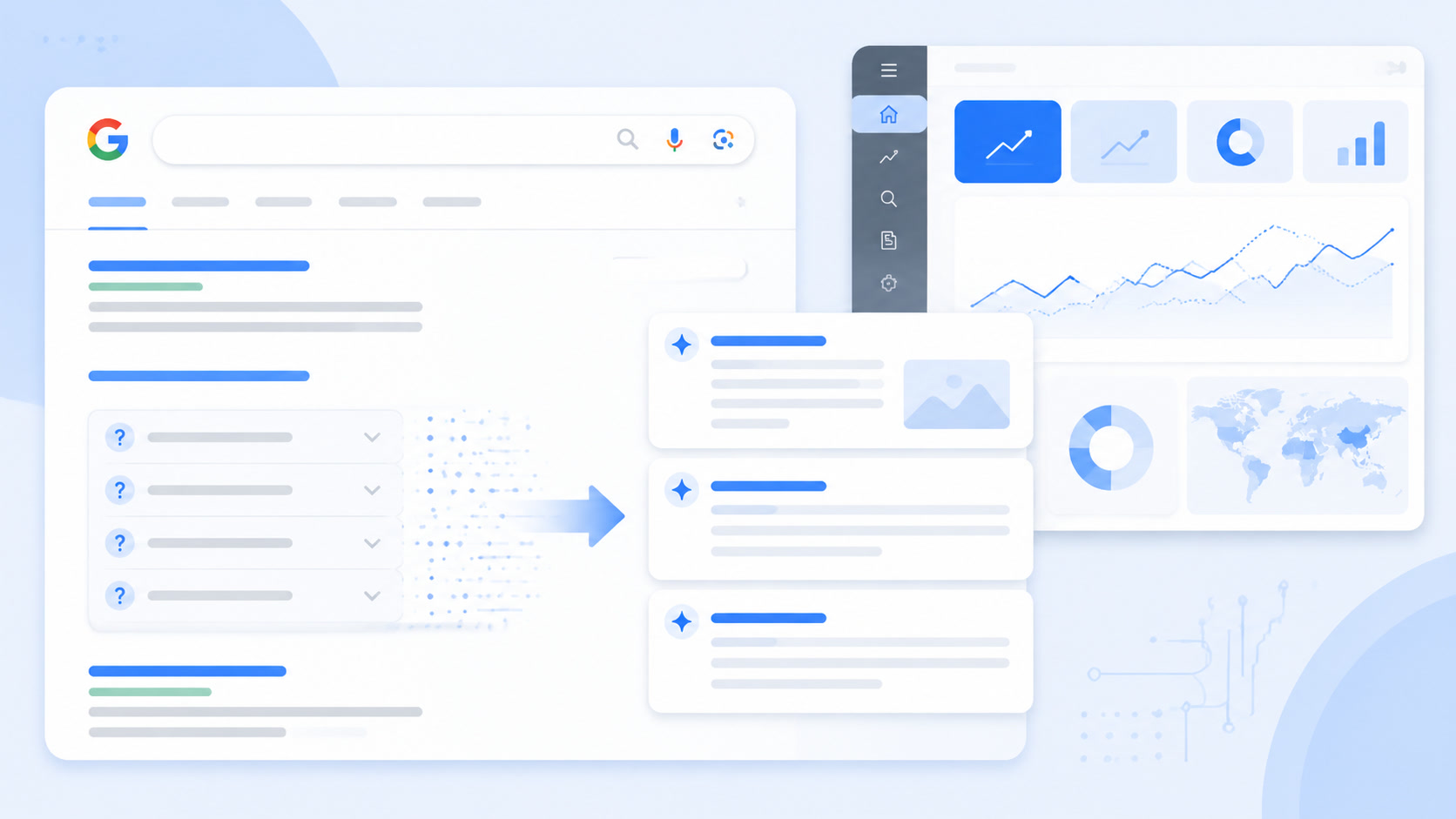
FAQ Rich Results Are Gone. Google's New AI Reports Tell You What Replaced Them
Google removed FAQ rich results on May 7, 2026. Three weeks later they launched AI Performance Reports in Search Console. That's not a coincidence. Here's what this shift means for your content strategy and how to measure your visibility in AI-generated answers.
FAQ Rich Results Are Gone. Google's New AI Reports Tell You What Replaced Them
On May 7, 2026, Google killed FAQ rich results. No warning. No immediate replacement. Sites that relied on that markup for search visibility —ours included— stopped seeing expandable snippets in the SERP overnight.
SEO Twitter reacted predictably: panic, conspiracy theories about the death of structured data, and a flood of "how to adapt" articles that basically said nothing.
Three weeks later, on June 3, 2026, Google launched Search Generative AI Performance Reports in Search Console. And suddenly the story changed.
I am not going to claim this was coordinated. But look at the timeline. May 7: FAQ rich results die. June 3: AI performance reporting launches. I don't think Google makes two structural moves in three weeks by accident. There is a direction here, and everything we thought we knew about structured data needs updating.
What Actually Happened to FAQ (and What Everyone Misses)
Google removed the display of FAQ rich results in the SERP. This matters: they did not remove support for FAQ schema. The markup is still valid. The difference is you no longer get a visual expandable snippet in search results.
What most people missed is the timing. Google's official AI Optimization Guide —published May 15— explicitly lists FAQ, HowTo, Product, Article, and Review as schema types that "already serve AI features." This means Google still consumes FAQ schema internally, but to feed AI Overviews and AI Mode, not to show rich snippets.
Translation: FAQ schema stopped being an SEO display tactic and became an AI citation tactic. If your content has well-structured FAQ markup, Google can still reference it when Gemini builds a synthesized answer. You just will not see the snippet in the traditional SERP.
This changes how we measure structured data ROI. Before it was easy: add FAQ schema → see rich results → measure CTR. Now the benefit is invisible unless you use the new tools.
The Search Console AI Reports: What Google Did Not Explain Well
Google announced the Search Generative AI Performance Reports with decent fanfare. In theory they show:
- Your content's impressions in AI Overviews and AI Mode
- Breakdown by page, country, and device
- Trend data over time
In practice, at least for now, the report has limitations. It is only available to an initial cohort in the UK. Data is not historical —it starts counting from when you enable the report. And critically, it measures impressions, not clicks. Which makes sense given that AI Mode has a 93% zero-click rate according to recent studies.
But here is what actually matters about these reports and almost nobody has pointed out: for the first time, Google is explicitly telling you which of your pages appear in AI answers. Before, you had to infer this with third-party tools, manual searches, or just guess. Now you have direct data.
For a site like Mintec —publishing technical content on marketing and automation— this is gold. We can see which articles Gemini cites, which it ignores, and adjust accordingly.
FAQ Schema: Keep It or Kill It?
This is the question we have heard most since May. The answer, as with most SEO questions, is "it depends."
If your priority is AI Overview citation: keep it. Google confirmed FAQ schema feeds its AI features. If you have an article with well-structured Q&A, the markup helps Gemini find and cite you. There is no direct metric for this yet —the AI reports tell you if you appear, but not why— but the principle is sound.
If your priority is page speed: you can remove it. FAQ schema no longer generates rich results, and while the markup weight is minimal, every byte counts. On sites with hundreds of pages, accumulated unnecessary schema has a cost.
If you are starting from scratch: use FAQ schema only if your content genuinely answers questions people search for. Do not add it because "everyone does it." Google no longer rewards FAQ schema with display, so the markup only earns its keep if it serves your content structure.
We have 51 articles with FAQ schema on Mintec. Our call was to keep it on pages already performing well in organic traffic and add it only to new content where Q&A format comes naturally —not forced. The AI reports will tell us in a few months whether the strategy holds.
The Decision Framework: Three Schema Tiers for 2026
With FAQ rich results gone and AI reporting here, we updated our internal structured data prioritization. Sharing it here because you probably need something similar:
1. Entity and Context Schema (High Priority)
- Article — essential for any blog. Defines author, date, and content type.
- Organization — key for E-E-A-T. Establishes who you are as a business.
- BreadcrumbList — helps Google understand site architecture.
- SiteNavigationElement — useful for large sites with complex structure.
These do not generate flashy rich results, but they are the signals Google uses to understand who you are and what you talk about. They are the foundation of AI citation.
2. Answer Content Schema (Medium-High Priority)
- FAQ — still useful if your content has natural Q&A format. Now an AI signal, not a SERP signal.
- HowTo — same as FAQ: valuable for tutorials and step-by-step guides.
- VideoObject — critical if your content includes video. Google AI Mode prioritizes multimedia.
3. SERP Display Schema (Low Priority)
- Product — only if you run ecommerce. Google still shows prices and availability.
- Review — useful for reviews, but Google reduced its prominence.
- LocalBusiness — essential for local businesses but does not affect AI visibility.
The fundamental shift: we used to prioritize schema by what it showed in the SERP. Now we prioritize by what it communicates to Google's AI. Two completely different logics.
How to Use the New AI Reports (and What to Watch For)
If you have access to the Search Generative AI Performance Reports (rolling out to more countries in coming weeks), here is how to extract real value:
Identify your top AI-impression pages. These are your natural candidates for Gemini citation. Reinforce them with more data, tables, and internal links.
Compare against traditional search performance. A page ranking well in traditional search but absent from AI Overviews has a structure problem. It probably lacks semantic markup or direct answers.
Look for country patterns. If your content appears in AI for some countries but not others, it could be a language issue, cultural adaptation gap, or simply uneven AI Mode rollout.
Do not fixate on clickless impressions. 93% of AI Mode searches end without a click. But an AI Overview impression is still valuable as brand exposure and authority signaling. Measure impact via branded search and direct traffic as proxies.
At Mintec we started monitoring these reports from launch. Early finding: our pages with comparison tables and FAQs get 3x more AI Overview impressions than linear text posts. Not a coincidence. Gemini looks for structured information it can cite in fragments.
FAQ Schema Is Dead. Long Live Structured Data.
The FAQ rich results removal is not the end of structured data. It is the end of structured data for display and the beginning of structured data for AI. Two different worlds with different metrics.
The Search Generative AI Performance Reports Google launched in June are the first real tool we have to measure this new reality. If you have not enabled them yet, do it. If you do not have access, it will probably arrive in the coming weeks.
And if you are still debating whether to keep your FAQ schema, consider this: Google does not invest in AI performance reporting for features it plans to sunset. The fact that these reports exist is the strongest signal that AI-focused structured data is a priority, not an experiment.
We have already adjusted our strategy. If you want to see our full thinking, we broke down Google's official AI Optimization Guide here and what AI Mode as default search actually means here. Between those two and this article, you have the full picture of what changed in SEO between May and June 2026.
Because yes: everything changed. But at least now we have data to measure it.
Frequently Asked Questions
What happened to Google FAQ rich results?
On May 7, 2026, Google removed FAQ rich results from search. FAQ schema markup no longer generates visual expandable snippets in the SERP, though Google still uses it internally to feed AI Overviews and AI Mode responses.
Should I remove FAQ schema from my site?
Not necessarily. FAQ schema still works as a content signal for Google's AI-generated answers, even though it no longer generates visual rich results. The decision depends on whether your priority is AI citation in Overviews or page speed optimization.
How can I measure my visibility in Google's AI answers?
On June 3, 2026, Google launched Search Generative AI Performance Reports in Search Console. These show your content's impressions in AI Overviews and AI Mode, broken down by page, country, and device.