
Google I/O 2026 Turned Search Into an AI Agent Platform. Your Content Strategy Is Not Ready.
Google I/O 2026 turned Google Search into an AI agent platform. Persistent agents work 24/7, generate complete UIs on the fly, and don't wait for a query. This changes how content needs to be created, structured, and maintained.
Google I/O 2026 Turned Search Into an AI Agent Platform. Your Content Strategy Is Not Ready.
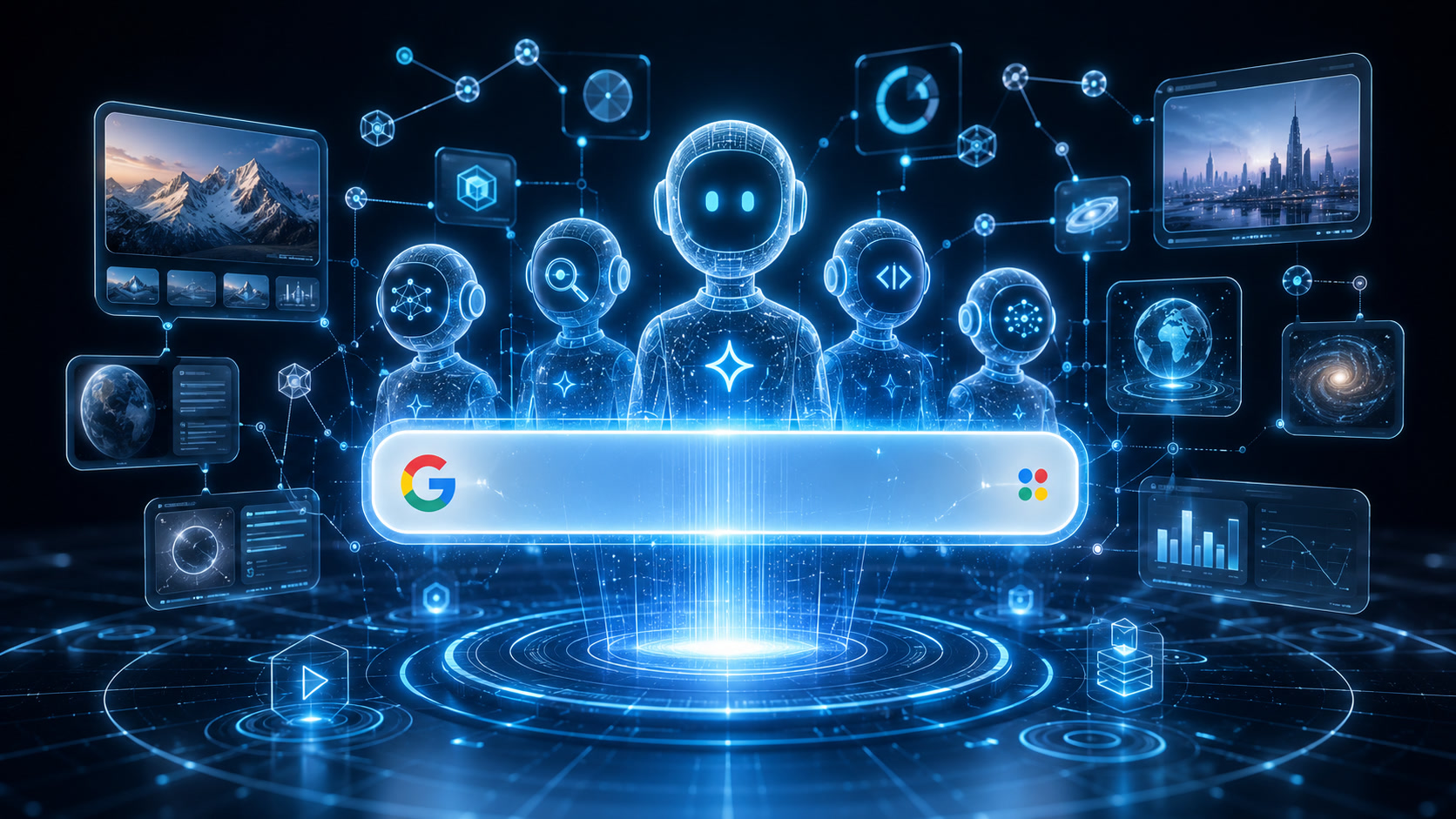
On May 19, 2026, Google did something it hadn't done in 25 years: it redesigned the search box. That was the least important thing that happened.
The real news was underneath. Google Search is no longer just an engine that returns links. It is a platform where AI agents work 24/7, generate complete interfaces on the fly, and find what you need before you ask. If your content isn't built for that world, your ranking in traditional results won't save you.
I've been watching search change for 15 years. This one is different.
What Actually Happened at Google I/O 2026
Google announced three things that change the rules for anyone publishing content on the web.
Persistent search agents. These are personalized AI agents running in the background, around the clock, without requiring the user to perform a query. They monitor for relevant information, track changes, and alert when something important surfaces. They start rolling out this summer for Google AI Pro and Ultra subscribers, according to PrimaTech's coverage of the event.
Generative UI in Search. Search can now build complete interfaces — comparison tables, interactive tools, dashboards — instead of displaying a list of links. Your content is no longer "consumed" on a separate page. It gets reassembled into an interface Google generates for you.
An intelligent search box that understands intent, not just keywords. Google called this "the biggest upgrade in 25 years." The new AI-powered search box processes complex, multi-step queries and responds with actions, not just results.
AI Mode hit one billion monthly users, as Chris Raulf noted in his I/O recap. One billion users in basically the first year of the feature's existence.
Why This Is Different From Everything Before
I have seen enough "search paradigm shifts" to be skeptical. Google has announced radical transformations before that turned out to be minor adjustments. This is not an adjustment.
The key difference: the user no longer initiates every interaction.
In the traditional search model, the user types a query, Google returns results, the user clicks. There is always an explicit query. Content lives on a static page the user visits.
With Google's persistent agents:
- The agent initiates the interaction when it finds something relevant
- Content gets reassembled into interfaces Google builds dynamically
- The "click" is no longer the primary delivery mechanism
This is not GEO (generative engine optimization). GEO is about optimizing for existing AI answers. This is about optimizing for AI agents that act on behalf of the user.
The Three Content Shifts That Actually Matter
I have been trying to translate this into something practical. Here is the framework we are using at Mintec to prepare content for this new paradigm.
1. From Keywords to Entity Graphs
AI agents do not understand web pages as text documents. They understand them as collections of entities — people, places, products, concepts, relationships. A page about "CRM with AI" is not a page about a keyword. It is a page describing the entity "AI CRM" and its relationships with "sales automation," "communication channels," and "predictive analytics."
What to do: Instead of optimizing for keywords, optimize for entity completeness. Every page should answer: what primary entity are you describing? What attributes does it have? What other entities does it relate to? Structured data (Schema.org — the same types that have always existed) is the vehicle for this. Google confirmed it in their AI optimization guide. You do not need new schemas. You need to use existing ones properly.
2. From Static Pages to Reassemblable Surfaces
Generative UI means Google will take fragments of your content — a paragraph here, a table there, a feature list over there — and reassemble them into a custom interface. Your page is not the destination. It is raw material for an interface Google generates.
What to do: Structure your content in self-contained blocks that make sense outside the context of the full page. Every section should be extractable and valuable on its own. Descriptive headings, complete data tables, feature lists that do not depend on the previous paragraph. If a section does not work outside the page context, agents will not use it.
3. From Freshness to Living Authority
Google's agents work 24/7 and monitor for changes. They can incorporate fresh information faster than the traditional index, according to Google's own guide. This has a direct consequence: frequently updated content has an advantage — but only if it maintains a quality floor.
What to do: Set up a regular review cycle for your most important content. This is not about slapping an updated date on old text. It is about keeping information genuinely current. Agents can detect stale data, and if they find a fresher source, they use it.
What Does Not Change (And What to Ignore)
Not everything is new. There is a lot of noise to ignore.
Authenticity and demonstrated expertise matter more, not less. Since agents are pickier about what they cite, mass-produced generic content has less value than ever. Google is not rewarding "AI-optimized" content. It is rewarding content that demonstrates real authority.
Existing structured data works fine. You do not need "AI schema" or "GEO schema." Those do not exist. What you need are the same schema types Google has supported for years: Article, FAQ, HowTo, Product, Review, Organization. If your team already implemented structured data correctly, you are ahead.
Traditional search traffic is not dead. AI Mode is growing fast, but traditional search still drives the overwhelming majority of web traffic. Abandoning traditional SEO to chase AI agents would be a mistake. The right strategy is to prepare for the future without neglecting the present.
This connects to what we covered in our analysis of Google's official AI optimization guide — the fundamentals of traditional SEO are the foundation for any agent strategy.
What to Do This Week
This all sounds abstract. Here are concrete actions.
Audit your most important content for entity completeness. Take your main service page or your most-visited article. Does it clearly describe a primary entity? Does it have structured data defining its attributes and relationships?
Identify which sections of your content are extractable. For each page, ask: if an agent takes the second paragraph and the table from section 4 and reassembles them into a generative interface, do they make sense together?
Set up a refresh cycle for authority content. Pick the 10 pages that generate the most traffic or rank highest. Put them on a monthly review calendar. Agents reward freshness.
Do not buy "agent optimization" tools. Nobody has enough data yet to sell you a solution. If someone is promising "AI Schema" or "GEO automation," they are improvising. What works is what has always worked: well-structured content, demonstrable authority, and up-to-date information.
At Mintec, we have been helping companies navigate search changes since 2011. This is the biggest shift we have seen, but it is not a reset. It is an evolution. The teams that prepare now will have a real edge when agent-based search becomes the norm.
Explore our digital marketing services →
For more context on how search is changing, read our analysis of Google's official AI optimization guide, our coverage of AI Mode as the default search setting, and how the new Search Console AI performance reports change traffic measurement.
Sources
- PrimaTech, "Google I/O 2026: Search Gets a Massive Agentic Shift in AI" (https://primotech.com/google-i-o-2026-search-gets-its-biggest-ai-overhaul-in-25-years-gemini-goes-agentic/)
- Chris Raulf, "Google I/O 2026: 5 Announcements Reshaping AI SEO Today" (https://chrisraulf.com/google-io-2026-ai-search-recap/)
- Forbes, "Google I/O 2026 Signals Agentic AI Shift To Defend Search Dominance" (https://www.forbes.com/sites/timbajarin/2026/06/02/google-io-2026-signals-agentic-ai-shift-to-defend-search-dominance/)
- Google Blog, "Google Search's I/O 2026 Updates: AI Agents and More" (https://blog.google/products-and-platforms/products/search/search-io-2026/)
- Google Search Central, "AI Optimization Guide" (https://developers.google.com/search/docs/fundamentals/ai-optimization-guide)
Frequently Asked Questions
What did Google I/O 2026 announce for Search?
Google integrated persistent AI agents that work in the background 24/7 without user prompts, generative UI capabilities that build complete interfaces on the fly, and a new intelligent search box that Google calls 'the biggest upgrade in 25 years.'
How does this change content strategy?
Content is no longer optimized just for keyword rankings. It needs to be extractable by agents, rich in structured entities, and designed to be reassembled into generative interfaces. Demonstrable authority and frequent updates matter more than before.
What matters more now: traditional SEO or GEO for agents?
Both. Traditional search traffic still dominates in volume, but agent response visibility is growing faster. The right strategy is to prepare content for both worlds simultaneously, not abandon what works.