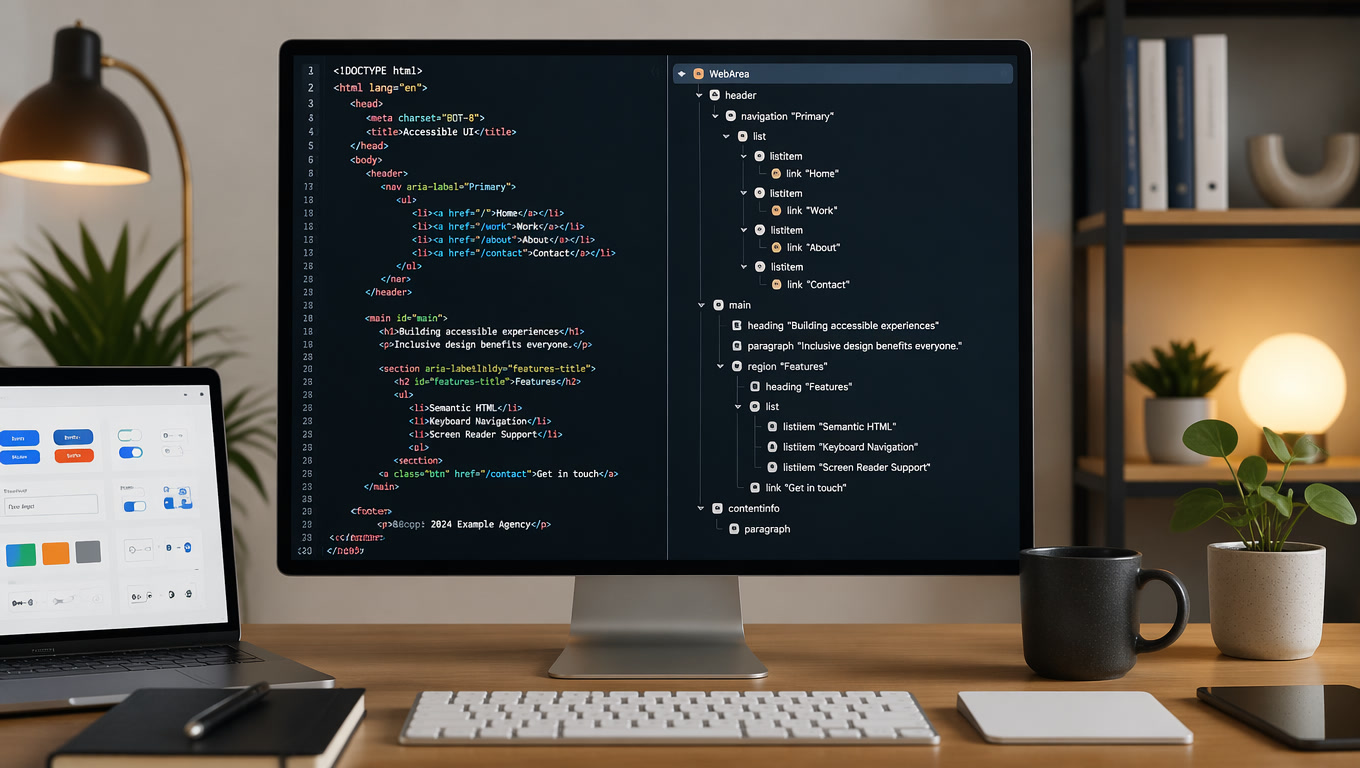
contrast-color() and reading-flow: the 2026 CSS that automates the accessibility fixes we do by hand
In the accessibility audits Mintec runs for clients, two manual fixes show up in almost every project: hardcoded color pairs to pass WCAG AA contrast, and manual reordering of reading order in flex and grid layouts. Both now have native CSS solutions: contrast-color() and reading-flow. Real-world analysis with browser support, first-hand cases, and a migration framework.
contrast-color() and reading-flow: the 2026 CSS that automates the accessibility fixes we do by hand
Yes: in 2026, CSS finally has native properties for the two accessibility fixes we most often apply by hand in Mintec's audits — WCAG AA color contrast and reading order in flex and grid layouts. They're called contrast-color() and reading-flow, and they change how accessible design systems get built.
We say this from the work, not from theory. In the accessibility audits we run for clients under the European Accessibility Act and WCAG, two findings show up in nearly every site: (1) dozens of hardcoded color pairs — color: #fff over background: #1a1a2e, color: #111 over background: #ffd166 — hand-written in the CSS so each button, badge, or theme variant passes AA contrast; and (2) flex and grid layouts where the visual order doesn't match the DOM order, and someone "fixed" keyboard navigation with tabindex or left the problem documented as tech debt.
Both patterns are exactly what 2026 CSS is removing. The platform roundups — like What's New in CSS 2026 and the official Interop 2026 announcement from WebKit — agree that the browser is absorbing accessibility work that used to be 100% manual. This connects directly to the shift toward native HTML and less ARIA we already documented: same trend, now in the CSS layer.
What we see in audits
When a site fails WCAG AA, the typical fixes we write into reports come in two flavors:
| Problem | Classic manual fix | Real cost |
|---|---|---|
| Text with insufficient contrast over its background | Hardcode color pairs per variant in CSS | Dozens of overrides that break when a brand token changes |
| Reading order different from visual order in flex/grid | Reorder the DOM, use order: + tabindex, or accept the failure | Fragile DOM, tabindex that desyncs, confused screen readers |
In a recent e-commerce redesign, we found 47 hardcoded color pairs just in UI components (badges, buttons, status chips). Changing the brand color meant touching 47 places — and three of them failed contrast after the change. That's the pattern contrast-color() eliminates.
On a corporate site with a mobile menu, the team had visually inverted the navigation with flex-direction: row-reverse and then had to explain the real order to the screen reader — with tabindex and ARIA attributes. That's the pattern reading-flow eliminates.
contrast-color(): let the browser pick the legible color
contrast-color() is a CSS function that takes a background color and returns black or white — whichever has the higher contrast. The interesting part isn't the line you save: it's that the browser computes real contrast against the effective color, not the one you assumed when writing the pair.
.badge {
  background: var(--status-color);
  color: contrast-color(var(--status-color));
}
In a design system, that turns this:
.badge-success { background: #2e7d32; color: #fff; }
.badge-warning { background: #f9a825; color: #111; }
.badge-danger  { background: #c62828; color: #fff; }
…into a single rule that works for any variant, including tokens that change at runtime (themes, dark mode, per-client customization). Safari and Firefox developers can use it today — both shipped support in 2025 — and Chrome has it as an Interop 2026 focus area, which guarantees consistent implementation this year.
Where not to trust it: WebKit's own announcement warns that contrast-color() "does not magically solve all accessibility concerns." It doesn't work well over gradients, images, or semi-transparent backgrounds — contrast is computed against a solid color. Those cases still need human judgment. Our rule at Mintec: use contrast-color() for solid backgrounds derived from tokens, and keep explicit pairs only where the background isn't a flat color.
reading-flow: reading order without tabindex
reading-flow fixes a structural problem of flexbox and grid: the visual order can differ from the DOM order, and screen readers and keyboard navigation follow the DOM, not the eyes. Chrome shipped it in May 2025 (version 137), with official documentation on the Chrome for Developers blog and an MDN entry.
.nav-mobile {
  display: flex;
  flex-direction: row-reverse;
  reading-flow: flex-visual; /* keyboard follows the visual order */
}

.dashboard-grid {
  display: grid;
  reading-flow: grid-rows; /* read row by row, not column by column */
}
A companion property — reading-order — lets you adjust a single child's order relative to its siblings, covering the fine-grained case that previously only tabindex could solve.
The critical point, and here's our unfiltered opinion: reading-flow is a safety net, not an excuse to scramble your DOM. If visual order and DOM order differ, the first response is still fixing the markup. reading-flow exists for cases where the difference is legitimate — row-reverse, grids with reordered areas, carousels — not for layout without discipline. Teams that use order: and row-reverse "because reading-flow will fix it" will have the exact same maintenance problem they had with tabindex, just with an extra support dependency.
Support and adoption strategy
| Feature | Chrome | Safari | Firefox | Status |
|---|---|---|---|---|
| contrast-color() | In development (Interop 2026) | 26+ | 146+ (2025) | Usable with fallback |
| reading-flow | 137+ (May 2025) | No | No | Chrome-first, additive |
| reading-order | 137+ | No | No | Fine-grained companion |
The strategy we apply in our projects is pure progressive enhancement — and it works because both properties are additive:
- contrast-color(): keep your current explicit pairs as the fallback and add the modern rule on top. Where the browser supports it, you remove maintenance; where it doesn't, you keep what already worked.
- reading-flow: if the DOM is already correctly ordered, the property changes nothing in browsers that don't support it. It only improves cases where the visual difference is intentional.
- Audit first: run the audit before touching CSS. In our projects, ~80% of reading-order problems are solved by reordering the DOM; the remaining 20% benefit from
reading-flow. Doing it the other way around optimizes the wrong layer.
The payoff: less CSS, fewer bugs, less debt
What we like most about these two properties is that they attack the problem at the root: instead of accumulating exceptions (color: #fff here, tabindex="3" there), the browser applies the correct rule automatically. In our migration projects, that translates into less code, fewer places to break contrast when a token changes, and follow-up audits that pass without friction — which is the real goal: accessibility as a competitive advantage, not a checklist.
If you're building or maintaining a design system, it's worth planning adoption now: WCAG 3.0 will keep requiring contrast and reading order, and European Accessibility Act enforcement isn't going to relax. Having the browser do that work for you — with two CSS properties, no JavaScript, no tabindex — is the best accessibility news of 2026. The same logic we applied with CSS anchor positioning to remove positioning JavaScript now applies to contrast and reading order.
Frequently Asked Questions
What is contrast-color() in CSS?
contrast-color() is a CSS function that returns black or white depending on which one has the highest contrast against a given background color. The browser calculates the contrast and picks the legible text color automatically, removing the need to hardcode color pairs by hand to pass WCAG AA.
What is the CSS reading-flow property?
reading-flow is a CSS property that controls the order in which the children of a flex, grid, or block container are exposed to screen readers and navigated with the keyboard. It lets the reading order follow the visual layout without reordering the DOM or using tabindex.
Can I use contrast-color() and reading-flow in production in 2026?
Yes, with progressive enhancement. contrast-color() is available in Safari and Firefox, and Chrome is working on it as an Interop 2026 focus area. reading-flow has been available in Chrome 137+ (May 2025) along with its companion reading-order property. Both are additive: if the browser doesn't support them, the site keeps working with your existing fallback.