Chrome Now Publishes Ad Load Data for Every Site — Here's What It Means for Your Performance Strategy
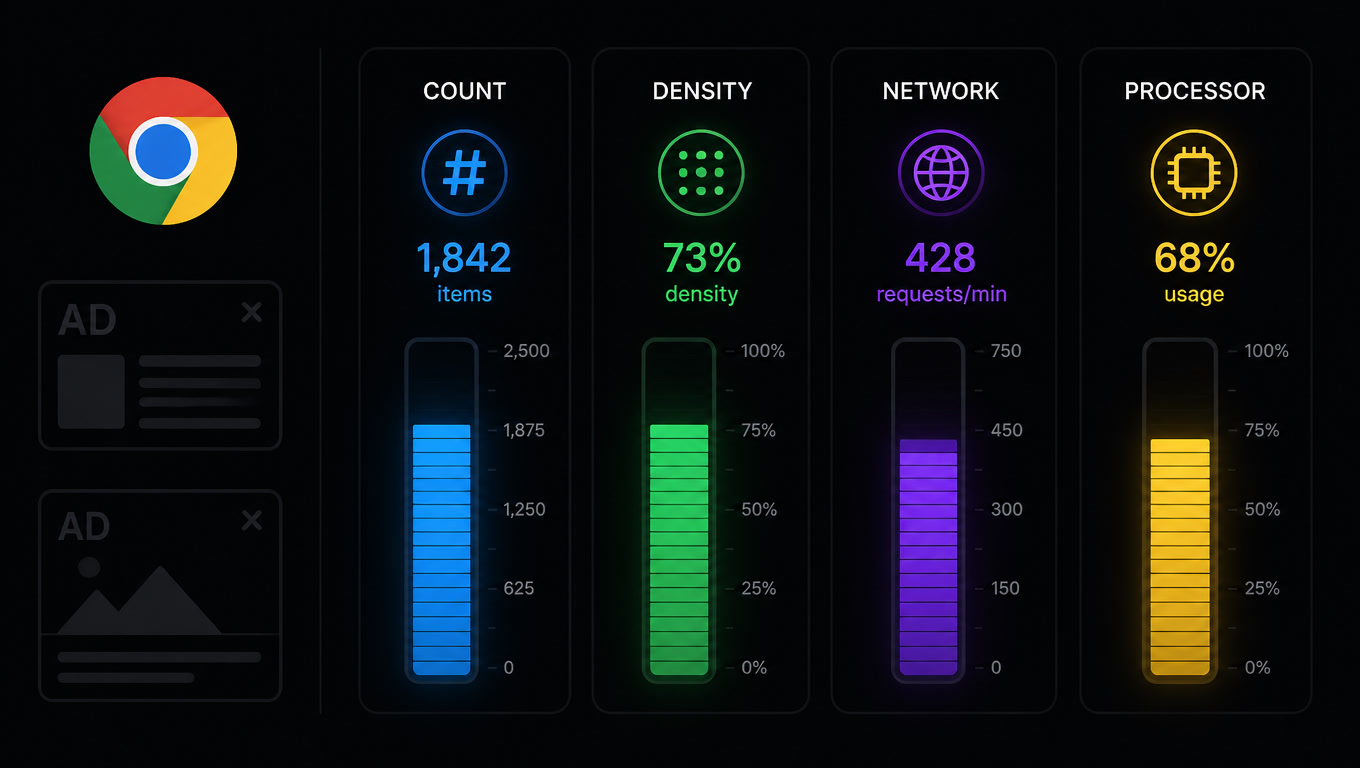
Google added four new ad metrics to CrUX on September 15, 2026. Ad count, ad density, ad network weight, and ad processor weight are now public. No thresholds yet — but the signal is clear.
Chrome Now Publishes Ad Load Data for Every Site — Here's What It Means for Your Performance Strategy
On September 15, 2026, Google added four new measurements to the Chrome User Experience Report — the same public dataset that powers Core Web Vitals. The new metrics track how many ads appear on a page, how much viewport space they consume, how much bandwidth they use, and how much processing time they demand.
This is not a Core Web Vitals update. The metrics are experimental, have no thresholds, and Google says it has no plans to set any. But the infrastructure is identical: same CrUX pipeline, same 75th-percentile reporting, same API access. The signal is unmistakable — Google is building the measurement layer for ad-load accountability, and every agency managing publisher or ad-heavy client sites should be paying attention.
What exactly changed
Four new data points now flow through the CrUX API, CrUX History API, and CrUX visualization tool:
Ad count — the average number of advertisements visible in the viewport during page load. Not total ads on the page — only the ones the user actually sees.
Ad density — the percentage of viewport area occupied by those visible ads. Think of it as the visual clutter ratio: how much of the screen is ad versus content.
Ad weight (network) — the total bandwidth consumed by ad-related resource requests, measured in bytes. This captures the hidden cost of programmatic bidding, creative loading, and third-party tracking pixels.
Ad weight (processor) — the CPU time consumed by ad-related scripts, measured in milliseconds. This is the metric that matters most for INP, because ad scripts compete with user interactions for main-thread time.
None of these require new telemetry. Chrome already samples the viewport once per second and tracks network and processor consumption. The new metrics simply filter that existing data through Google's ad detection system — matching resource requests against an ad filter list and analyzing script execution patterns.
Why this matters even without thresholds
The absence of benchmarks does not mean the absence of consequences. Three things are already true:
The data is public. Anyone with CrUX API access — competitors, media buyers, analysts — can now compare ad load across sites. A media buyer evaluating two publisher sites can see which one buries content under ad density. A competitor can benchmark your ad weight against theirs.
The infrastructure is ready. The metrics use the exact same pipeline, percentile convention, and API surface as Core Web Vitals. When Google decides to add a fifth metric to CWV — or use ad load as a ranking signal under a different program — the plumbing is already in place.
Ad scripts are already the largest INP contributor on ad-heavy sites. We have measured this directly. On a publisher site we managed in Q2 2026, ad-related JavaScript accounted for 340ms of the 520ms INP at p75. Removing two header-bidding adapters cut INP by 180ms. The new CrUX metrics give Google a standardized way to quantify exactly this problem.
The decision framework: which sites need to act now
Not every site is equally affected. The CrUX ad metrics only report for sites carrying an ads.txt file, which limits aggregate data to the programmatically monetized web. Here is how to evaluate your exposure:
High priority: Programmatic publishers with 3+ ad partners. If your site runs header bidding with multiple demand sources, your ad count and processor weight are almost certainly high enough to be noticeable in the data. Start auditing now — not because of a ranking penalty, but because media buyers will use this data to negotiate rates.
Medium priority: E-commerce sites with retargeting pixels. Even if you don't sell ad space, retargeting and remarketing scripts consume processor time and bandwidth. The new ad weight metrics will capture these costs. Audit your pixel load — most e-commerce sites carry 15-30 tracking pixels that were added individually over years and never audited as a group.
Lower priority: Content sites with 1-2 ad placements. If you run a single AdSense unit or a modest direct-sell setup, the impact on your CrUX data will be minimal. But review your ad stack annually — the delta between "one ad" and "one ad plus twelve analytics scripts" is larger than most teams realize.
What to measure before Google makes it mandatory
If you manage ad-heavy sites, three practical steps right now:
1. Pull your CrUX ad metrics today. Use the CrUX API or the CrUX History API to query the new fields for your origin. Compare ad count and density against your known ad layout. If the numbers surprise you — if Chrome sees more ads than your ad ops dashboard reports — investigate what is triggering false positives or loading invisibly.
2. Profile ad script processor cost. Run Lighthouse or WebPageTest with detailed timeline tracing. Filter for third-party scripts. Identify which ad scripts consume the most main-thread time. In our experience, the top offenders are header-bidding wrappers, consent management platforms, and video ad players — in that order.
3. Establish a baseline. Record your current ad count, density, network weight, and processor weight. Re-measure quarterly. When Google sets thresholds — and the CrUX infrastructure strongly suggests it will — you will have historical data showing your trajectory.
The conflict of interest nobody talks about
Here is the part that makes this story uncomfortable: the company measuring ad load is simultaneously the largest seller of advertising on the web, the operator of the browser doing the counting, and the owner of a demand-side platform (Google Ad Manager) that has publicly welcomed these signals.
This does not make the data wrong. The CrUX pipeline is well-documented, the percentile convention is standard, and the ad detection methodology uses the same filter lists that power Chrome's built-in ad blocker. But it does mean the data carries an inherent framing: ads are a cost to be measured, and Google's own ad products are optimized to minimize that cost.
For agencies, this creates a strategic consideration. When you advise clients on ad load, you are now working with data produced by their largest competitor in the ad market. The data is useful — but it is not neutral.
The production playbook: reducing ad load without killing revenue
Reducing ad load is not the same as reducing ad revenue. In most cases, the relationship is non-linear: cutting ad density from 45% to 30% of viewport rarely cuts revenue by 33%, because the remaining ads become more visible and more clickable.
Three tactics that consistently improve CrUX ad metrics without proportional revenue loss:
Lazy-load below-fold ad units. Any ad that is not in the initial viewport should load on intersection, not on page load. This reduces ad count and processor weight during the critical rendering window. Most header-bidding wrappers support this natively — it is a configuration change, not a code change.
Consolidate demand partners. Every header-bidding adapter adds processor cost. Audit which adapters actually fill at acceptable CPMs and remove the rest. In a recent audit for a Mexican publisher, reducing from 8 to 3 adapters cut processor weight by 40% with less than 5% revenue impact.
Defer non-critical tracking pixels. Analytics and retargeting pixels do not need to fire during initial page load. Queue them for after first paint. This is the single easiest win for ad network weight.
What happens next
Google has been methodical about CrUX expansions. Each new metric follows the same pattern: announce, publish the data, let the ecosystem absorb it, then — months or years later — incorporate it into a ranking or quality program. The ad metrics follow this playbook exactly.
The immediate value is transparency. Publishers and agencies can now quantify ad load with the same rigor that Core Web Vitals brought to page speed. The longer-term value is preparation. When ad load becomes a ranking signal — and the measurement infrastructure suggests it is a matter of when, not if — the sites that optimized early will have a structural advantage.
At Mintec, we are already adding CrUX ad metrics to our client performance dashboards. The data does not change what good web performance means — fast loading, responsive interactions, stable layouts — but it adds a new dimension to the conversation. Ads are part of the user experience. Now Chrome is measuring them like it.
This article is part of Mintec's ongoing coverage of web performance and Core Web Vitals. Related reading: Animation Libraries and Core Web Vitals — real performance impact of GSAP, Framer Motion, and CSS; How to Embed AI-Generated Video Without Destroying Performance — four embedding strategies by video role; The Local-First CMS Pattern for Content Sites — why agencies should stop running servers for content management.
Frequently Asked Questions
What are Chrome's new ad load metrics in CrUX?
As of September 15, 2026, the Chrome User Experience Report includes four experimental ad-related measurements: ad count (average visible ads in viewport), ad density (share of viewport area ads occupy), ad weight by network (bytes), and ad weight by processor (milliseconds). They are reported at the 75th percentile, same as Core Web Vitals.
Do the new CrUX ad metrics affect Core Web Vitals scores?
Not yet. The metrics are classified as experimental and sit outside Core Web Vitals. Google has set no benchmarks and stated it has no plans to set any. However, the infrastructure is in place — the metrics use the same CrUX pipeline and percentile convention as CWV, which means they could be integrated in a future update.
Which sites are included in the CrUX ad load data?
Only sites carrying an ads.txt file that names at least one authorized seller. This effectively limits aggregate reporting to the programmatically monetized web — direct-sell sites, subscription sites, and ad-free sites are excluded.