

AI Voice Agents for Small Business: The Receptionist That Never Sleeps (With Real Numbers)
An AI voice agent costs $300-$999/month and can recover $4,000-$8,500/month in lost calls. We analyzed 1,000+ real deployments, compared Vapi vs Retell vs Bland vs Synthflow, and built a decision tree to tell you if your business actually needs one.
AI Voice Agents for Small Business: The Receptionist That Never Sleeps
A dentist told me the other day: "I'm losing calls and I don't know how many." I told him the FCC estimates the average U.S. service business misses 27% of inbound calls during business hours — and 62% when you include nights and weekends. He looked at me like I'd told him the roof was leaking.
That's exactly what an AI voice agent is: finding and patching a hole the average owner doesn't even know exists.
But it's not that simple. We've seen deployments that recover $340,000/year and others that get abandoned on day seven. The difference isn't the technology — it's the implementation.
What They Actually Are (And What They're Not)
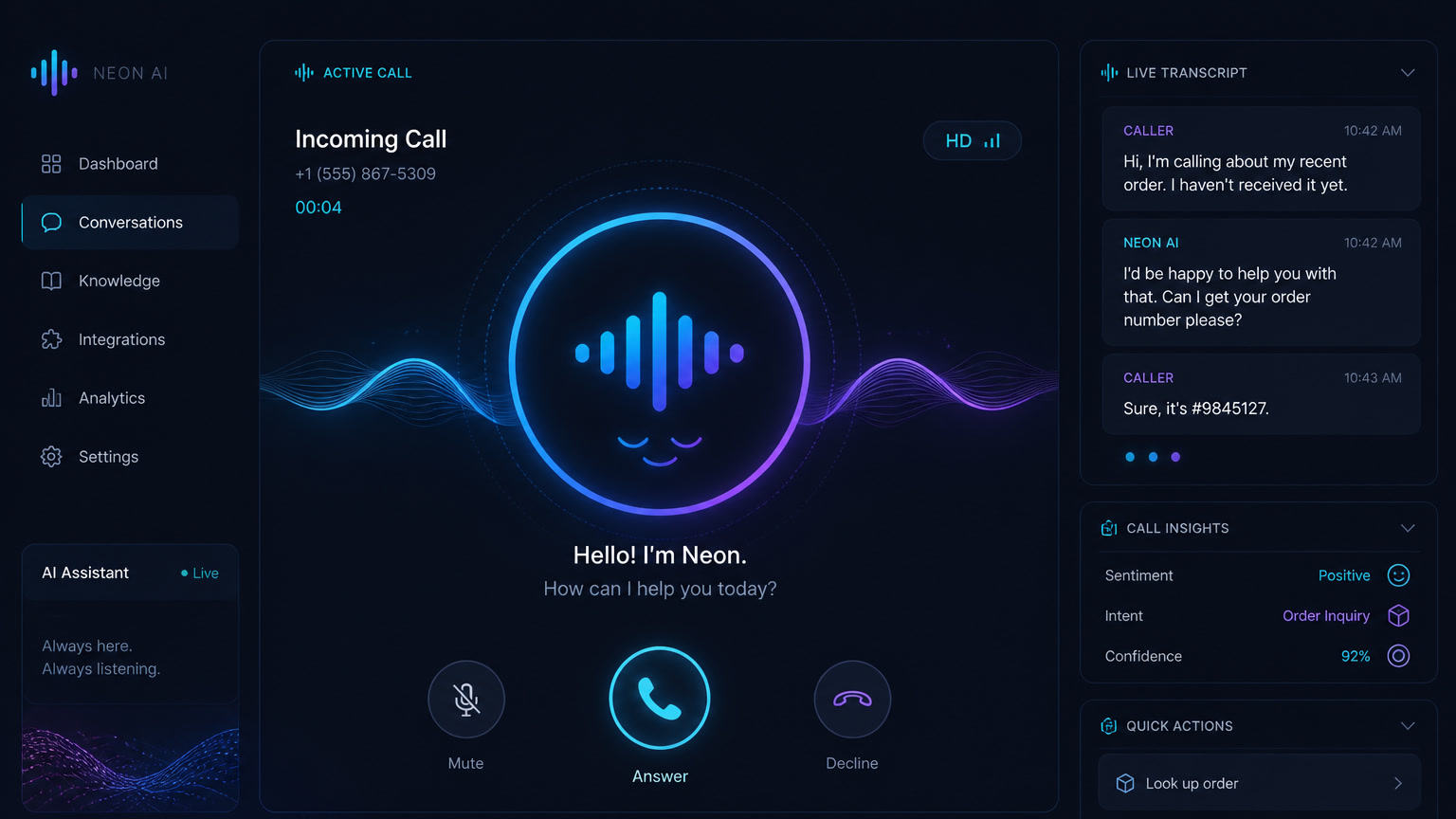
An AI voice agent is not an IVR menu. It's not "press 1 for sales, press 2 for support." It's a system that answers on the first ring, understands what the caller needs in natural language, qualifies the lead, books appointments on your calendar, and escalates to a human when the situation demands it.
Think of it as a virtual receptionist who speaks like a human, works 24/7, never calls in sick, and costs a fraction of a part-time employee.
What it's not: It's not a text chatbot duct-taped to a phone line. It doesn't replace your CRM. It doesn't handle billing disputes or emotional callers. And it absolutely does not work at 100% on day one — there's a real learning curve.
The Real Numbers: 1,000+ Deployments
The most solid data we found comes from Stakd Systems, who analyzed over 1,000 AI voice agent deployments across 17 service business categories in 2026. These aren't vendor projections — they're production numbers.
Average metrics:
- Monthly ROI: 8-15x service cost
- Payback period: 3-8 weeks
- Average recovered revenue: $6,750/month per deployment
- Calls previously missed that are now captured: 62%
- Post-AI capture rate: 98.5%
ROI by industry (real data):
| Industry | Monthly Recovery | ROI Multiple | Payback |
|---|---|---|---|
| Restoration (water/fire) | $22,000-$45,000 | 18-28x | 1-2 weeks |
| HVAC | $8,000-$24,000 | 15-22x | 2-3 weeks |
| Plumbing | $6,500-$18,000 | 12-18x | 2-4 weeks |
| Roofing | $9,000-$26,000 | 10-15x | 3-4 weeks |
| Dental | $4,500-$11,000 | 8-12x | 4-6 weeks |
| Med Spa | $6,000-$15,000 | 8-14x | 4-6 weeks |
| Real Estate | $3,200-$9,500 | 7-12x | 5-7 weeks |
Lowest ROI is cleaning services (5-8x) — but still net positive.
The Tampa HVAC Case Study
An HVAC contractor in Tampa was losing $18,000/month in after-hours calls that went to voicemail. 80% of those who left a message were never called back within 24 hours. His real exposure was $215,000/year, though he estimated $30,000.
They deployed a voice agent integrated with ServiceTitan. Live in 5 weeks. Results at 8 months:
- After-hours answer rate: 62% → 98%
- After-hours booking conversion: 6% → 31%
- New emergency jobs captured: +24/month
- Recovered revenue: $28,000/month, $340,000/year
- Answering service eliminated: $16,800/year saved
- Year 1 ROI: 6.4x on $52K implementation
The most interesting finding: 14% of after-hours calls were upsell opportunities — existing customers wanting maintenance plans that nobody had offered them.
The Day-30 Gap Nobody Talks About
Here's where most people get it wrong. Vendors show demos where the agent works perfectly. In production, the gap looks like this (ScaleMe AI data):
| Metric | Day 1 (live) | Day 30 (tuned) | What changed |
|---|---|---|---|
| First-response latency | 1.8s | 0.9s | VAD threshold + prompt length |
| Tier-1 deflection | ~28% | ~62% | Escalation rules + KB ingestion |
| False escalation rate | ~22% | ~6% | Prompt rule on ambiguous intent |
67% of small businesses abandon their AI tools within 90 days (Stanford 2026 AI Index Report). For voice agents, most quit on day seven — exactly when the tuning curve starts paying off.
If you hold for 30 days with 30 minutes/week of transcript review and prompt tweaking, the numbers improve dramatically. Day 1 is not the deployment. Day 30 is.
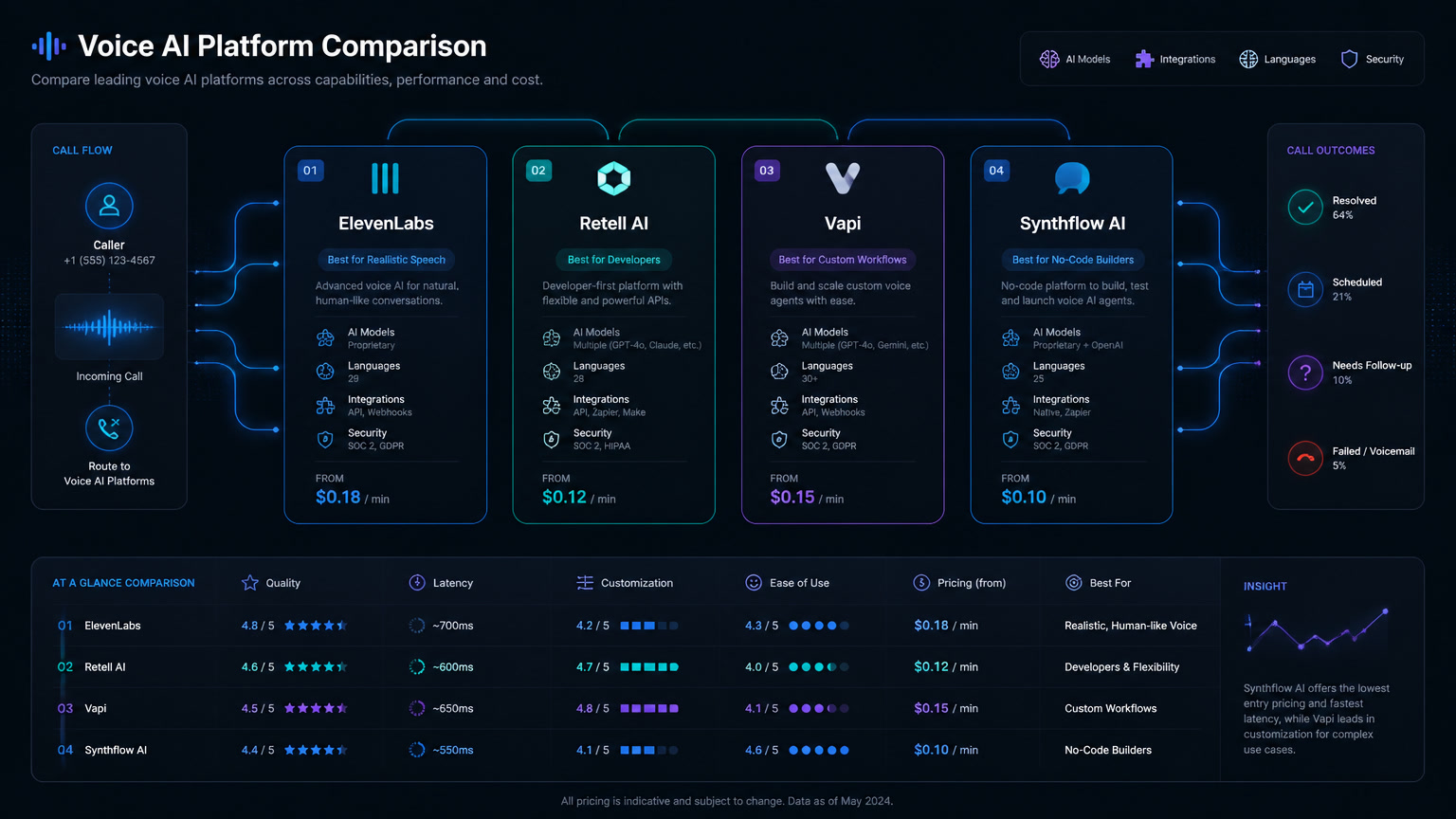
Platform Comparison: Who's Who
Not all platforms are equal, and the choice depends on your technical level and volume.
Vapi — The developer's pick
- Base price: $0.05/minute
- Real cost (with providers): $0.15-$0.33/minute
- Requires: API integration, technical knowledge
- Best for: Teams with internal developers wanting maximum control
- Integrations: n8n/Make via webhook
Retell AI — The balanced choice
- Price: $0.07/minute average
- No hidden fees, all-inclusive
- Native integrations: Cal.com, Google Calendar
- Best for: Businesses wanting fast setup without a dedicated developer
- Typical dental practice: ~$400-$700/month
Bland AI — For high volume
- Scale plan: $499/month, $0.11/minute
- Enterprise pricing available
- Best for: Call centers, businesses with 1,000+ calls/month
Synthflow — The no-code option
- Pro plan: $0.225/minute
- Drag-and-drop interface
- Best for: Owners without a technical team
- Calendly/Cal.com native
Our recommendation: If you have under 800 calls/month and no developer, start with Retell or Synthflow. If you have volume or a technical team, Vapi with n8n/Make gives you more control for less money.
Do You Need One? Decision Tree
Answer these five questions:
How many calls do you receive per month?
- Under 100: probably don't need a voice agent. A text chatbot covers it.
- 100-500: strong case. ROI materializes fast.
- 500+: urgent case. Every missed call is real money.
How many calls are you currently losing?
- If you don't know, install a temporary line for a week and measure. Most discover they're losing 25-40%.
What's your average ticket?
- $100-$300: moderate ROI (3-5x). Consider whether the complexity is worth it.
- $300-$1,000: clear case. Every recovered call justifies the agent.
- $1,000+: no discussion. Implement now.
Do you have a human escalation process?
- If you don't define it BEFORE deployment, the agent becomes a robot that frustrates customers. Define what escalates and what doesn't.
Do you have a calendar/scheduling system?
- Cal.com (free), Calendly, or your PMS. The agent needs to check availability in real time.
The First Month: What to Actually Expect
Based on real deployments, here's the honest timeline:
Week 1: Setup + first 50-100 calls. The agent answers, but latency is high (~1.8s) and deflection is low (~28%). Don't panic.
Week 2: Review 10-15 transcripts daily. Adjust prompts. Identify the 3-5 questions the agent handles poorly. Add responses to the knowledge base.
Week 3: Latency drops to ~1s. Deflection rises to 40-50%. Callers start not noticing it's AI. This is where most people quit. Don't.
Week 4: Stable metrics. Deflection 55-65%. False escalations drop below 8%. You start seeing real ROI.
Month 2-3: Continuous optimization. Deflection 60-70%. The agent handles recurring situations well. Human staff focus on what truly requires judgment.
The Part Nobody Wants to Hear
An AI voice agent isn't magic. It's a tool that requires:
- 30 min/week of maintenance (review transcripts, adjust prompts)
- Escalation rules defined before launch
- Measurement with data, not feelings
- Patience of 30 days to see real numbers
And there are things it doesn't handle well:
- Emotional or complaint calls
- Ambiguous or out-of-scope requests
- Processes that change constantly without agent updates
The question isn't "does it work?" — the data says yes, emphatically. The question is "are you willing to invest the 30 hours in month one to make it work?"
Most businesses that fail with voice agents don't fail on technology. They fail on premature abandonment. The ones that hold for 30 days discover that ROI isn't a projection — it's a fact.
At Mintec, we implement AI voice agents for service businesses across Latin America and the US. If you want to evaluate whether a voice agent makes sense for your business, contact us and we'll run a diagnosis with your real numbers.
Frequently Asked Questions
How much does an AI voice agent cost for a small business?
Between $300 and $999/month for a single line handling under 800 calls, including platform, voice synthesis, and telephony. The typical return is 8-15x the monthly cost for service businesses.
How long does it take an AI voice agent to be production-ready?
14 to 28 days from pilot to production. The first month reaches 40-55% deflection; by month three, 55-70%. Vendors promising 90% from day one are showing you a demo, not a deployment.
Do AI voice agents replace reception staff?
They replace 60-90% of reception tasks (answering, qualifying, scheduling, messages). Existing staff get reassigned to higher-value work. They don't eliminate the human need — they redirect it.