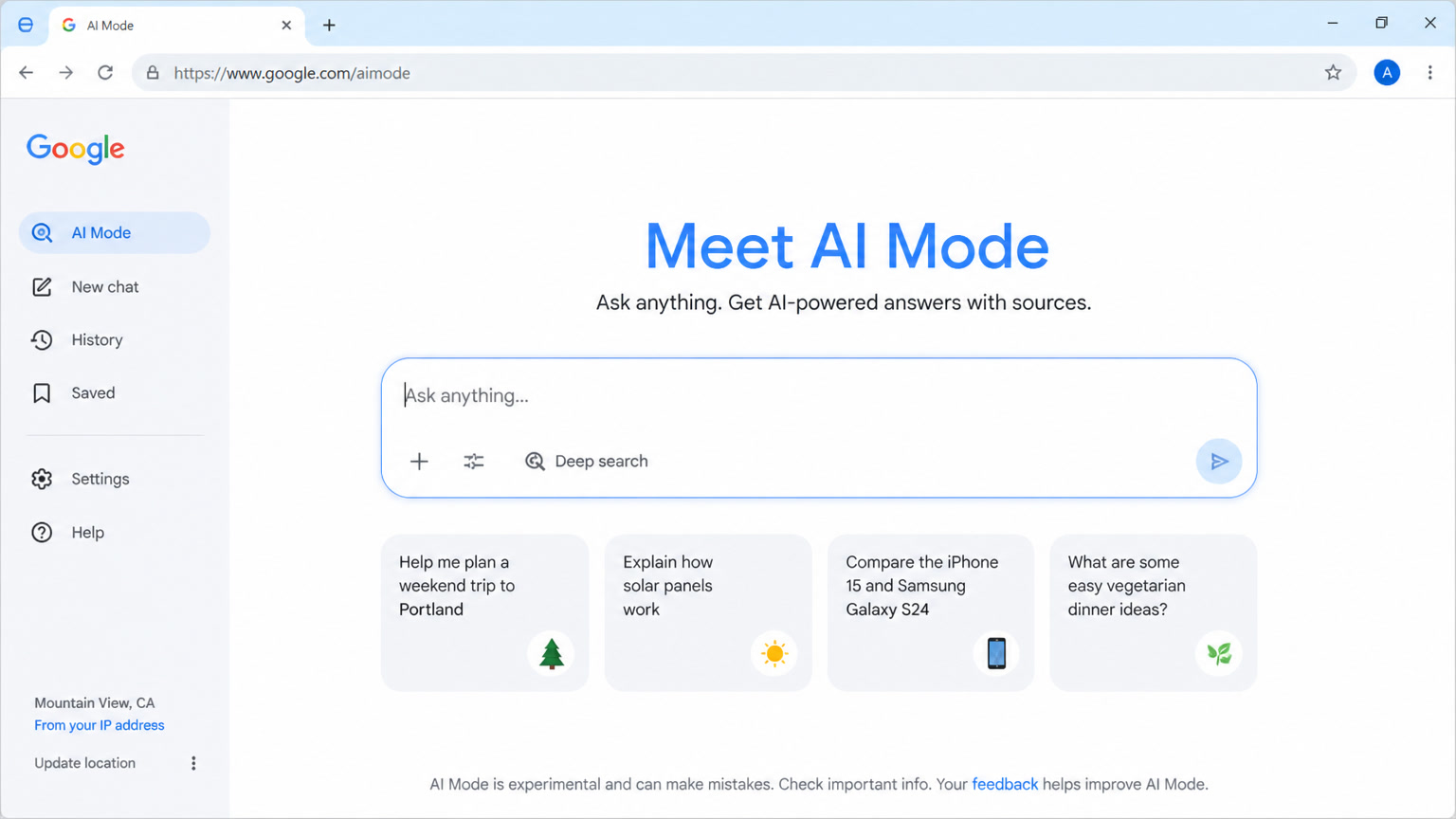


Google admits AI Mode clicks pay less. Same auction.
Paid clicks rose 8% and cost per click 4% while Google says AI Mode queries monetize less. The fix is a fourth budget line, not a new campaign.
On October 28, Google said two things that have to be read together. Its head of search data science told advertisers that people now arrive earlier in the buying journey, asking long questions far from a purchase. That same afternoon, Alphabet's chief business officer told Wall Street that the AI Mode queries driving that shift monetize worse than traditional searches. The practical consequence is uncomfortable: you are being sold more early-journey inventory at the same auction price, while your account is still scored at the bottom of the funnel. The fix is not a new campaign type. It is a fourth budget line with its own metric, its own eligibility rules, and permission to lose money for a quarter.
Two statements, one afternoon
Search Engine Journal's Greg Jarboe put the pair side by side on November 9, and the framing is right: Ginny Marvin's briefing described a shift in where queries sit in the journey; Philipp Schindler's call answer described a shift in what those queries are worth to Google. Neither is a scandal. Together they are a planning problem.
Schindler's wording: strong growth in AI Mode queries "had an impact because of the lower monetization we were seeing in AI Mode." The same day, Google's Shashi Thakur announced ads in AI Mode expanding to ten more countries and multiturn ads — ads on follow-up questions — going live in the United States.
Read that combination carefully. Google is adding ad surface where intent is weakest, in the same quarter it told investors that surface earns less per query. Neither fact is hidden.
What the filing shows that the release left out
Alphabet's 10-Q, filed October 28, carries the measures the press release skipped:
| Measure (Google Search & other) | Q3 2026 | First nine months |
|---|---|---|
| Paid clicks, year over year | +8% | +11% |
| Average cost per click, year over year | +4% | +4% |
| Search & other revenue | $63.35B, +12% | $187.02B, +15.8% |
| Google Network impressions | -14% | -11% |
| Google Network cost per impression | +14% | +11% |
Two things jump out. Paid click growth decelerated from 13% in both Q1 and Q2 to 8% in Q3 while cost per click kept climbing 4% — there was no discount for the move up the funnel. In the mobile transition the monetization gap arrived as cheaper clicks; this time it arrives as queries growing faster than monetizable clicks. And the 10-Q's own explanation of Search revenue growth names query growth, advertiser spending and delivery improvements — not AI Mode or AI Overviews. The mechanism Google describes to advertisers and the one it describes to regulators are different documents.
Eight percent more clicks at a 4% higher price reconciles almost exactly to 12% revenue growth. Google is selling more inventory, not better-priced inventory — and the inventory it is selling more of is the long, exploratory question.
Whether you can even serve there
Most accounts discover they have an opinion about a placement they cannot reach. Google's help documentation draws a line practitioners still get wrong:
| Your setup | Above/below the AI answer | Inside it (contextual matching) |
|---|---|---|
| Search, exact match only | Eligible | Not eligible |
| Search, phrase match only | Eligible | Not eligible |
| Search, broad match | Eligible | Eligible |
| AI Max for Search | Eligible | Eligible, plus newest formats |
| Performance Max | Eligible | Eligible |
| Shopping | Eligible | Eligible |
| Dynamic Search Ads | Eligible | Eligible (keywordless route) |
| App campaigns | Eligible | Not eligible |
A B2B account built on exact and phrase match — which is most B2B accounts — is structurally absent from the fastest-growing part of the surface, and no amount of bidding fixes it. The only way in is to loosen targeting, which means paying for searches that were never going to convert unless you prune hard.
Two constraints that change how you plan rather than how you optimize: in-answer ads currently serve in a limited set of English-language markets, and there is no opt-out. Google states that AI Overviews and AI Mode are core Search experiences, so negative keywords and brand exclusions are the entire control surface. Then the reporting problem — in-answer ads are reported as Top Ads with no segmented breakdown. You get the cost, not the label. Wait for a clean AI Mode column and you will plan for this a year late.
Blended CPA is the wrong judge for this inventory
This is why it is a budget-structure problem, not a targeting problem. A discovery impression that resolves into a purchase six weeks later looks, in a blended 30-day CPA report, exactly like waste. Someone pauses it. The account gets marginally more efficient and stops growing. I have watched that cycle end the same way in enough accounts to treat it as a rule rather than a risk.
Four lines, four jobs:
| Line | What it may serve | How it is judged | What it cannot do |
|---|---|---|---|
| Brand and exact harvest | Brand terms, proven non-brand exact | CPA against target, impression share on must-own terms | Consume budget it did not earn |
| Matched intent | Broad match on core commercial themes, tight negatives | CPA by query cluster, conversion rate on new-to-account queries | Absorb discovery spend and hide it |
| Discovery / AI surfaces | Broad or keywordless on AI Max, PMax, Shopping, DSA, final URL expansion constrained | Cost per new converting query, first-touch presence in conversions, 60-90 day path contribution | Be judged on 30-day last-click CPA |
| Catalog / feed | Shopping and PMax with a clean feed | ROAS by product group | Fund brand traffic |
The rule that makes it work is a cap, not a target. Line three gets a fixed share of paid search budget you can afford to lose inside one quarter, and it is the only line allowed to run without a CPA target. If the cap is uncomfortable to say out loud, it is the right cap: keep-or-cut becomes a scheduled, explicit decision instead of an accident that happens when someone notices the blended number moved.
The measurement that makes it defensible
You cannot win this with last-click. You can win it with a segmentation built from your own search terms export, and it takes an afternoon. This is a method, not a benchmark — the number that matters is yours.
- Export search terms with clicks, cost, conversions and conversion value for 90 days, at a level where individual terms are still visible.
- Group every term by word count: 1-3, 4-7, 8+. Crude proxy for journey stage, crude in the useful direction: stable, comparable month over month, and independent of Google's intent labels.
- Per segment, compute conversion rate, CPA or ROAS, and cost per new converting query — "new" meaning the query had not converted for the account before this period.
- Then the number that decides the argument: for each segment, the share of conversions where at least one term from that segment appeared anywhere in the path, at 30, 60 and 90 days. Path metrics, not last-click.
- Compare the two views by segment, never in aggregate.
You are looking for a segment where last-click CPA looks unacceptable and path participation looks material. That gap is your evidence for a discovery line, expressed in your own account's terms, and it survives the first month when someone asks why you are buying eight-word questions at four times the blended CPA. It also tells you which cluster to cap and which to kill, because not every long-query segment earns a place.
One thing the segmentation exposes: the 8+ word segment is what contextual matching was built for, and exact match cannot reach it at all. If your account has no broad or keywordless route, that segment is not underperforming — it is missing from your data, and the comparison becomes an argument about a blind spot.
Three things that quietly break it
Final URL expansion picking the wrong page. When Google chooses a destination for a nuanced query, it chooses from what you have. A pricing page with no comparison content, no sizing guidance and no use-case language gets picked anyway, and the conversion rate that follows looks like a targeting failure when it is a landing-page failure. Audit your highest-spend landing pages against the specifics a follow-up question would ask about.
Monthly negatives. Google's own guidance for broad-match and AI Max expansion is weekly search-term review for the first 60 days. Monthly is the cadence that produces the broad-match horror story everyone quotes.
Borrowing the wrong scoreboard. Discovery spend judged by view-through or cheap clicks always looks excellent and always funds the wrong thing. Cheap clicks are not the goal; new converting queries are.
The decision rule
If the discovery line cannot produce incremental conversions at a cost you would pay for a first sales conversation inside one quarter, cut it. Do not blend it back into the main campaign and do not quietly reallocate mid-quarter to make a monthly number look better. Blending hides the decision, and a hidden decision becomes a monthly argument about CPA instead of an annual argument about growth — precisely the position Google just put every paid search manager in, on the record, in a filing.
Take the four-line table and your segmented export into the budget meeting and ask for a number, not a campaign type.
If you want the segmentation built against your own account before you defend next year's number, our digital ads team runs it as a standing quarterly review, and the contact page is the fastest way to start. For how Google's AI-driven Search campaigns restructure targeting, read the AI Max migration timeline next; if your bid targets themselves are drifting, the August 17 bidding change explains why. The same early-journey problem is now visible on the other auction you run, so the Meta product browsing opt-out is the mirror-image decision on the social side.
Frequently Asked Questions
Does Google really monetize AI Mode queries less than traditional search?
Yes, and Google said it on the record. On the Q3 2026 earnings call on October 28, Alphabet chief business officer Philipp Schindler attributed part of slower Search ad growth to the lower monetization Google sees in AI Mode. The same quarter's 10-Q shows paid clicks up 8% year over year against 13% in both Q1 and Q2, with cost per click up 4%.
Can exact match keywords serve ads inside AI Overviews and AI Mode?
Not on the contextual side. Google's help documentation says ads inside AI Overviews and AI Mode need AI-powered targeting: broad match on Search or keywordless targeting through AI Max for Search, Performance Max, Shopping or Dynamic Search Ads. Exact and phrase match serve only when the query itself shows direct commercial intent, so they never reach the long exploratory questions where the new inventory lives.
How should top-of-funnel paid search be measured if not by CPA?
Give it its own line and its own metric. Segment search terms by length (1-3, 4-7, 8+ words) and measure each segment on cost per new converting query and on presence in conversion paths at 30, 60 and 90 days, not on last-click CPA. A discovery line judged by blended CPA gets paused in month two, exactly when it starts paying back.
Can advertisers opt out of ads in AI Mode?
No. Google states that AI Overviews and AI Mode are core Search experiences and cannot be targeted or excluded separately. Negative keywords and brand exclusions remain the only controls, which is why the negative-keyword cadence matters more than it used to.