TikTok Ad Creative in 2026: Duration, Hooks, and Benchmarks by Industry (Real Data)
We analyzed data from TikTok Creative Center covering 24,000+ top-performing ads to answer what actually works in TikTok advertising: optimal video length, hook types by industry, CTR benchmarks, and regional creative differences. We manage TikTok ad campaigns — here's what the data says vs. what the gurus claim.
TikTok Ad Creative in 2026: Duration, Hooks, and Benchmarks by Industry (Real Data)
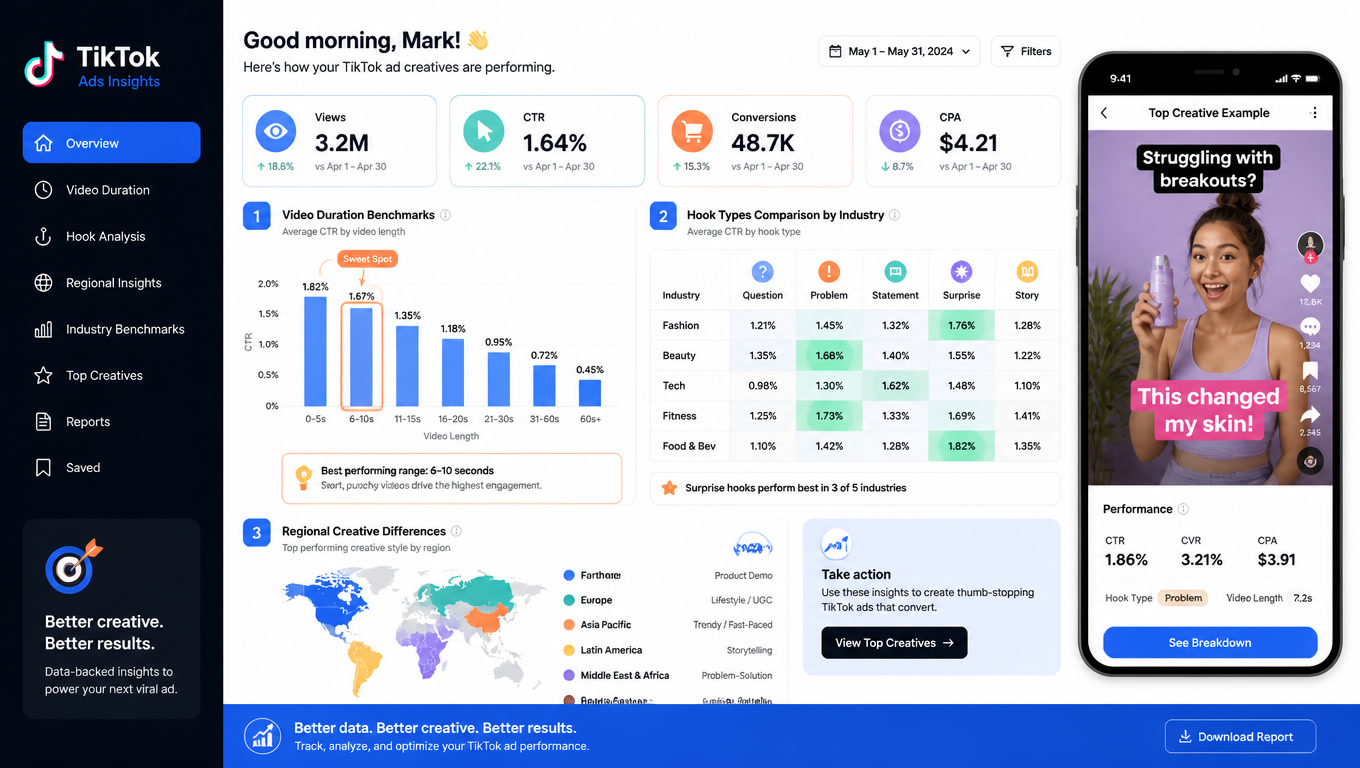
For years, the received wisdom has been: shorter is better on TikTok. 7-10 seconds, a quick hook, move on. But when you actually look at the data from TikTok Creative Center — covering over 24,000 top-performing ads — a very different picture emerges. The highest-CTR ads aren't the shortest. They cluster consistently in the 15-25 second range, following a structure most creative teams don't replicate systematically.
At Mintec, we manage TikTok ad campaigns for clients across LATAM and the US. We use Creative Center data — TikTok's own performance-ranking tool across 21 industries and 5 markets — to inform every creative decision. This article isn't a list of tips someone wrote after scrolling their feed for 10 minutes. It's what the data actually shows when you analyze the best-performing ads at scale.
The "Shorter Is Better" Myth (and Why It's Wrong)
The most repeated dogma in TikTok advertising is that videos need to be under 15 seconds. "Short attention spans, short content," they say. The data disagrees.
When we sorted ads by CTR — click-through rate, the metric that actually matters for conversions — the top performers weren't the sub-10-second clips. They clustered in the 15-25 second range.
The reason is intuitive once you think about it: a 7-second ad can grab attention, but it rarely provides enough context for someone to feel compelled to click. You need a minimum amount of storytelling to take a viewer from "that's interesting" to "I need to check this out."
The top-performing structure in that 15-25 second window follows a consistent pattern:
| Seconds | Function | What Should Happen |
|---|---|---|
| 0-3 | Hook | Something visually arresting or a statement that creates curiosity |
| 3-10 | Context | The problem, desire, or situation viewers can relate to |
| 10-18 | The answer | Product reveal, demonstration, transformation, social proof |
| 18-25 | Call to action | Clear, specific, urgent |
Ads over 40 seconds showed sharp retention collapses after the 25-second mark regardless of industry. The audience still watching after 25 seconds is engaged, but it's a tiny fraction — you've already lost 70-80% of your viewers by then.
The exception: Gaming and entertainment. These categories sustain longer watch times because the content itself is entertaining. A 45-second gameplay clip with a product integration performs very differently than a 45-second skincare demonstration.
Spark Ads Still Win — But the Lead Is Shrinking
Spark Ads — ads run through a creator's existing organic post rather than published from a brand account — still outperform standard non-Spark formats on engagement metrics across every industry we analyzed.
This makes sense. They appear in the feed as organic content from a real person. Users don't immediately register them as ads. The perception gap creates a performance gap.
But here's what's changing: the gap is closing.
In the last 180 days, non-Spark ads in e-commerce and gaming have pulled within 0.05 percentage points of Spark Ads on CTR. That's essentially parity.
Why? Brands are getting dramatically better at producing content that looks organic without needing a creator's account. Handheld camera angles. Imperfect audio. Casual delivery. No studio lighting. Real environments.
The visual language of "organic TikTok" is now well-understood enough that in-house teams and production agencies can replicate it convincingly. The format no longer requires an actual creator posting it — it just needs to look like one did.
The holdout verticals: Financial services and health. In trust-sensitive categories, ads coming from real people's accounts still massively outperform branded content. Non-Spark financial ads underperform by 40%+ on engagement. When someone is talking about money or medical topics, the messenger matters as much as the message.
The Hook Landscape: What Works by Industry
Not all hooks are created equal. The opening 1-3 seconds of a TikTok ad determine whether anyone sees the rest. Here's what's dominating by vertical:
Beauty & Personal Care
The top 20% of beauty ads by CTR almost always show the result within the first 2 seconds. Not the process — the result.
A skincare ad that opens with the "after" shot (clear, glowing skin) and then flashes back to "here's how I got here" outperforms ads that start with the problem. People scroll past problems. They stop for aspirational results.
Other patterns: "I tried this for 30 days" voiceovers, GRWM (Get Ready With Me) openers, close-up texture shots of product application.
E-commerce (Non-App)
Price anchor in the first 5 seconds correlates with higher conversion rates. Not just mentioning price, but framing it: "I found a $15 alternative to the $80 version" or "This is $23 and it changed my morning routine."
Unboxing still works but it's format-dependent. The unboxing needs to happen fast — product out of package within 3 seconds, not 10 seconds of packaging unwrapping.
Tech & Electronics
Problem statement hooks dominate: "Tired of X?", "Why does nobody talk about this feature?", "I replaced my $300 gadget with this."
Longer average duration (25-35 seconds). Tech products often need more explanation time, and audiences in this category have higher patience for detailed content.
Screen recordings with face-in-corner format perform surprisingly well — the "looking at my screen while reacting" format translates to ads when done well.
Gaming
Highest average retention rates of any category. Gamers will watch longer content if the gameplay is compelling.
"Wait for it" tension builds and before/after skill comparisons work consistently. The moment-of-impact format (building to a peak play) keeps people watching specifically to see the payoff.
Financial Services
Educational hooks overwhelmingly dominate. "I saved $X by...", "Stop doing X with your money", "Here's what nobody tells you about..."
Data visualizations and screen recordings of dashboards perform well when paired with voiceover explanation. The format signals credibility.
Spark Ads are almost mandatory in this category. Non-Spark financial ads underperform by 40%+ on engagement. Trust is everything.
Food & Beverage
First-bite reactions and cooking process videos lead. The "making it" format (overhead shot of ingredients being combined) consistently hooks viewers.
Ads that show real customer reactions outperform polished brand content by a wide margin. Authenticity cues matter — phone-quality video outperforms cinema-quality in this category.
Regional Creative Differences That Actually Matter
If you're running ads in multiple markets, don't assume your US creative transfers. The data shows meaningful regional divergence:
Germany: Higher performance from ads with subtitles, even when the audio is in German. German audiences expect subtitles as a default. More formal tone in financial and B2B categories — the casual "hey what's up" opener that works in the US can feel off-putting in DACH markets.
Japan: Much shorter hooks — 1-2 seconds vs. 3 seconds in the US. Japanese users make scroll decisions faster. Text overlay is more prominent than voiceover. Vertical split-screen formats (comparison/reaction styles) perform well. Visual density is higher in top-performing Japanese ads.
Brazil: Music-forward ads outperform voiceover-forward ads. This is the only major market where the audio track itself — not the spoken word — is the primary hook driver. Longer average durations (25-30 seconds) — Brazilian audiences have more patience for storytelling.
UK: Very similar to US in creative DNA. The main difference is that humor performs slightly better, and self-deprecating tones outperform aspirational tones in categories like fitness and fashion.
CTR Benchmarks Nobody Talks About
Here's what "good" looks like for the top 20% of ads by TikTok's Creative Center rankings:
| Industry | Median CTR (Top 20%) |
|---|---|
| E-commerce (Non-App) | 0.85% |
| Beauty & Personal Care | 0.72% |
| Gaming | 0.68% |
| Apps | 0.62% |
| Food & Beverage | 0.55% |
| Financial Services | 0.48% |
| Education | 0.44% |
| Travel | 0.41% |
| Business Services | 0.38% |
Two important notes:
These are the top 20%. If your ads are hitting 0.5% CTR in e-commerce, you're solidly mid-pack for the best ads. If you're at 0.3%, you have clear creative optimization headroom.
Don't compare your financial services CTR to an e-commerce benchmark. The intent dynamics are completely different. A user watching a shoe ad is closer to purchasing than one watching an investment fund ad.
The Retention Curve Pattern Top Ads Share
We analyzed second-by-second retention curves for hundreds of top-performing ads. The universal pattern:
- 100% → 75-85% (irreducible scroll-through loss)
- 75-85% → 50-60% (hook quality shows here)
- 50-60% → 40-50% (hook follow-through)
- 40-50% → 25-35% (content quality, steady decline)
- 25-35% → gradual tail
The critical benchmark: below 40% at second 3 means your hook needs fundamental rework, not iteration.
The click timing data is equally revealing. For the majority of high-CTR ads, the click spike happens between seconds 15-20 — roughly 75-80% through the video, not at the very end. This suggests the optimal CTA placement is three-quarters through the video, not at the final frame.
How to Apply This to Your Campaigns
After managing campaigns for clients across multiple industries, here's what we've seen work:
1. For conversion campaigns, target 15-25 seconds. If you're optimizing for CTR and conversions, don't go under 15 seconds and don't go over 30. For brand awareness and reach, shorter formats work fine because the goal is impression volume, not intent generation.
2. Hook diversity matters more than hook perfection. In accounts where we tested 5-6 different hook types per industry (result-first, price anchor, problem statement, educational, testimonial, "wait for it"), the algorithm's learning accelerated and we found winners faster than perfecting a single hook type.
3. If you're entering a new market, research local patterns. Investing 1-2 hours reviewing top ads filtered by region will save weeks of underperforming creatives. A direct translation of your US ad won't perform as well as a native creative built from local patterns.
4. Monitor your retention at second 3. It's the most predictive metric of ad performance. If you're losing more than 60% of viewers in the first 3 seconds, you don't need to iterate the hook — you need a fundamentally different concept.
5. Place your CTA at 75-80% through the video, not at the end. The click spike occurs before the video ends. If your CTA is on the final frame, you're missing the peak intent moment.
TikTok's Creative Center data updates constantly. What we found analyzing 180 days of data will shift next quarter. The brands that consistently outperform aren't the ones who found one winning formula — they're the ones who check the data regularly and adapt.
At Mintec, we use this data to inform every TikTok campaign we manage. If you'd like to apply this approach to your account, let's talk.
Related articles:
- TikTok Ad Costs by Industry in 2026
- TikTok Ad Mistakes That Get Rejected in 2026
- TikTok Search Ads and Hubs: What Changed in 2026
- Meta + TikTok: The 2026 Funnel Strategy
Sources: SociaVault — "TikTok Ad Creative Trends in 2026: What the Data Actually Shows" (TikTok Creative Center data analysis, June 2026). Internal campaign data from Mintec-managed accounts (Jan-Jun 2026). CTR benchmarks from top 20% of ads per industry per TikTok Creative Center rankings.
Frequently Asked Questions
What is the optimal TikTok ad length in 2026?
TikTok Creative Center data shows the highest-CTR ads cluster in the 15-25 second range. Sub-10-second videos grab attention but rarely provide enough context to drive clicks. Beyond 30 seconds, retention collapses — 70-80% of viewers are gone by the 25-second mark. Gaming and entertainment are the exceptions, sustaining longer watch times because the content itself is engaging.
What hook types work best for TikTok ads by industry?
It varies dramatically by vertical. Beauty: show the result in the first 2 seconds, not the problem. E-commerce: anchor the price in the first 5 seconds. Tech: problem-statement hooks with longer durations (25-35 seconds). Gaming: tension-building 'wait for it' formats. Financial services: educational hooks revealing savings or common mistakes. Food & beverage: first-bite reactions or overhead cooking process shots.
Do Spark Ads still outperform standard TikTok ads in 2026?
Yes, but the gap is shrinking. Spark Ads still lead on engagement across all industries, but in e-commerce and gaming, non-Spark ads have pulled within 0.05 percentage points of CTR — essentially parity. The reason: brands have gotten much better at producing content that looks organic without needing a creator's account. The holdout verticals where Spark Ads remain mandatory are financial services and health, where trust in the messenger matters as much as the message.