
TikTok Ad Costs Rose 12% in 2026 — Industry Benchmarks You Need to Protect Your Budget
TikTok ad costs rose 12.28% YoY in 2026 — nearly double Meta's increase. Using data from Benly, Clouted, and our campaign operations across LATAM and the US, we break down CPM, CPC, and CPA by industry — and when paying more still makes sense.
TikTok Ad Costs Rose 12% in 2026 — Industry Benchmarks You Need to Protect Your Budget
If you're managing TikTok Ads campaigns, you've already noticed: costs went up. The real question is whether your industry rose 5% or 22%, and whether what you're paying is healthy range or burning budget without teaching the algorithm anything.
We've been managing TikTok Ads campaigns for clients across ecommerce, education, health, and SaaS in LATAM and the US since 2023. We've watched CPMs double in some verticals and stay flat in others. In 2026, with a 12.28% average year-over-year increase — nearly double Meta's rate — understanding industry benchmarks isn't optional anymore. It's the difference between a healthy ROAS and an account that burns budget without learning.
This article breaks down CPM, CPC, and CPA data by industry, explains why costs are rising faster than other platforms, and provides a practical framework for deciding when TikTok still makes sense for your brand.
The increase nobody predicted: +12.28% YoY
TikTok generated $33.12 billion in global ad revenue in 2025, up 40% year-over-year. Projections for 2026 hit $43.96 billion. That demand-side growth — more advertisers competing for the same inventory — is the primary driver behind rising costs.
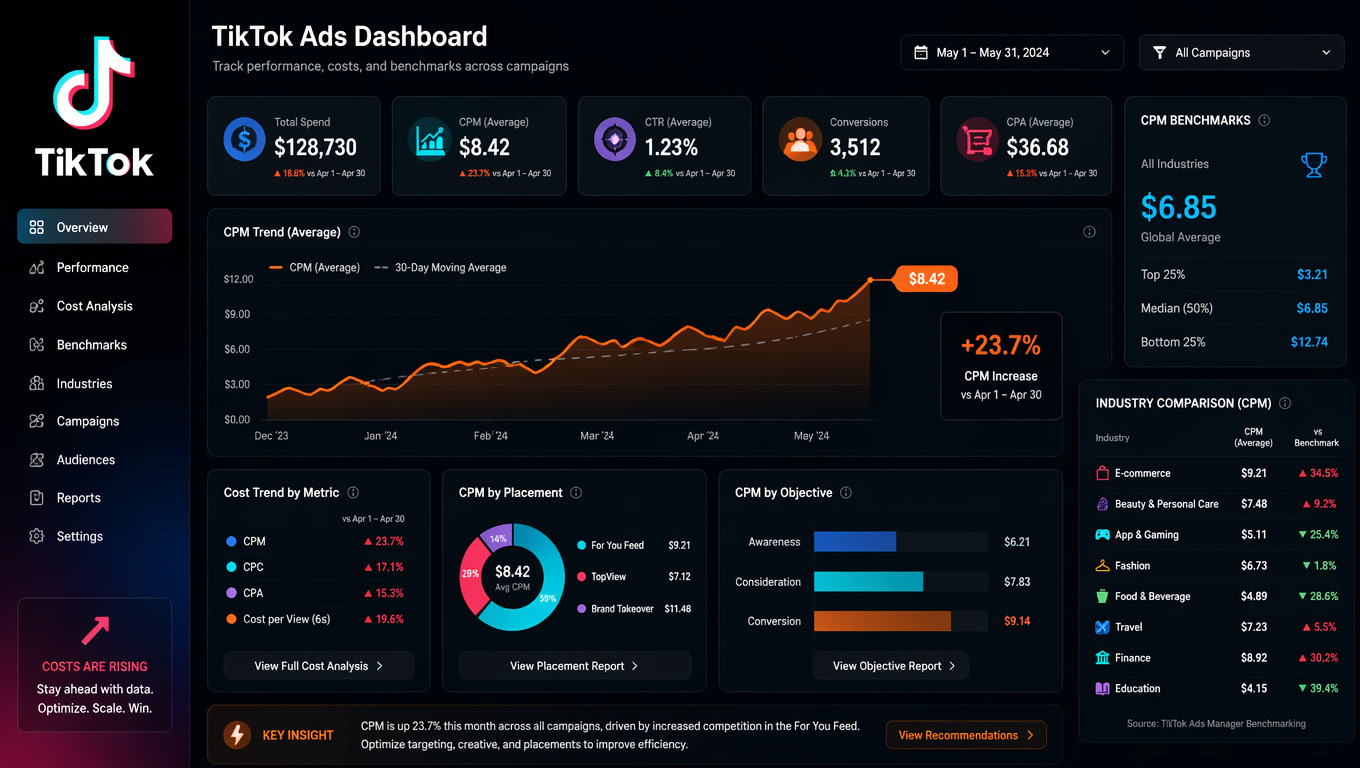
According to AffNinja and Clouted data, TikTok CPMs grew 12.28% year-over-year in 2026, compared to roughly 6-7% for Meta. The most competitive industries (finance, technology, health) saw the most aggressive increases, while entertainment and food remained relatively stable.
| Metric | 2025 | 2026 | Change |
|---|---|---|---|
| Average CPM | $7.40 | $8.50 | +14.9% |
| Average CPC | $0.70 | $0.85 | +21.4% |
| CPA (conversion) | $28 | $35 | +25% |
| Average ROAS | 4.5x | 4.13x | -8.2% |
Sources: Benly.ai (January 2026), Clouted (June 2026), Triple Whale (2025-2026).
This table reflects what we're seeing in the accounts we manage: costs rising faster than efficiency, compressing margins. This doesn't mean TikTok stopped being profitable — it means selectivity matters more than ever.
CPM by industry: who pays more and why
TikTok CPM varies by up to 3.5x between the most and least expensive industries. The reason isn't just advertiser competition — it also reflects the customer lifetime value each industry can justify.
| Industry | Average CPM | Range | YoY Change |
|---|---|---|---|
| Fashion & Apparel | $6.50 | $4.00-9.00 | +8% |
| Beauty & Cosmetics | $7.20 | $5.00-10.00 | +12% |
| E-commerce (General) | $8.00 | $5.50-12.00 | +10% |
| Food & Beverage | $5.80 | $4.00-8.00 | +5% |
| Entertainment | $5.20 | $3.50-7.00 | +3% |
| Gaming & Apps | $7.80 | $5.00-12.00 | +15% |
| Health & Fitness | $9.50 | $6.00-14.00 | +18% |
| Finance & Insurance | $18.00 | $12.00-28.00 | +22% |
| Education | $11.00 | $7.00-16.00 | +14% |
| Travel & Hospitality | $8.50 | $5.50-13.00 | +9% |
| Technology & SaaS | $14.00 | $9.00-22.00 | +20% |
| Home & Garden | $7.00 | $4.50-10.00 | +7% |
Source: Benly.ai (March 2026), based on aggregated account data from US and European markets.
What this means in practice: if you're in the top third (finance, SaaS, health), paying $12 CPM might be excellent. If you're in fashion or food and paying over $8, you have an efficiency problem — not a market problem.
CPC and CPA: the metric that actually matters
CPM only tells part of the story. A high CPM can be fine if CTR compensates. Industries like beauty and entertainment achieve lower CPCs despite moderate CPMs because their content naturally fits TikTok's format.
| Industry | Average CPC | Purchase CPA | Lead CPA |
|---|---|---|---|
| Fashion | $0.65 | $28-45 | $8-15 |
| Beauty | $0.58 | $22-38 | $6-12 |
| E-commerce | $0.75 | $32-55 | $10-18 |
| Food & Beverage | $0.52 | $18-30 | $5-10 |
| Entertainment | $0.45 | N/A | $5-12 |
| Health & Fitness | $0.95 | N/A | $8-20 |
| Finance | $2.20 | N/A | $20-45 |
| Education | $1.30 | N/A | $12-25 |
| Technology/SaaS | $1.80 | N/A | $15-35 |
Source: Benly.ai (2026), supplemented with Mintec's own campaign data from LATAM markets.
Key observation: finance and tech face a double problem — high CPMs combined with lower CTRs because their content is less native to TikTok's format. The solution isn't bidding lower, it's investing in creatives that feel native to the platform. At Mintec, we've seen SaaS campaigns reduce CPC by 35% just by switching from product animations to on-camera testimonials with a casual tone.
TikTok vs. Meta: where your budget goes further in 2026
The direct CPM comparison favors TikTok by 20-40%, but CPA typically favors Meta — especially for direct conversion. The reason: Meta has years of conversion data, more mature attribution models, and the Advantage+ ecosystem optimizing in real time.
| Metric | TikTok | Meta | Edge |
|---|---|---|---|
| Average CPM | $6-12 | $5-12 ($8.17 median) | TikTok slightly |
| Average CPC | $0.50-1.50 | $0.50-2.00 (varies) | Similar |
| Median ROAS | 1.4x - 4.13x | 2.2x - 4.0x | Meta (conversion) |
| Organic viral reach | Yes | Limited | TikTok |
| Data targeting | Basic | Advanced (CAPI, pixel) | Meta |
| Optimization maturity | Medium | High | Meta |
| Native formats | Short video, trends | All formats | TikTok (engagement) |
Sources: Triple Whale, Clouted, Mintec proprietary data.
The rule we use internally: TikTok for discovery and creative angle testing at low cost; Meta for scaling what works and converting. This aligns with the funnel approach we detailed in our piece on Meta + TikTok: the funnel strategy that beats either/or.
When TikTok is still profitable (and when it's not)
Based on our campaign operations, here are the scenarios where TikTok continues to deliver strong results:
✅ Still profitable when:
- Your CPM is within your industry's range (+15% is acceptable; +30% is a warning sign)
- Your creatives generate watch time >5s and completion rates >25%
- You have a retargeting funnel on Meta or Google to capture the traffic TikTok discovers
- You use Spark Ads (20-30% cheaper than standard in-feed, according to Benly)
❌ Stops being profitable when:
- Your TikTok CPA exceeds your Meta CPA by 40%+ without volume justification
- You can't produce 6-10 creative variants per month (TikTok penalizes repetition)
- Your target audience is 45+ (TikTok penetration drops significantly)
- You compete in finance or insurance without a clear creative differentiator
For a deeper look at the relationship between creative fatigue and performance, check our analysis of creative fatigue in Meta Ads under Andromeda. While it's about Meta, the principle applies equally to TikTok: creative rotation is the primary driver of efficiency.
How to plan your TikTok budget in 2026
If you take one concrete action from this article, make it this: stop planning your TikTok budget based on a generic $8.50 CPM. Your industry, your creative quality, and your market determine your actual cost.
The process we use at Mintec:
- Find your real benchmark: use the CPM-by-industry table in this article as your starting point. If your current CPM is >25% above your industry benchmark, investigate before scaling.
- Calculate your maximum allowable CPA: your TikTok CPA shouldn't exceed 30% of your contribution margin. If your product has a 50% margin, your maximum CPA is 15% of the selling price.
- Test with Spark Ads first: Spark Ads cost 20-30% less in CPM than standard in-feed and generate better engagement rates. If they don't work with Spark Ads, it's unlikely another format will.
- Measure the ecosystem, not the isolated platform: TikTok discovers customers who may convert on Meta or Google. If you're only looking at TikTok's isolated ROAS without measuring full-funnel impact, you're making decisions with incomplete data.
For brands in LATAM — where CPMs tend to be 30-50% lower than the US — TikTok remains an exceptionally cost-effective acquisition channel, especially when paired with consistent organic content. If you're just starting out, our guide to creative mistakes that get TikTok ads rejected will save you the first few weeks of trial and error.
Bottom line
TikTok Ads in 2026 costs more than 2025, but it's still cheaper than Meta for reach and discovery. The key isn't finding the cheapest platform — it's knowing which platform does which part of the job at a cost your business can sustain.
The days of $4 TikTok CPMs are probably gone. But for brands that understand their benchmarks, produce native creatives, and measure full-funnel impact, TikTok remains one of the most efficient acquisition channels available.
Related articles:
Frequently Asked Questions
How much does TikTok advertising cost in 2026?
Average TikTok CPM in 2026 ranges from $6 to $12, with a median of $8.50. CPC ranges from $0.50 to $1.50, and CPA (cost per conversion) varies from $15 to $80 depending on industry. Costs rose 12.28% YoY — nearly double Meta's increase — but TikTok remains 20-40% cheaper than Meta in CPM for reach campaigns.
Which industries have the highest and lowest TikTok CPM?
Finance & insurance has the highest average CPM ($18, up to $28), followed by technology/SaaS ($14) and education ($11). Entertainment ($5.20) and food & beverage ($5.80) have the lowest CPMs. The 3.5x spread between the most and least expensive industries reflects both advertiser competition and customer lifetime value in each vertical.
Is TikTok still cheaper than Meta Ads in 2026?
For reach and awareness, yes — TikTok is 20-40% cheaper in CPM than Meta. However, for direct response conversions, Meta typically delivers lower CPAs thanks to more mature optimization algorithms and richer audience data. The gap is narrowing: TikTok Shop product ads convert at 3.7%, nearly double traditional in-feed TikTok ads (1.8%).