Storyblok Agents: When Your Content Team Talks to the CMS Through AI
Storyblok launched Agents on September 10, 2026: a conversational content operations layer that lets editors find stale content, build custom agents, and automate recurring tasks — without writing code. What changes for content teams and why it's not the same as a developer agent API.
Storyblok Agents: When Your Content Team Talks to the CMS Through AI
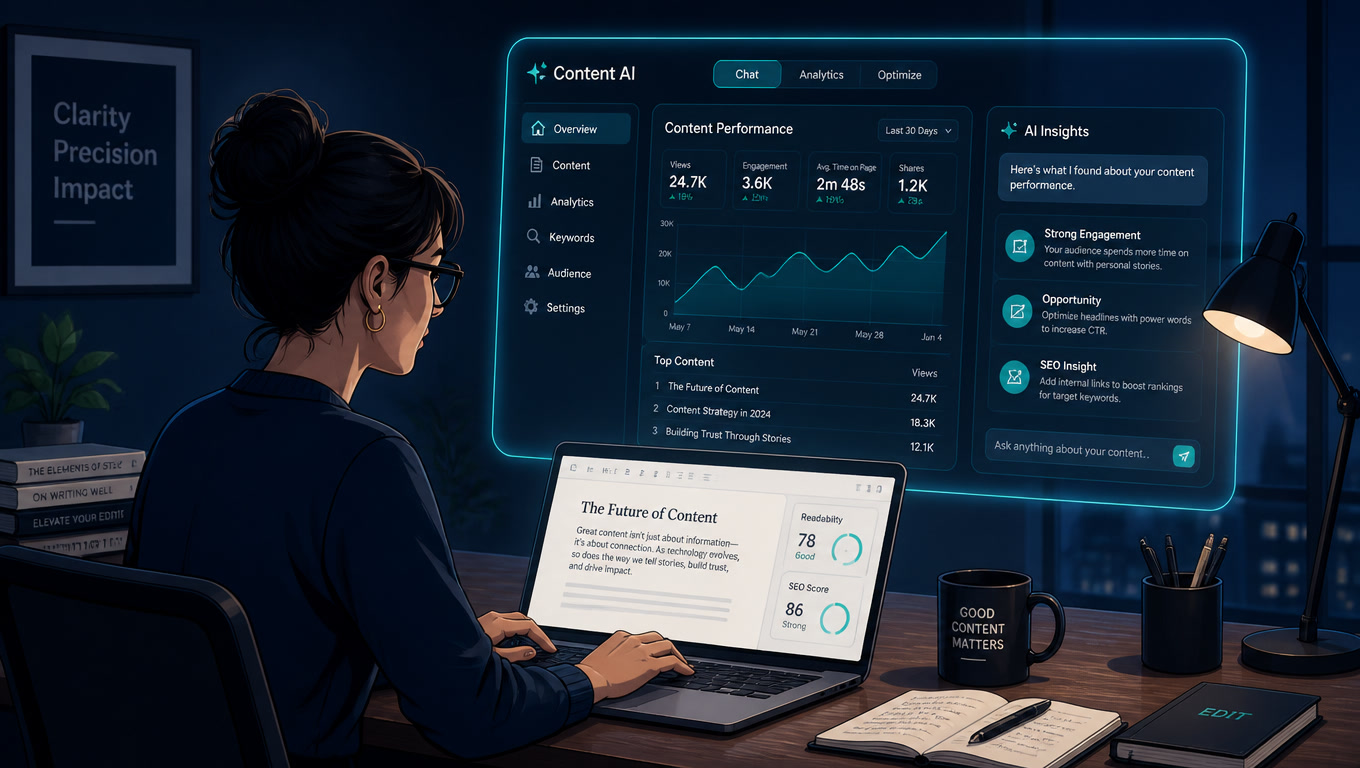
Storyblok shipped Agents on September 10, 2026, and what it does isn't a chatbot bolted to the CMS — it's a content operations layer that turns the editor into someone who can ask their own system "what needs attention?" and get an actionable answer. Over the past few months we've seen two layers of AI in headless CMS: the developer API (Wagtail 8 with its 50+ operation agent API) and the publishing guardrails architecture (our own four-layer framework running in production). Storyblok Agents completes the triangle: the content layer — the one editors and content managers actually need.
Three layers, not one
When we talk about AI in CMS, the conversation has split into two wrong camps. One side sells "AI magic" as an admin feature. The other builds APIs so developers can connect external agents. Neither solves the real problem for content teams: knowing what's broken without manually reviewing 2,000 pages.
The AI-in-CMS architecture in 2026 has three distinct layers:
| Layer | Who uses it | Example | Level of control |
|---|---|---|---|
| Agent API | Developers | Wagtail 8 MCP, Strapi Agent API | Full — you build the automation yourself |
| Publishing guardrails | Technical teams | Our four-layer framework in Astro | High — you define approval rules |
| Conversational operations | Editors and content managers | Storyblok Agents | Medium — ask and execute, no code |
What Storyblok does differently is let the end user — the editor who doesn't write CSS or configure webhooks — interact with the content system without technical intermediation.
What an editor can do with Agents
The Storyblok demo is concrete. An editor can ask:
- "What content hasn't been updated in over 6 months?" → the agent searches the workspace, lists obsolete articles, and the editor decides whether to update or archive.
- "Is there duplicated content between these two collections?" → the system identifies semantic overlap, not just exact duplicates.
- "Which pages have incomplete translations?" → lists localization gaps by language.
- "Build an agent that reviews content freshness every Monday and sends me a report" → the editor defines the task, the agent executes it under existing permissions.
The key difference: agents only operate within the permissions and approval workflows already in the CMS. It's not a free agent publishing content. It's an agent that researches, reports, and executes only when the team approves.
Why it matters for composable architecture
The timing isn't accidental. Contentful just closed its Salesforce acquisition and became a native Agentforce content layer. Wagtail exposes an MCP API so any external agent can consume CMS operations. Sanity continues betting on its "Content OS" with automated audits.
Every CMS is solving the same question from a different angle: how do I integrate AI into content without destroying governance?
Storyblok chooses the conversational layer. It's not the most technical (that's Wagtail). It's not the boldest (that's Contentful/Agentforce). It's the most accessible for the team that actually produces content: editors, writers, content managers who need visibility into their content's health without opening a terminal.
In our Astro + Cloudflare stack, we handle the governance layer with a four-layer pipeline: scoped identity, deduplication gates, schema validation with diff, and post-publish verification with rollback. Storyblok Agents solves a different level of the same problem — the discovery layer, the one that says "this needs attention" before a human has to go looking.
What it doesn't solve (and why that matters)
Storyblok Agents has clear limits worth naming:
It doesn't replace governance architecture. If your CMS lets an agent modify content without an approval gate, you have a security problem, not a feature. The publishing guardrails we run in production — schema validation, visible diff, explicit approval — remain necessary regardless of which CMS you use.
It doesn't solve the data problem. A conversational agent is only as good as the CMS metadata. If your content lacks publication date fields, review status fields, or localization taxonomies, the agent has nothing to talk about. The investment in structured content models remains the prerequisite.
It's not multi-CMS. Unlike an MCP API that can connect to any platform, Storyblok Agents lives inside Storyblok. If your stack includes Contentful for product and Storyblok for editorial, you have two different agent systems.
The most important signal
The most relevant part of the launch isn't the feature — it's the direction. Storyblok is saying the CMS interface of the future isn't just a visual editor and an API. It's a conversation. The editor asks, the system responds, and actions execute within existing permission boundaries.
This is exactly what we described in our agentic CMS analysis: the evolution from "CMS as tool" to "CMS as a system that operates with agents." The difference is that Storyblok puts it in the editor's hands, not just the developer's.
For teams evaluating their content stack, the question isn't "do I need AI agents?" — that answer is already yes. The question is: at which layer of your content operation does AI generate the most immediate value? If your problem is visibility into stale, duplicated, or incomplete content, Storyblok's conversational layer is a concrete answer. If your problem is automating publications with governance, you need the guardrails layer. If your problem is integrating external agents, you need the API.
All three coexist. Most teams are only building one.
Published September 12, 2026 · Mintec · Content architecture and AI operations
Related articles:
Frequently Asked Questions
What does Storyblok Agents do that wasn't possible before?
Agents adds a conversational layer to the CMS: editors can ask the system about stale, duplicated, or unlocalized content, and execute changes directly in the conversation. It also enables building custom agents for recurring tasks like freshness audits or localization draft generation.
Does Storyblok Agents replace developers?
No. Agents operate under existing team permissions and approval workflows. They are content operations tools, not CMS architecture tools. Developers still define content models, workflows, and business rules.
How does this compare to Wagtail's agent API or publishing guardrails?
These are three distinct layers. Wagtail exposes a 50+ operation API for developers to build automations. Publishing guardrails control what an agent can publish and when. Storyblok Agents gives editors a conversational interface to interact with their content without touching code.