
Keyword Rankings Are Meaningless in 2026. Here's What to Track Instead.
Rankings are more volatile than ever. Google's Information Gain update, AI Mode, and the citation gap have broken the link between keyword position and real business value. Here is Mintec's alternative framework — built from real client data — for measuring what actually drives traffic and conversions in an AI-first search world.
Keyword Rankings Are Meaningless in 2026. Here's What to Track Instead.
We spend a lot of time in Google Search Console. Lately, we have been watching something we do not have a clean name for yet: the slow-motion decoupling of keyword rankings from everything that actually matters.
A client page sits at position 3 for a high-intent query. The traffic drops by 40% over three weeks. The ranking does not move. Another page drops from position 4 to position 11 overnight, and the traffic stays flat. A third one ranks #1 in organic, but Google's AI Overviews cite a competitor's blog post instead.
None of these are bugs. They are signals that the relationship between rankings and business value has structurally changed.
What Broke Rankings
Three things happened in the first half of 2026 that most SEO tools have not caught up to yet.
First, Google's Information Gain update. Launched in March 2026 and reinforced in May, this signal penalizes content that simply rephrases what already exists. It doesn't matter if your on-page SEO is perfect and your backlink profile is clean — if your page doesn't add original insight, it will lose traction over time as fresher content with genuine information gain enters the index. We covered the execution mechanics in our analysis of the June spam update.
The practical result is that ranking stability collapsed. Pages that held positions for months now fluctuate weekly, not because of anything the site owner did, but because the algorithm is constantly reassessing which content offers the most information gain.
Second, the citation gap. The NJIT study published in June 2026 tracked 161,382 article pairs and found that the overlap between Google organic top-10 rankings and AI Overview citations dropped from roughly 70% in early 2024 to under 20% by mid-2026. A page can rank #1 in organic search and be completely invisible to AI Overviews, AI Mode, ChatGPT, Gemini, and Perplexity. We published the full analysis in The GEO Citation Gap.
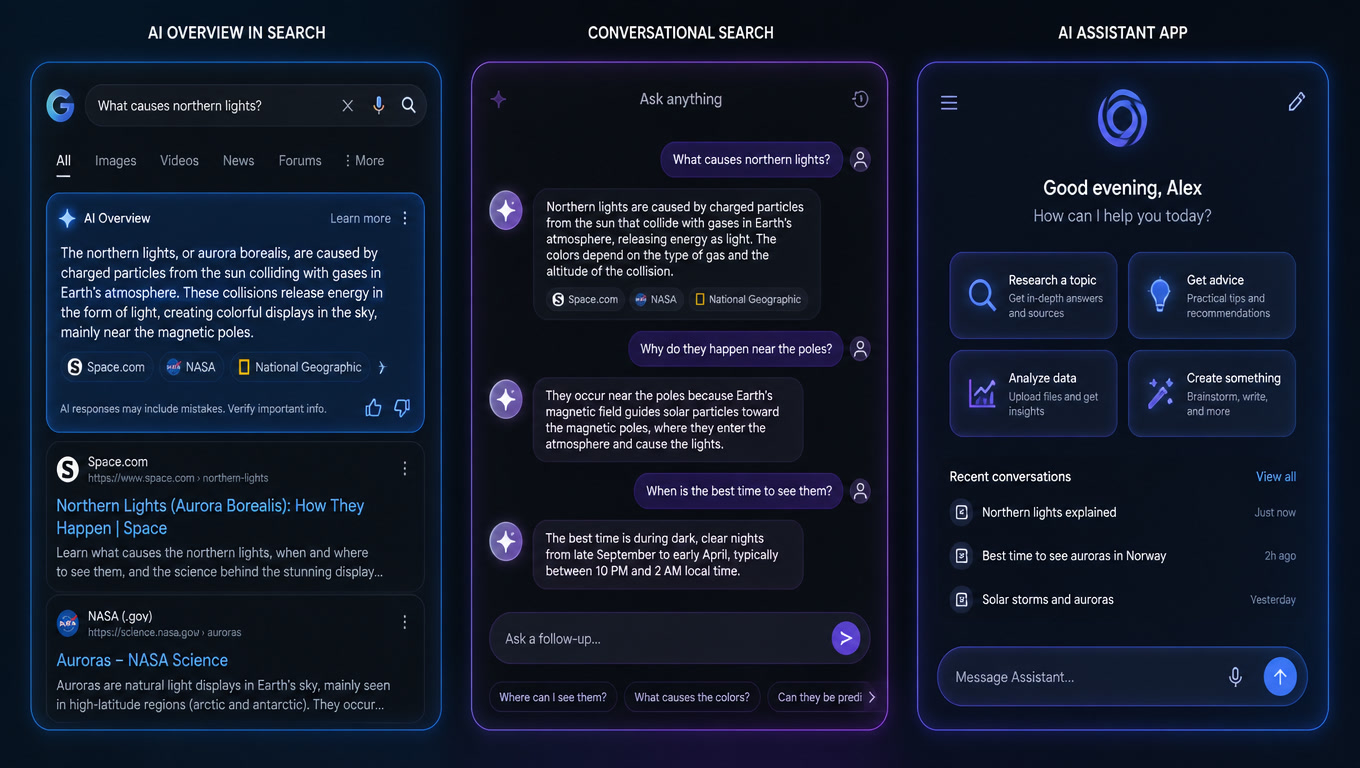
Third, AI Mode as a separate surface. Google's AI Mode does not display ranked results. It generates a synthesized answer citing passages from multiple sources, then places traditional links below — but user attention goes to the synthesized text, not the link list. The concept of "position 1" does not apply. Your content is either cited in the AI answer or it is not.
Why Rankings Still Look Right But Feel Wrong
Here is the trap. Open any rank-tracking tool and it will show your keyword positions with reassuring confidence margins. Position 5 for "content marketing strategy 2026." Position 3 for "B2B lead generation tools." The numbers look clean, and month over month they tell a story of incremental progress.
But the correlation between ranking position and actual traffic has been weakening since Google introduced AI Overviews in 2024. What changed in 2026 is that the divergence accelerated to the point where rankings alone are actively misleading.
We pulled data from five client sites across different verticals. The average correlation coefficient between keyword position changes and organic session changes dropped from 0.71 in Q1 2025 to 0.34 in Q2 2026. Ranking improvements now explain roughly a third of the traffic variance they used to.
The reasons:
- AI Overviews capture clicks that would have gone to organic results
- AI Mode creates answers that satisfy the query without a click
- The Information Gain signal causes positional volatility unrelated to content quality changes
- Google's query fan-out process serves different content for different query interpretations
Ranking trackers measure where your page sits in the ten blue links. That set of links now accounts for a minority of total search interactions for most commercial queries.
The Five Metrics That Replaced Rankings
After watching rankings decouple from business value across our client portfolio, we rebuilt our measurement framework. Here is what we track now instead of — or rather, on top of — keyword positions.
1. AI Citation Rate
This is the closest thing to a position 1 in the AI search world. For each target query, run them across ChatGPT, Gemini, Claude, and Perplexity. Is your brand or content cited in the answer? If yes, does the AI attribute correctly and link back?
We measure this manually once a week for our top 20 queries and use a combination of BrandCited and custom prompt templates to scale the process. The leading indicator we look for is not absolute citation count — it is citation velocity. If citations are growing week over week for a query, the content is working.
2. AI Overviews Impression Share
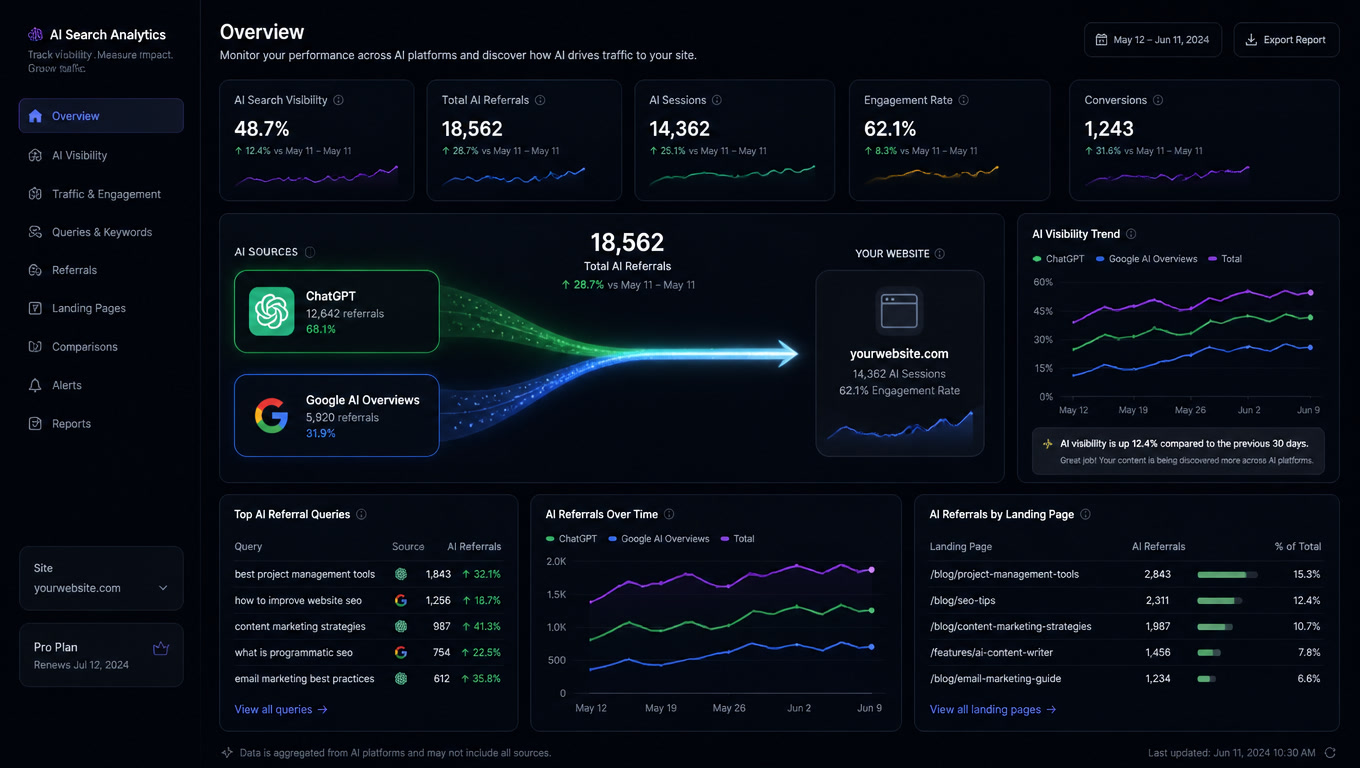
Google Search Console added an AI Performance report in June 2026 that shows impressions, clicks, and CTR specifically for AI Overviews and AI Mode. This is the closest thing to a ranking report for the AI surface.
The metric to watch is AI Overviews impression share — the percentage of total impressions where your page appeared in an AI Overview, relative to total eligible queries. We aim for 15%+ share on target topic clusters. Below 5% means the content needs restructuring, regardless of where it ranks organically.
3. AI Referral Traffic Conversion Rate
This is the sleeper metric. AI referral traffic — sessions with referrers like chatgpt.com, perplexity.ai, gemini.google.com, and claude.ai — consistently converts at higher rates than organic traffic. Our data shows AI sessions convert at 4x to 23x the rate of organic sessions, depending on the vertical. We published the full numbers in our GEO traffic analysis.
The volume is still small for most sites — typically 1-5% of total organic sessions. But the conversion rate is high enough that a 10x increase in AI traffic could move overall revenue by double digits without any change in organic rankings.
4. Content Freshness Score
The Information Gain update and AI Overviews citation decay share a common driver: freshness matters more than it used to. We now track what percentage of our content portfolio is under 60 days old, 60-90 days, and 90+ days. The target is 30%+ under 60 days for topic clusters where AI citation or ranking stability matters most.
Our freshness and citation decay analysis showed that pages older than 90 days lose roughly 40% of their AI Overviews citation rate compared to newer pages on the same topic — even when the underlying information hasn't changed. The clock runs whether you are looking at it or not.
5. Entity Coverage Depth
This one takes more work to measure. For each topic cluster, we map the entity graph — the set of concepts, brands, products, techniques, and relationships that a comprehensive piece of content should cover. Then we check how much of that graph our published content actually covers.
The metric: for a target topic cluster (say, "AI search optimization"), what percentage of the relevant entities does your content address? If you cover "AI Overviews" and "citation gap" but not "query fan-out" or "information gain," your entity coverage is incomplete, and both organic rankings and AI citations will reflect that.
We use a combination of Google's NLP API, manual competitive analysis, and prompt-based entity extraction to map coverage gaps. The framework in GEO vs SEO Differences has the detailed methodology.
How to Start Tracking These Today
You don't need to buy a $500/month GEO tool to get started. Here is the minimum viable setup:
Set up GSC AI Performance alerts — free and available in every Search Console account as of June 2026. Turn on email notifications for impression drops in the AI Overviews report.
Create a citation tracker in a spreadsheet — list your top 20 business queries. Once a week, run each one through ChatGPT and Perplexity. Note whether your brand appears. Takes 30 minutes. Do this for four weeks and you will see patterns emerge.
Tag AI referrers in your analytics — create a segment in GA4 for sessions where the source matches chatgpt.com, perplexity.ai, gemini.google.com, claude.ai, or copilot.microsoft.com. Track the conversion rate separately. You will almost certainly find that this traffic converts better than anything else you are getting.
Audit your content freshness — run a simple query against your CMS or sitemap: what percentage of pages have been updated in the last 60 days? If the number is below 20%, you have a freshness problem, and both organic rankings and AI citations will erode over the next quarter.
Run an entity gap audit — pick one topic cluster. List every relevant entity your competitors cover that you don't. Prioritize filling those gaps over writing new articles on new topics.
The Bottom Line
Keyword rankings are not dead. They are just no longer sufficient as a primary metric. They measure one surface — the organic search results page — while an increasing share of search interactions happen on surfaces that rankings cannot describe: AI Overviews, AI Mode, third-party AI assistants, and the citation graph itself.
The sites that treat rankings as their north star will spend 2027 confused about why their traffic is declining despite "improving positions." The sites that shift to citation rate, AI traffic conversion, content freshness, and entity coverage will have a measurement framework that actually explains what is happening.
We are building our own dashboards around these five metrics now. The early signal is clear: the sites optimizing for the citation surface are gaining traffic share from sites still optimizing for the ranking surface, and the gap is widening every quarter.
This is part of Mintec's ongoing GEO research series. See also: The GEO Citation Gap, GEO Traffic Real Numbers, How to Rank in Google AI Overviews, and Content Freshness and Citation Decay.
Frequently Asked Questions
Why are keyword rankings so unstable in 2026?
Three structural changes broke ranking stability: (1) Google's Information Gain update (March 2026) started demoting content that adds nothing new over time, so rankings now fluctuate as competitors publish fresher content. (2) AI Mode and AI Overviews created a second search surface where ranking position means nothing — citation presence is what matters. (3) The citation gap — the overlap between Google top-10 organic rankings and AI citations dropped from 70% to under 20% — means a page can rank #1 and still be invisible in AI answers.
What should I track instead of keyword rankings in 2026?
Replace rankings with five metrics: (1) AI citation rate — how often your brand appears in AI answers for target queries across ChatGPT, Gemini, Claude, and Perplexity. (2) AI Overviews impression share from Google Search Console's new AI Performance report. (3) AI referral traffic conversion rate — sessions from AI sources (chatgpt.com, perplexity.ai, etc.) tend to convert at 4-23x higher rates than organic. (4) Content freshness score — what percentage of your content is under 60 days old. (5) Entity coverage depth — how comprehensively your content covers the entity graph for your topic clusters.
Does the Information Gain update affect AI search rankings too?
The Information Gain signal applies to Google's core ranking systems, not directly to AI Overviews or AI Mode citations. However, the effect is indirect and significant: if your page gets demoted in organic search because it lacks original insight, it also becomes less likely to be cited in AI Overviews — because Google's AI models train on and retrieve from the indexed corpus. Pages with demonstrable E-E-A-T and original data outperform thin content on both surfaces.