Meta Killed the Off-Meta Opt-Out: How Your Retargeting Audiences Just Changed (And Why Your ROOS Isn't What You Think)
Meta removed the off-Meta activity opt-out in July 2026. Users who opted out are now visible again, silently growing retargeting pools and shifting lookalike seeds. Here's how to adjust before you blame your creative.
Meta Killed the Off-Meta Opt-Out: How Your Retargeting Audiences Just Changed (And Why Your ROOS Isn't What You Think)
If you manage Meta Ads campaigns, you probably opened July seeing weird numbers. Maybe frequency on your retargeting audiences crept up for no obvious reason. Or ROAS dipped a couple points on campaigns that had been cruising. Or lookalikes started performing differently.
Before you blame your copy, your creative, or the algorithm — there's a more likely explanation. And it has nothing to do with your execution.
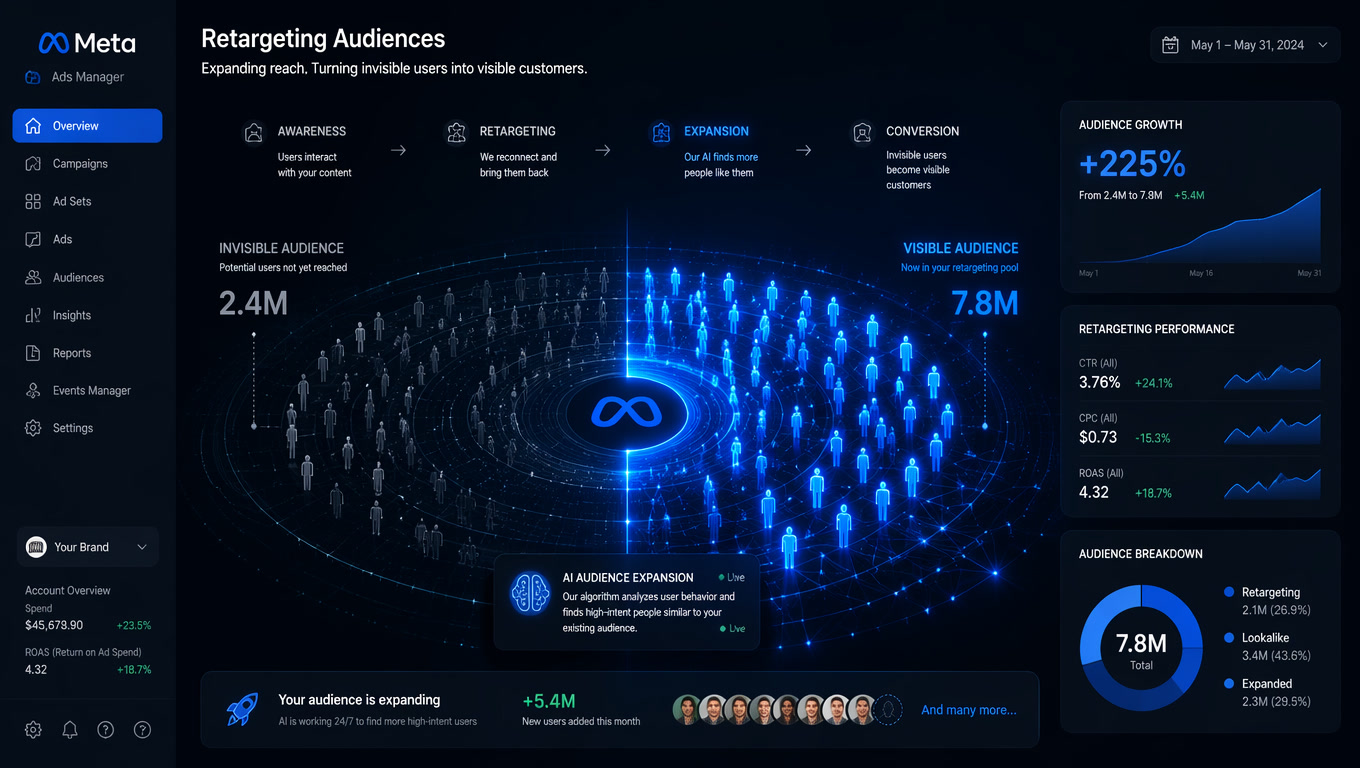
Meta removed the "Your activity off Meta Technologies" setting in July 2026 — the privacy control that let users disconnect their off-platform data (purchases, browsing, app events) from their Meta profile. Users who had opted out are now visible again. Your audiences changed without you touching a single setting.
What actually happened
On June 9, Meta quietly announced it was retiring the privacy control that let users sever the link between their off-platform activity and their Meta profile. The change began rolling out in July in the US and select countries, with more regions to follow.
Per Common Thread Collective, the mechanical effect is straightforward: people who previously opted out are now visible to your retargeting campaigns built on Pixel and Conversions API data.
The immediate downstream effects:
- Your retargeting audiences grew automatically. Without you editing anything, website visitor and purchaser pools expanded to include users you were unknowingly excluding.
- Your lookalike seeds shifted. More identifiable customers means the seed audience feeding your lookalikes is more complete — and slightly different — than the one that trained last month's lookalikes.
- Your retargeting frequency moved. More people in the same budget = more reach potential, but also a different audience structure. If frequency crept up, it may simply be that the pool expanded. Not necessarily fatigue.
- Your reported ROAS may have dipped slightly. Same spend, larger (and theoretically colder) audience because newly visible users may have lower purchase intent right now. If you don't adjust the baseline, performance looks like it dropped.
Meta confirmed no new data is being collected. The same events you were already sending are now used across more surfaces: Feed recommendations, AI responses, and ads. But the practical effect for advertisers is that audience composition changed.
Why this is dangerous (and silent)
The dangerous thing about this change is that there's no button to press. It's not an update you accept or a feature you toggle. It just happened, and your dashboard looks exactly the same. Only the numbers are different.
At Mintec, we manage campaigns for clients across multiple verticals, and what we've seen this week is consistent: accounts reporting 10-15% frequency increases on retargeting campaigns, and ROAS dropping 2-5 percentage points. In every case, the instinctive reaction is "let's swap the creative" or "let's cut budget."
And in every case, that's the wrong move.
The real risk is making operational decisions based on a definitional shift disguised as a performance change. It's like stepping on a scale that got recalibrated, seeing a higher number, and starting a diet you don't need. The scale moved — not you.
What NOT to do
Don't cut retargeting budget based on July vs. June comparisons. The ROAS you're seeing is artificially lower because the denominator changed. Give campaigns 2-3 weeks to stabilize with the new audience composition before making budget calls.
Don't swap creative for imaginary fatigue. If frequency went up but CTR and conversion rates within the audience held steady, the issue isn't creative. It's pool size.
Don't kill lookalikes that "aren't performing like before." The seeds changed. Lookalikes need to retrain with the new composition. Give it 1-2 weeks for the algorithm to adjust.
Don't assume it's your account. If you're seeing these patterns, you're probably not alone. The platform change is the likely culprit. Check with teammates or peers if they're seeing the same.
What TO do
1. Re-baseline your reports
Before you compare July against June, adjust the baseline. Annotate your reports: "Starting July 2026, retargeting audiences include previously invisible users due to Meta's off-Meta activity change." Create a new starting point for frequency and ROAS on retargeting, and don't compare against June without this caveat.
2. Segment the analysis
Don't look at the whole account. Isolate retargeting campaigns and compare them within July (first week vs. third week). The trend within the month matters more than the comparison against June. If ROAS is recovering week over week, that's a positive signal.
3. Monitor audience composition
Use the audience breakdown in Ads Manager to see which audiences grew the most. Website Custom Audiences (WCA) will likely show the biggest change. Engagement-based audiences (video views, lead form completions) may be unaffected. This insight helps you decide where to focus attention.
4. Retrain critical lookalikes
For campaigns where lookalikes are strategic (prospecting with purchase LALs), consider creating fresh lookalikes from scratch with the updated seeds. The seed is now more complete and may generate higher-quality audiences. Your existing LAL might be underperforming simply because the seed changed without the algorithm knowing.
5. Check your exclusions
If you use audience exclusions (e.g., "exclude purchasers from last 30 days"), verify they're still working correctly with the new visibility. An exclusion that worked at 100% before may now be missing users who were previously invisible. Review your exclusion audience sizes.
6. Document the change for your team or client
This is an invisible change. Your client doesn't know it happened. Your boss doesn't know. If you don't document it, someone will read July's report and conclude "campaigns are worse." Put a note at the top of your report. Explain that a platform-level change affects data comparability. It will save you awkward conversations.
The upside: richer lookalike seeds
Not everything is negative. The fact that lookalike seeds are now more complete is a genuine opportunity. If you were losing customers who had opted out, those customers are now back in the pool. Your lookalikes can be more precise because the training seed is more representative of your actual customer base.
In the accounts we manage, we're taking advantage of this by creating fresh 1% lookalikes from scratch with the updated seeds and A/B testing them against existing lookalikes. In several cases, the new LALs are outperforming. Your mileage may vary, but it's worth testing.
What else changed in July
The off-Meta opt-out wasn't July's only change. Meta also shipped:
- EU location fees (July 1): 2-5% fees on impressions in the UK, France, Italy, Spain, Austria, and Türkiye, hitting your invoice but never showing in Ads Manager. If your ROAS dipped on campaigns with European delivery, it might be the fee — not performance.
- Legacy metric deprecation (June 15): Meta migrated from traditional reach/impressions to "Media Views" / "Media Viewers." Numbers after June 15 are not comparable to before.
- Muse Image in Advantage+ (July 7): Meta's new image model started powering Advantage+ creative variations.
- Push Delivery to This Ad (July 10): A new manual override to steer delivery toward one specific ad within an ad set, without duplicating.
All these changes landed within weeks of each other. If your July dashboard looks strange, it's not paranoia. It's platform whiplash.
Conclusion
The off-Meta activity change is the quietest — and potentially the most impactful — of July's updates because it alters the denominator of your retargeting metrics without any visible notification in Ads Manager. It's not a change you can undo, but it's one you can adjust for.
The key is separating reporting noise from real performance signal. Adjust your reports, document the change, and give your campaigns time to stabilize. This can be a transition month — not a crisis.
And if someone on your team says "retargeting campaigns are worse this month," ask them if they adjusted for the off-Meta change. Their answer will tell you whether you have a performance problem, or just a reporting one.
— Mintec, Digital Agency
Frequently Asked Questions
What changed with Meta's off-Meta activity setting in July 2026?
Meta removed the 'Your activity off Meta Technologies' setting that let users disconnect their off-platform activity from their Meta profile. Users who previously opted out are now visible again for retargeting campaigns, without any action from the advertiser.
How does this affect my retargeting ROAS?
Your retargeting pool grew because previously invisible users are now visible. This can increase frequency and slightly lower reported ROAS — not because real performance dropped, but because the denominator (audience composition) changed. It's a reporting artifact, not a creative fatigue signal.
Should I change my retargeting strategy because of this change?
Not immediately. First re-baseline your metrics so your month-over-month comparison is fair. Don't cut budget or swap creatives based on July data compared to June without adjusting for this change. Real performance trends only show after you correct for the denominator shift.