

Meta and GA4 Disagree on Purpose: How to Read the Gap and Which Number Wins
Meta and GA4 will never report the same conversions: Meta counts link clicks, 1-day views and 1-day social interactions inside a 7-day window and models what it cannot watch, while GA4 only counts sessions its tag actually observed. Expect a 10-30% gap in Meta's favor on a healthy account; when Meta reports more than twice GA4 — or more orders than your store actually processed — that is a tracking fault, not performance. The fix is not forcing the numbers to match; it is giving each one a job.
Meta and GA4 Disagree on Purpose: How to Read the Gap and Which Number Wins
Meta and GA4 are never going to report the same conversion count, and the gap between them is not a bug you fix — it is the predictable result of two systems answering two different questions. Meta answers "how many conversions can I credit to an ad someone clicked, saw, or interacted with inside my attribution windows?" GA4 answers "which channel got last non-direct credit for the session that converted?" On a healthy account, Meta lands 10-30% above GA4's paid-social number. When Meta reports more than twice GA4 — or more conversions than your store actually has orders — you no longer have an attribution difference, you have a tracking fault. This is how we read that gap with client accounts: what each system counts, which gap sizes are normal, and which number is allowed to govern which decision.
Two dashboards, two definitions of a conversion
Neither platform is lying. They are measuring from different vantage points, and the differences are structural:
| Meta Ads Manager | GA4 | |
|---|---|---|
| What gets counted | Conversions credited to an ad interaction inside attribution windows: 7-day click, 1-day engage-through, 1-day view-through | Key events the GA4 tag actually observed, credited to the session's source or the property's reporting attribution model |
| View-through | Yes — 1 day | No mechanism to see an ad impression at all |
| Unobservable users | Modeled from aggregate patterns after iOS 14.5 opt-outs | Lost when consent is denied, a content blocker runs, or the tag never fires |
| Identity | Logged-in user graph across devices, pixel plus Conversions API | Browser or app session |
| When a conversion is stamped | When Meta's event fires, often server-side | When the session fires in the browser |
| Best at | In-account optimization: creative rotation, bid and budget moves | On-site behavior: funnel drop-off, landing page performance, channel sanity checks |
A buyer who clicks your Meta ad Monday, comes back through a Google search Thursday, and purchases gives Meta a click-window conversion and gives GA4 an organic session. Both assignments are correct inside their own logic, and they will never reconcile to the same total.
There is a second confusion layer: GA4 itself gives two different answers. Acquisition reports credit the last non-direct session source, while event-scoped reports follow the property's reporting attribution model (data-driven by default), which splits credit across observed touchpoints. When two GA4 reports disagree with each other, the instinct is to blame Meta — wrong target.
Your pre-2026 baseline is stale
Meta rewired attribution twice this year, and both changes moved the gap:
- January 12, 2026 — Meta removed the 7-day and 28-day view-through windows entirely. Reported conversions dropped 15-40% overnight for most advertisers, with actual sales unchanged. We wrote the rebuild protocol for that change in Meta Killed Attribution Windows.
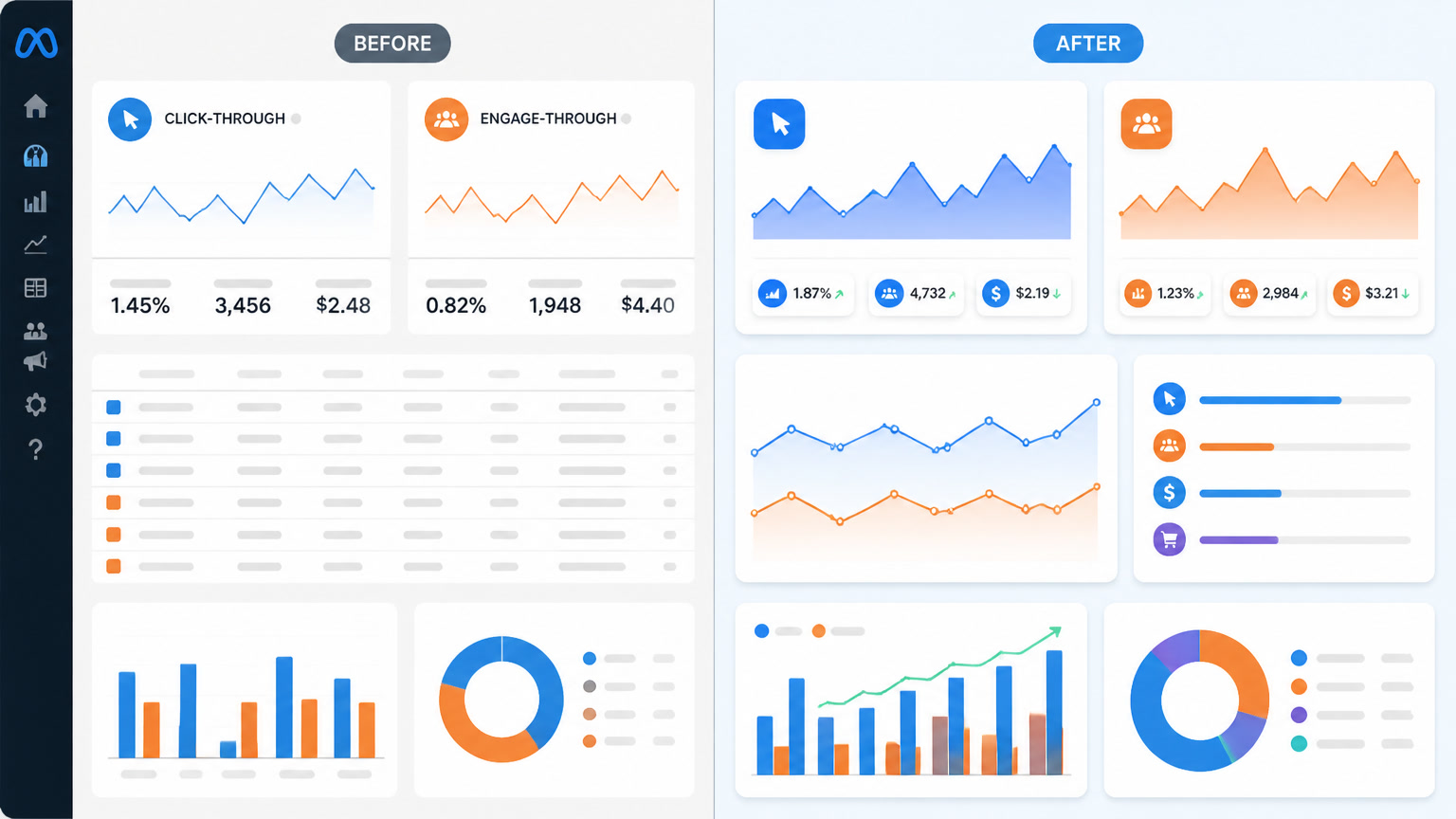
- March 3, 2026 — Meta redefined click-through: only link clicks count now. Likes, saves, shares and profile taps moved to a new engage-through bucket with a 1-day window. Across client accounts we watched click-through columns fall 18-25% while CRM revenue stayed flat — the mechanics are in Click-Through vs Engage-Through.
Two consequences. First, the March change actually pulled Meta's click definition closer to how GA4 counts paid-social sessions, so a gap that widened for years should have narrowed — if your gap grew anyway, that is signal, not noise. Second, anyone still comparing 2026 numbers against a 2025 baseline is measuring Meta's policy change, not their performance. Rebuild your baseline from mid-March 2026 forward.
The gap bands: normal, suspicious, broken
Normal — Meta 10-30% above GA4. Independent audits put the healthy band at 10-30% (Conner Crowe, June 2026), with 20-40% a commonly repeated practitioner heuristic that depends on your iOS share and how much view-through you run. Inside the band, Meta is doing its job: counting 1-day views GA4 cannot see, recovering cross-device paths, and modeling the conversions tracking restrictions took away — modeled conversions alone can run 10-40% optimistic against an actual order log on iOS-heavy accounts.
Suspicious — the gap changes shape. Three patterns that mean investigate before you touch a bid:
- Meta's total exceeds your order count for the same period. This is double firing, not strong performance: a pixel and a Conversions API both sending purchases without a shared
event_id, or a reloadable thank-you page. We have audited accounts reporting 130 conversions against 100 real orders. - GA4's paid-social number collapses after a theme update, app install, or consent-banner change. The tracking broke; the channel did not.
- The gap widens week over week with no change in channel mix or iOS share. Usually Conversions API match quality drifting — when Event Match Quality slips below 7.0, Meta starts modeling blind, and we found sub-6.0 scores to be the number-one hidden cause of unstable campaigns across 15+ account audits (full EMQ breakdown).
Broken — over 2x, or unexplained clicks-to-sessions loss. If Meta reports triple GA4's paid-social figure, stop reading dashboards and audit the tracking chain. If link clicks and GA4 sessions diverge wildly for one placement, OS, or country, split the traffic by placement and run the bot-vs-bad-targeting checks (four-check diagnostic).
How we actually run the comparison
1. Compare like with like. Same date range, same timezone, same conversion event. Meta's attributed purchases versus GA4 key events on session source/medium = paid social — not Meta's entire "results" column against GA4's total conversions. Add the engage-through column to your Ads Manager view so you know what is inside Meta's number instead of guessing.
2. Judge the trend, not the level. We run the ratio weekly: Meta conversions divided by the same-period order count. In band and stable — roughly ±10% for three consecutive weeks — and we trust platform trends for tactical calls. The full Meta-side health protocol, including our 0.9x-1.4x order-ratio band, lives in the attribution windows piece; this article is about reading the GA4 side of the same ritual correctly.
3. Diagnose out-of-band weeks before adjusting anything. Run the three failure shapes above in order: dedup, consent/tag, match quality. Decisions made during an out-of-band week are almost always wrong — several clients tried to "recover volume" by doubling budgets when only the metric had moved.
4. Assign jobs instead of hunting one true number.
Which number governs which decision
| Decision | The number that governs | Why |
|---|---|---|
| Scale, cut, or rotate inside the account | Meta's own trend, while the ratio is stable | The algorithm trains on its own signal; overruling it with an unrelated metric breaks the feedback loop |
| Revenue, orders, AOV — anything touching the P&L | Order system or CRM | The only source with no attribution opinion |
| Landing page, funnel drop-off, on-site behavior | GA4 | It sees everything that happens after the click |
| Cross-channel efficiency (Meta vs Google vs TikTok) | Blended efficiency: total revenue ÷ total spend | Attribution-model agnostic; comparable week over week |
| Client and executive reporting | Platform-reported labeled as such, with the source-of-truth column beside it | Merging everything into one "true" number is what restarts the argument every week |
The opinion part: stop trying to reconcile to a single number. Every reporting meeting we have inherited starts with "Meta says X, GA4 says Y, who is lying?" — and nobody is lying. GA4 is a poor arbiter of channel credit and an excellent one for what happens after the click; platform dashboards are optimization signals, not financial statements. Teams that assign each number a job spend their meetings on decisions instead of arithmetic. The same pattern repeats across the stack — TikTok's dashboard can overstate ROAS by 30-60% before you apply a layered measurement stack, and B2B platforms undervalue themselves with contact-level metrics. There is no platform whose dashboard is the truth.
What to do this week
- Pull last month's Meta-attributed purchases against your actual order count. Ratio inside 0.9x-1.4x? Your gap is definitional — document the band and stop re-litigating it.
- Ratio above 1.4x? Check
event_iddeduplication between pixel and Conversions API before anything else. - GA4 paid social collapsed? Start from the date of your last theme, tag, or consent change.
- Relabel one slide: "platform-reported" next to the order-system number, side by side, never averaged.
If the numbers still fight each other after that, the problem is in the tracking chain, not the dashboard — and it is cheaper to fix before the next budget scale. Talk to our paid media team and we will run the reconciliation audit with you.
Frequently Asked Questions
What is a normal difference between Meta and GA4 conversion numbers?
On a healthy account, Meta reports 10-30% more conversions than GA4 attributes to paid social, and a 20-40% gap is a commonly cited practitioner range. Inside that band the two platforms are behaving as designed. If Meta reports more than twice GA4's number — or more conversions than your store actually recorded orders — the gap has stopped being attribution and started being a tracking fault.
Why does Meta always show more conversions than GA4?
Because Meta counts things GA4 structurally cannot see: 1-day view-through conversions from people who never clicked, conversions from saves and shares inside a 1-day engage-through window, and modeled conversions for users whose activity could not be observed after iOS privacy changes. GA4 only records sessions its tag fired on, so those same buyers get credited to the last non-direct channel instead — usually organic search or direct.
Which number should leadership see: Meta or GA4?
Neither alone. Revenue and order counts should come from the order system or CRM, which has no attribution opinion. Meta's numbers are for decisions inside the account — which creative to scale, which ad set to cut. GA4 is for on-site behavior — where the funnel leaks after the click. A blended figure such as total revenue divided by total spend is the only cross-channel number that stays comparable over time.