

MCP Is Changing How AI Search Cites Your Content — And Most Publishers Haven't Noticed
The Model Context Protocol lets AI agents query your data directly instead of scraping your pages. That changes everything about how content gets cited in AI search — and most publishers haven't started thinking about it.
MCP Is Changing How AI Search Cites Your Content — And Most Publishers Haven't Noticed
Here is something that keeps bothering me. Every week, I read another "how to get cited by AI search" guide. FAQ schema. Structured data. Answer-first formatting. Author E-E-A-T. Good advice, all of it — and it misses the biggest structural change in how AI agents consume content since the chatbot itself.
The Model Context Protocol — MCP, the open standard Anthropic released in late 2024 — gives AI agents a direct line to your data that bypasses your web pages entirely. And both Google and OpenAI have formally adopted it.
I think this is the most consequential infrastructure shift for publishers since the PageRank algorithm. Not because it is happening overnight — it is not — but because it rewrites the fundamental relationship between content producers and the AI systems that cite them.
The Old Pipeline: AI Reads Your Page
Right now, when an AI search engine wants to cite your content, the pipeline looks roughly like this:
- A crawler (GPTBot, Googlebot, ClaudeBot) visits your page and downloads the HTML.
- The AI extracts text from the rendered page, removing markup.
- It identifies relevant passages using semantic similarity to the user's query.
- It rewrites or quotes those passages in its response, with a citation link back to your URL.
This pipeline has a fundamental limitation: the AI is reading your content the same way a human would — through the visual presentation layer. If your data is buried in a paragraph instead of a table, the AI might miss it. If your page structure is complex, the extraction might grab the wrong passage. If your page changes, the AI won't know until its next crawl cycle.
Every GEO optimization you have read about is a workaround for this limitation. FAQ schema helps because it labels question-answer pairs explicitly. Structured data helps because it provides a machine-readable alternative to HTML. Answer-first formatting helps because it puts the key information at the top, before the extraction window closes.
These are all patches on a fundamentally indirect pipeline.
The MCP Pipeline: AI Queries Your Data Directly
MCP changes the pipeline to something closer to this:
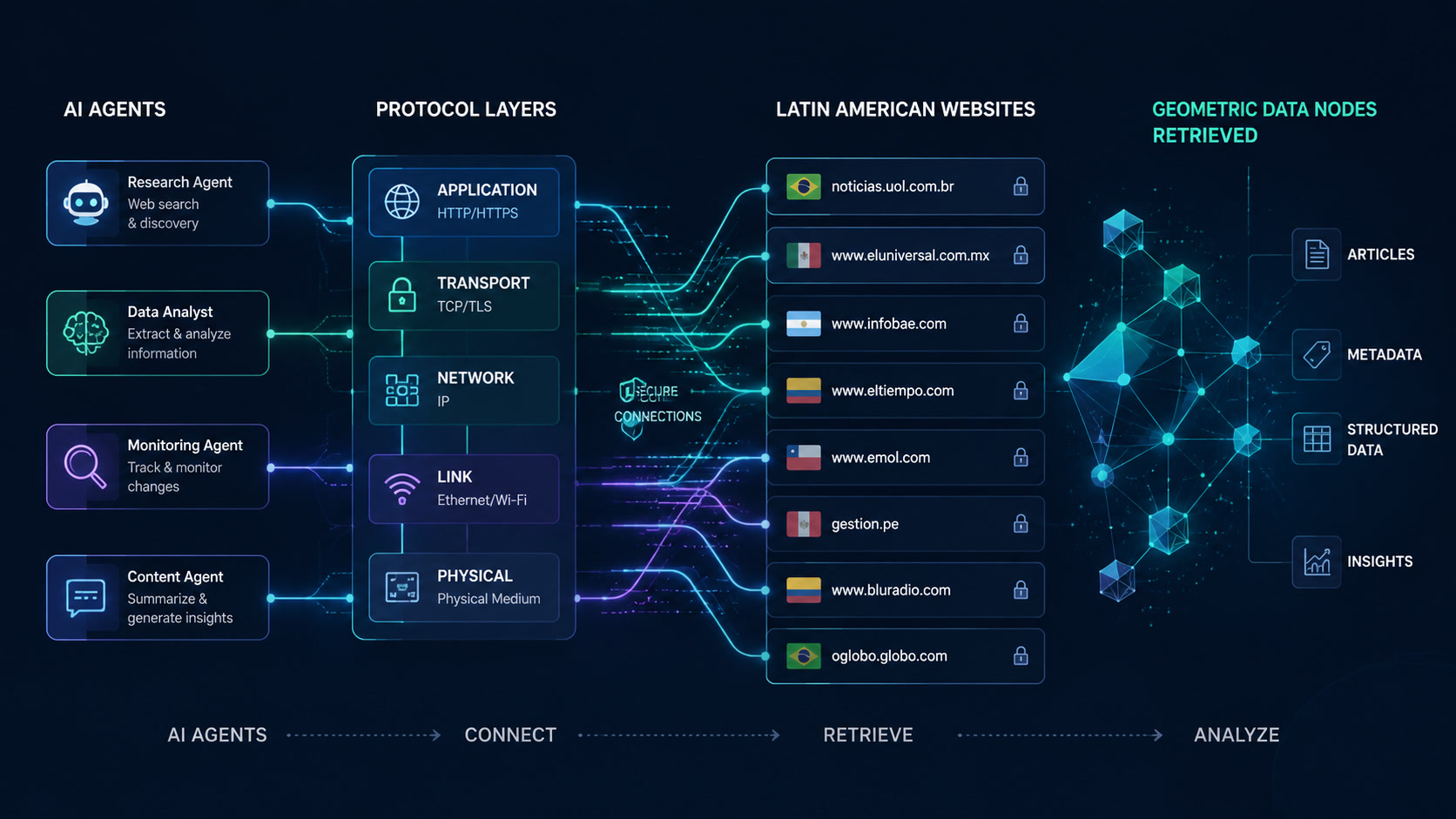
- You run an MCP server — a lightweight API endpoint that exposes your content as structured, queryable data.
- An AI agent (Claude, Gemini, ChatGPT) connects to your MCP server through the standard protocol.
- The agent queries your data directly: "What are the specifications of product X?" or "What is the current pricing for service Y?"
- Your MCP server returns the exact, current answer as structured data.
- The agent cites the answer, with a link back to your site.
No HTML parsing. No passage extraction. No crawl delay. The AI gets the answer directly from your data source, in the format it needs, in real time.
This is not theoretical. Google adopted MCP in April 2025. OpenAI adopted it weeks earlier. As of July 2026, Gemini, ChatGPT, and Claude all support MCP connections. The AAIF (AI Agent Interoperability Forum) held the first MCP Dev Summit in New York in April 2026, drawing 1,200 attendees.
The infrastructure is being built. The question for publishers is whether they will be on it.
WebMCP: The Browser-Level Layer
What makes this even more concrete is WebMCP — the browser-level standard Google and Microsoft co-developed through the W3C Web Machine Learning Working Group, announced at Google I/O 2026.
WebMCP lets websites expose structured "Tool Contracts" to AI agents through a browser API — navigator.modelContext. It launched in Chrome 146 Canary in February 2026. The idea is that any website can declare: "here is the structured data an AI agent can query from me" through a standardized browser interface.
The complete 2026 agent stack uses three protocols:
- MCP for internal tools and data sources
- WebMCP for browser-accessible website interactions
- A2A (Agent-to-Agent) for multi-agent orchestration
For publishers, WebMCP is the most relevant layer because it does not require running your own MCP server. It works through the browser, using structured data you already have on your pages — if it is properly organized.
What This Actually Changes for Content Strategy
The easy reaction is to call MCP "structured data, but for agents" and move on. That misses what is different. Let me walk through the three concrete changes.
1. From indirect to direct citation
Right now, your content is a candidate for AI citation. The AI reads your page, decides what is relevant, and might cite it. You influence this decision through optimization, but you do not control it.
With MCP, your content becomes a response to a direct query. The AI asks a specific question, and your server returns a specific answer. The relationship shifts from "the AI reads my page and might use some of it" to "the AI queries my data and gets an exact result."
This is better for accuracy, worse for serendipity. If you have the data the AI needs, you get cited with near-certainty. If you do not have it structured and available, the AI moves to the next server.
2. From best-effort freshness to real-time currency
Your page gets crawled when the crawler visits. Weekly, maybe monthly. In between, the AI is working with stale data.
MCP queries are real-time. The AI asks, your server answers with the current state. If you update your pricing at 10 AM, the AI query at 10:01 AM gets the new price. There is no crawl lag.
For content that changes frequently — pricing, availability, specifications, comparisons — this is transformative. It also means stale content becomes instantly visible. If your MCP server returns data you have not updated in six months, the AI sees that too.
3. From page-level to entity-level citation
Right now, AI citations point to a page. The user has to find the relevant information on that page themselves.
MCP enables entity-level citation. The AI can cite a specific product, a specific specification, a specific data point — and link back to the exact page on your site where that entity lives. The citation is more useful to the user and more attributable to the publisher.
What This Is Not
I keep seeing MCP compared to robots.txt, llms.txt, or sitemaps. Those comparisons are misleading.
Robots.txt tells crawlers what to avoid. MCP tells agents what to query directly. One is exclusion, the other is invitation.
llms.txt provides a plain-text summary for LLM training context. MCP provides a structured, queryable API for live agent interactions. One is a static file, the other is a dynamic protocol.
Sitemaps list pages for discovery. MCP exposes data entities for retrieval. One points to URLs, the other to structured answers.
MCP is not a replacement for any of these. It is a new layer that sits alongside them — and for certain types of content, it will be the primary way AI agents interact with your site.
Where This Leaves Publishers
If I sound certain about the direction, I am less certain about the timeline. MCP adoption for web content is early. Most AI agents still default to the old pipeline (scrape → extract → cite). The MCP pipeline requires publishers to set up servers or adopt WebMCP, which most have not done.
Here is what I think is realistic:
For the next 6-12 months: MCP matters most for data-heavy publishers — e-commerce sites with product catalogs, SaaS companies with pricing pages, comparison sites, directories, and any site whose value is in structured, queryable information. If that describes your site, start experimenting with structured data that maps to query patterns AI agents use.
For the 12-24 month horizon: As more AI agents default to MCP queries for certain types of information, sites without MCP access will lose citations to sites that have it. The question becomes: when an AI agent needs current pricing for a service, will it cite the page it crawled last week, or the MCP server that returns real-time data? The server wins every time.
For the 24+ month horizon: WebMCP or something like it becomes standard browser infrastructure. Websites expose Tool Contracts as part of their normal technical setup. MCP citation becomes one of the standard surfaces in GEO audits, alongside AI Overviews, AI Mode, and Information Agents.
Two Things to Do Right Now
I am not going to give you a ten-step checklist. Most of the steps would start with "wait" anyway. But two things are worth doing today:
1. Audit your content for MCP-queryable patterns. Look at your highest-traffic pages. Ask: if an AI agent could query this data directly, what would it ask? "What are the specs of product X?" "What is the current price of service Y?" "How does this compare to competitor Z?" If the answers to those questions are buried in prose instead of structured data, you are leaving MCP citations on the table.
2. Structure your entity data now, even if you are not running an MCP server yet. The sites that will benefit from MCP citation are the ones that already have clean, structured, machine-readable data about their products, services, and content. That means product schema, FAQ schema, how-to schema, comparison tables — not just for SEO, but as the foundation for an MCP server you may deploy later.
The reward for acting early on infrastructure shifts is usually modest until the shift goes mainstream. Then the gap between prepared and unprepared opens fast. I think MCP is that kind of shift — the kind where being six months early looks silly until being six months late looks disastrous.
Sources:
- Anthropic, "Introducing the Model Context Protocol" (Nov 2024)
- TechCrunch, "Google to embrace Anthropic's standard for connecting AI models to data" (Apr 2025)
- ZDNet, "Google joins OpenAI in adopting Anthropic's protocol for connecting AI agents" (Apr 2025)
- Byteiota, "WebMCP: Google's I/O 2026 Standard for Agent-Ready Websites" (May 2026)
- NiteAgent, "WebMCP: Google's New Web Agent Protocol Changes How AI Interacts with Websites" (May 2026)
- Discovered Labs, "WebMCP Adoption Timeline: When Will AI Agents Start Using Your Website Data" (Feb 2026)
- AAIF, "MCP Dev Summit North America" (Apr 2026)
- Mintec, "Information Agents: The Third AI Search Surface Nobody Is Optimizing For" (Jul 2026)
Frequently Asked Questions
What is the Model Context Protocol (MCP)?
MCP is an open-source standard created by Anthropic (late 2024) that lets AI models connect to external data sources and tools through a standardized interface. Think of it as a universal API for AI agents — instead of each AI needing custom integrations, MCP provides one protocol that works across Claude, ChatGPT, Gemini, and other major models.
How does MCP affect AI search citations?
Traditionally, AI search engines like ChatGPT and Gemini cite content by indexing web pages, extracting relevant passages, and attributing them. MCP introduces a new path: AI agents can bypass page scraping entirely and query structured data directly through MCP servers. This means content that exposes structured data via MCP gets cited differently — and potentially more accurately — than content that only exists as HTML pages.
Should I set up an MCP server for my website?
Not yet for most publishers. MCP adoption for web content is still early. But you should start planning for it by structuring your content data (product info, pricing, comparisons, specifications) in machine-readable formats that an MCP server could serve. The sites that have structured data ready when MCP citation becomes mainstream will have a first-mover advantage.