

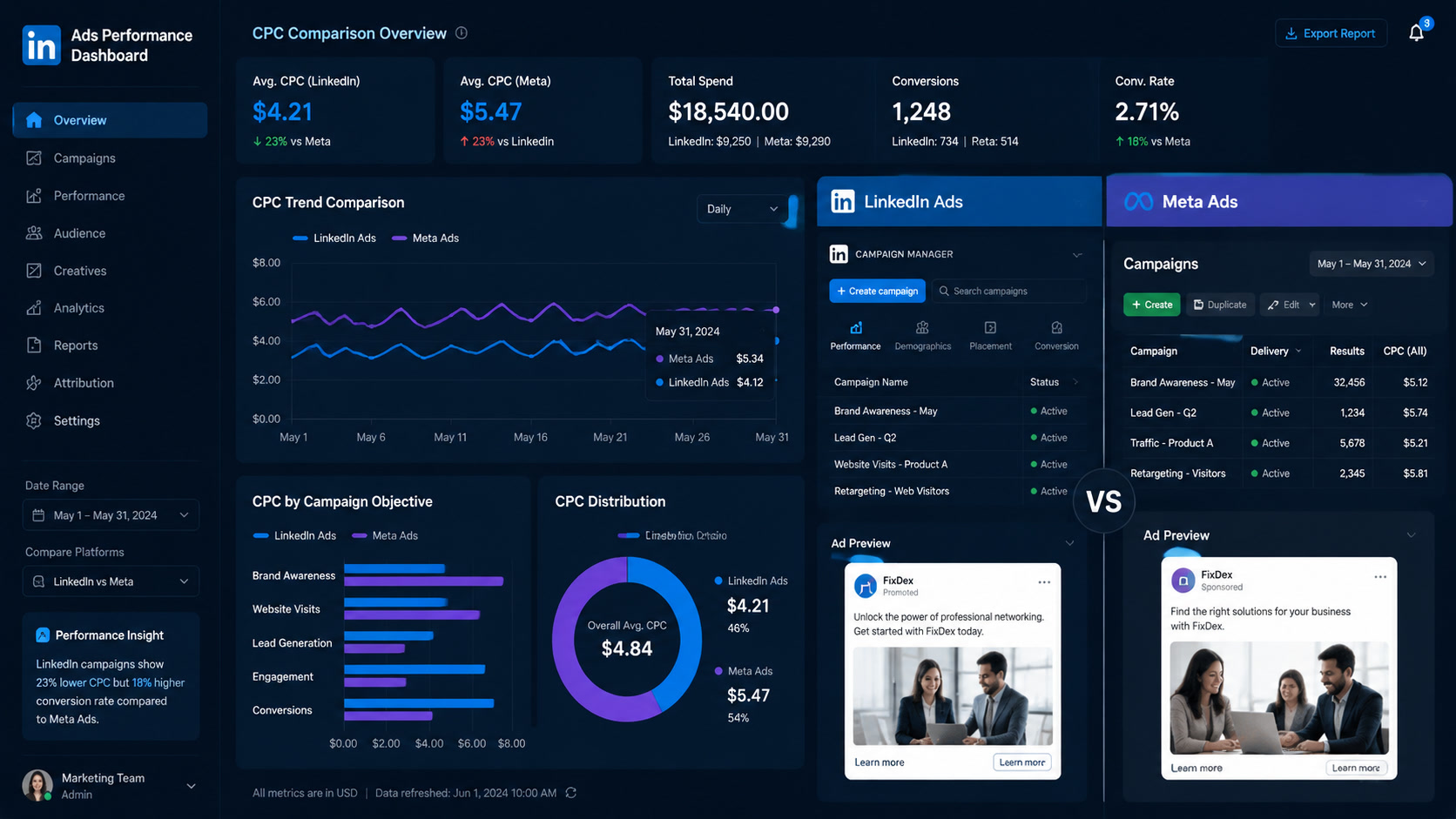
LinkedIn Ads Are 3x More Expensive — Here's When the Premium Actually Pays Off
LinkedIn Ads cost 3-5x more than Meta, but for specific B2B goals the lead quality gap more than justifies it. We manage campaigns across both platforms — here's the decision framework we use to allocate budget.
LinkedIn Ads Are 3x More Expensive — Here's When the Premium Actually Pays Off
A LinkedIn click costs three to five times what a Meta click costs. And sometimes LinkedIn is still the cheaper channel. The difference is what you're actually buying: reach versus relevance.
We manage paid media campaigns across Meta, TikTok, and LinkedIn at Mintec. The question we hear most —almost weekly— is whether LinkedIn Ads are worth the premium when Meta and TikTok offer such competitive CPMs. The short answer: it depends on your deal size, audience specificity, and funnel stage.
This article won't just list LinkedIn benchmarks — though those are included. What follows is the decision framework we use internally to split budget between LinkedIn and other platforms, backed by real campaign data and 2026 market trends.
What LinkedIn Ads actually cost in 2026
LinkedIn is projected to hit $9.7 billion in ad revenue in 2026 — significant growth driven by more advertisers chasing the same B2B inventory. This has pushed costs upward, especially in competitive verticals like technology, consulting, and financial services.
Based on data from Benly.ai and Datavinity, here are the 2026 cost ranges we're seeing across our managed accounts:
| Metric | Average Range | LinkedIn vs Meta |
|---|---|---|
| CPM | $5–$8 (broad) / $15–$25+ (narrow) | 1.5–3x more |
| CPC | $3–$8 | 3–5x more |
| CPL (lead) | $50–$150+ | 2–4x more |
| Avg CTR | 0.40%–0.65% | Similar or lower |
| Lead conversion rate | 2–5% | Comparable |
Sources: Benly.ai (2026), Datavinity (2026), Mintec internal campaign data.
But raw CPL doesn't tell the full story. LinkedIn's higher cost per lead is typically offset by lead quality — if your targeting is dialed in.
In a campaign we managed for a fintech consultancy, LinkedIn CPL was $85 versus $32 on Meta. However, the lead-to-qualified-opportunity conversion rate was 18% on LinkedIn versus 4% on Meta. That made the real cost per opportunity $472 on LinkedIn and $800 on Meta. LinkedIn was more expensive per lead but cheaper per qualified outcome.
The decision framework: when the premium pays off
Here's the framework we use internally to decide whether LinkedIn deserves a share of the budget:
✅ LinkedIn wins when:
1. Deal size exceeds $5,000 ACV. Our rule of thumb: if customer lifetime value is under $5,000, LinkedIn's CPL is hard to justify. Above $5k, the premium pays for itself if the qualification rate is 3x higher — which it usually is for high-intent LinkedIn audiences.
2. You need a highly specific job title. "CFO at fintech companies in Mexico with 50–200 employees" — that audience simply doesn't exist on Meta. LinkedIn is the only platform where you can combine job function, seniority, industry, company size, and geography in a single audience.
3. You're in the prospecting stage. LinkedIn excels at reaching cold audiences who don't know your brand. For retargeting warm audiences, Meta is typically more efficient — as we cover in our Meta + TikTok funnel strategy article, which applies the same logic to LinkedIn.
4. Your buyer journey requires multiple touchpoints. LinkedIn supports ad sequences across formats — sponsored content, InMail, video — that keep your brand present during long B2B sales cycles (60–180 days is common).
❌ Meta or TikTok win when:
1. Your product has a low price point or is self-serve. SaaS at $500/month ACV, online courses, low-ticket consulting — Meta's CPC makes these economics work where LinkedIn's $80+ CPL would break the model.
2. You need volume to feed a retargeting funnel. TikTok and Meta generate 5–10x more impressions for the same budget. If your strategy depends on building large warm audiences for retargeting, start on low-CPM platforms.
3. Anyone on the team can buy. Products any team member can purchase — productivity tools, team software — benefit more from Meta's broad reach than LinkedIn's job-title targeting.
This connects directly to our Smart+ vs Advantage+ comparison — choosing the right automation layer matters as much as choosing the right platform.
What changed on LinkedIn in 2026
Three shifts redefined LinkedIn advertising this year:
1. The algorithm now favors creators over companies. The 2026 algorithm update dramatically cut company page organic reach. This has a direct paid media effect: where brands once combined organic and paid for presence, paid is now essentially required for cold audiences. Winning brands are investing in Thought Leader Ads — ads published from real people's profiles instead of company pages — which typically see 30-40% higher engagement rates.
2. Interactive and video formats are expanding. LinkedIn has introduced interactive ad formats (polls, carousels with CTAs) and is prioritizing video in the feed. Our campaign data shows LinkedIn video ads generate 2.3x more engagement than static ads, though CPM tends to run 15–20% higher because video competes across more inventory.
3. Intent-based targeting is still catching up. Unlike Meta's Andromeda, which infers purchase intent from creative content, LinkedIn still relies on declarative data — job title, industry, skills. This means targeting quality depends more on how well you know your audience and less on platform intelligence. For a deeper look at how Meta handles this from the creative side, see our article on Meta Andromeda budget concentration .
The math that matters
The formula we use with every client is straightforward:
Cost per opportunity = CPL / Qualification rate
Where:
- CPL = total spend / leads generated
- Qualification rate = % of leads that become a sales-qualified opportunity
Whichever platform delivers the lowest cost per opportunity should get the most budget — regardless of which has the highest CPL.
For a B2B SaaS company with a $15,000 ACV deal, a cost per opportunity of up to $2,000 may be acceptable. For a $200 course, the same figure would be unsustainable. LinkedIn is neither cheap nor expensive in the abstract — it's cheap or expensive relative to the customer value it generates.
Bottom line
LinkedIn Ads in 2026 aren't for everyone. For B2B brands with high deal sizes, specific audiences, or long sales cycles, the premium pays for itself. For low-ticket, high-volume products, Meta or TikTok deliver better returns.
The right approach isn't choosing one platform — it's combining them with a clear framework. LinkedIn for qualified prospecting, Meta for scaling what works, TikTok for discovery. If you want to dig deeper into structuring this combination, our guide to Meta + TikTok funnel strategy covers the next logical step.
Related articles:
Frequently Asked Questions
How much do LinkedIn Ads cost in 2026?
LinkedIn CPM ranges from $5-$8 for broad targeting, but can exceed $20 for narrow audiences. Average CPC is $3-$8, and CPL (cost per lead) ranges from $50 to $150+ depending on industry. LinkedIn is 3-5x more expensive than Meta on a per-click basis, but qualified lead volume can justify the premium.
Should I use LinkedIn or Meta for B2B advertising in 2026?
It depends on deal size and funnel stage. For deals above $5k ACV with specific audiences (C-level, niche industries), LinkedIn offers targeting Meta can't match — job title, company size, industry, and seniority in one audience. For high-volume, low-ticket leads, Meta is usually more cost-effective. The best strategy uses both: LinkedIn for top-of-funnel prospecting and Meta for retargeting.
Have LinkedIn ad prices increased in 2026?
Yes. LinkedIn is projected to reach $9.7 billion in ad revenue in 2026, driven by more advertisers competing for B2B inventory. The 2026 algorithm update that prioritizes creator profiles over company pages has also reduced organic reach, increasing pressure on paid media to maintain visibility — and driving up CPMs in competitive verticals.