LinkedIn 2026: Likes No Longer Drive Reach — Here's What Actually Works for B2B
LinkedIn's 2026 algorithm prioritizes deep conversations over surface reactions. We ran a 10-week experiment across 5 B2B accounts to understand what gets distributed now. Results, comment thread seeding strategy, and what we stopped doing.
LinkedIn 2026: Likes No Longer Drive Reach — Here's What Actually Works for B2B
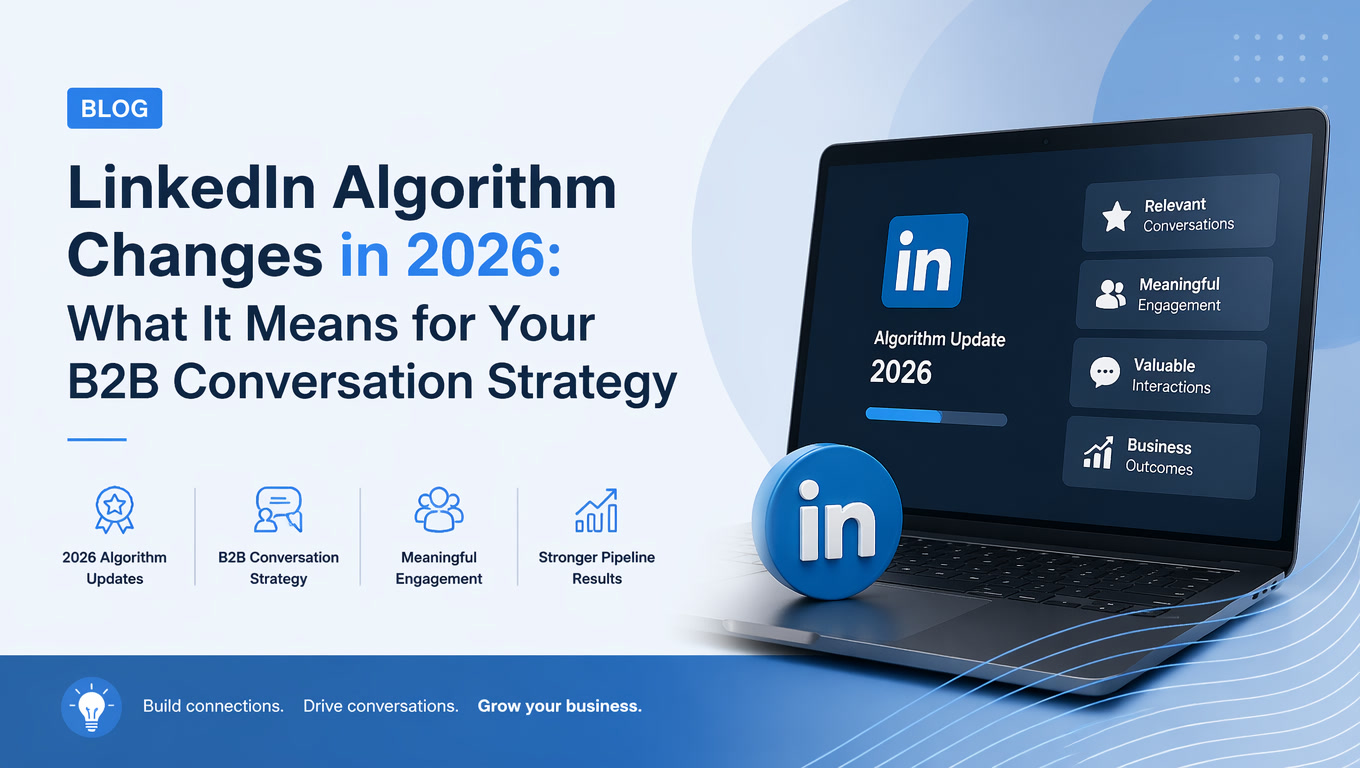
If your LinkedIn strategy still measures success by reaction counts, the 2026 algorithm is quietly penalizing you. The latest Richard van der Blom report — the most widely cited analysis of LinkedIn's algorithm — confirms what we'd been observing across our accounts since late 2025: surface-level reactions (likes, celebrate, support) have lost weight as distribution signals. What moves the needle now is deep conversation.
At Mintec, between February and April 2026, we designed a 10-week experiment across 5 B2B client accounts in edtech, SaaS consulting, logistics, HR tech, and financial services. We wanted to answer one concrete question: what content formats and engagement strategies actually generate organic reach on LinkedIn today? The results fundamentally changed our approach.
What the 2026 LinkedIn algorithm actually changed
LinkedIn never publishes official algorithm updates — changes are inferred from distribution patterns — but the consensus among researchers like Richard van der Blom and monitoring platforms like Ordinal and Dowsocial is clear. LinkedIn's 2026 algorithm introduced three fundamental shifts:
Conversations outweigh reactions. A comment thread with 20 replies is worth more for distribution than 100 likes with zero comments. The algorithm interprets conversation as a signal of valuable content that keeps users on the platform.
Read time is the new king metric. LinkedIn now measures how long users spend on your post before scrolling. Longer-form content that gets read in full outperforms short posts consumed in seconds.
Saves and DM shares outweigh public reshares. When someone saves your post or shares it via direct message, the algorithm interprets that as content valuable enough to keep or selectively share. This signal now exceeds public reshare weight.
| Signal | Weight in 2024 | Weight in 2026 |
|---|---|---|
| Reactions (likes) | High | Medium-low |
| Comments | High | Very high |
| Conversation threads (>5 replies) | Medium | Very high |
| Read time | Low | Very high |
| Saves | Medium | High |
| DM shares | Low | High |
The 10-week experiment: what we tested and what we found
We designed a controlled experiment across 5 B2B accounts, each posting 4 times per week for 10 weeks. We controlled for posting time, content length, visual format, and engagement strategy.
Format 1: Text-only posts with comment seeding
We posted 800-1,200 words with no image or carousel. Each post ended with an open-ended question designed to spark discussion. Within the first 30 minutes, our team responded to every comment with follow-up questions.
Result: This format produced the highest average organic reach: 3.4x more impressions than carousels and 5.2x more than static image posts. The key wasn't just the question — it was the systematic response to every comment. When the author engaged back, LinkedIn re-distributed the post.
Format 2: Informational carousels
5-7 slide carousels with data, frameworks, and actionable advice. The last slide included a CTA inviting comments.
Result: Carousels generated more reactions (2.1x more likes than text-only) but less reach (0.7x compared to text-only). The algorithm initially favored carousels, but reach plateaued after 24 hours. Text-only posts continued receiving impressions for up to 72 hours.
Format 3: Native LinkedIn video
2-4 minute vertical videos with the author speaking directly to camera. Minimal editing — just a straight take.
Result: Videos had the highest read time (LinkedIn counts playback time as engagement) but lower initial reach. However, when we paired video with an initial comment summarizing key points, reach improved 2.3x. The algorithm seems to reward video most when combined with text that generates conversation.
The technique that moved the needle most: Thread Seeding
The most important discovery from our experiment was what we call Thread Seeding. The technique is simple but requires discipline:
Post a thesis, not a summary. Instead of "5 benefits of content marketing," lead with "Content marketing is broken. Here are 3 reasons your current strategy won't work in 2026." A provocative thesis invites pushback and discussion.
Respond to every comment within 15 minutes with a question that deepens the thread. Don't use generic replies like "Thanks for your comment." Instead: "Did you see that pattern in your industry too? I suspect the X sector is feeling it more because..."
Don't let threads die. If a comment gets 3+ replies, keep engaging even 24 hours later. The algorithm detects continued activity and re-activates distribution of the original post.
Post at 8:30-9:30 AM and 6:00-7:00 PM (audience timezone). Our data shows two engagement peaks: start of workday and post-dinner. Publishing in these windows and responding actively for 2 hours maximizes the seeding effect.
In accounts where we applied this technique rigorously, average organic reach per post went from 2,800 to 8,400 impressions in 8 weeks. The most dramatic single-case improvement came from the SaaS consulting account: a 12-comment thread on a post about billing model changes led to 14,300 impressions — their highest organic reach in 18 months.
One counterintuitive pattern we observed: posts with controversial theses (e.g., "your CRM doesn't work" or "agile is dead for marketing") generated 2.7x more comments but also 1.8x more negative reactions. The algorithm didn't penalize the negative reactions — it rewarded the conversation volume. LinkedIn's 2026 algorithm doesn't distinguish between positive and negative engagement. It just wants engagement that keeps people on the platform.
It's not a hack — it's understanding how the algorithm works and working with it.
What we stopped doing (and you should too)
We stopped asking for likes. "Comment 'more info' if you want to learn more" was a 2024 strategy. In 2026, single-word comments don't generate enough deep conversation signal. Now we ask for opinions: "Have you faced this challenge in your company? Tell me how you solved it."
We stopped optimizing only the first hour. Previously, most of a post's reach was decided in the first 60 minutes. With the 2026 algorithm, distribution can reactivate up to 72 hours later — especially if the post keeps receiving comments. Now we monitor at 24, 48, and 72 hours.
We stopped posting daily. Quality over quantity. Accounts posting 5-7 times per week had lower per-post reach than those posting 3-4 times, because the algorithm distributed each individual post less. The optimal frequency in our experiment was 4 posts per week.
Why this matters for B2B in 2026
LinkedIn is where B2B decisions happen. 80% of B2B leads from social media come from LinkedIn (2026 data). If the algorithm now rewards deep conversations, brands that invest in generating real discussion — not accumulating reactions — will dominate the feed.
This is especially relevant for B2B startups and consultancies competing with larger firms. A startup with 500 followers that generates meaningful conversations can out-reach a company with 50,000 followers posting generic corporate content. The algorithm levels the playing field when you understand how to play.
The like is courtesy. The comment is currency. The conversation is capital.
If you're serious about building a LinkedIn presence that generates actual B2B leads, start with our guide on community-led growth for B2B — the same conversation-first philosophy applied to building entire communities around your brand. For a broader view on branded content strategies that work alongside algorithmic distribution, that guide covers the content formats that earn engagement across platforms. And if you need a systematic approach to scaling content production, our content production pipeline framework shows how to generate the volume needed for LinkedIn's 2026 distribution model.
Is your brand ready to stop counting likes and start generating conversations that sell? At Mintec, we design B2B LinkedIn content strategies that work with the algorithm, not against it. Let's talk.