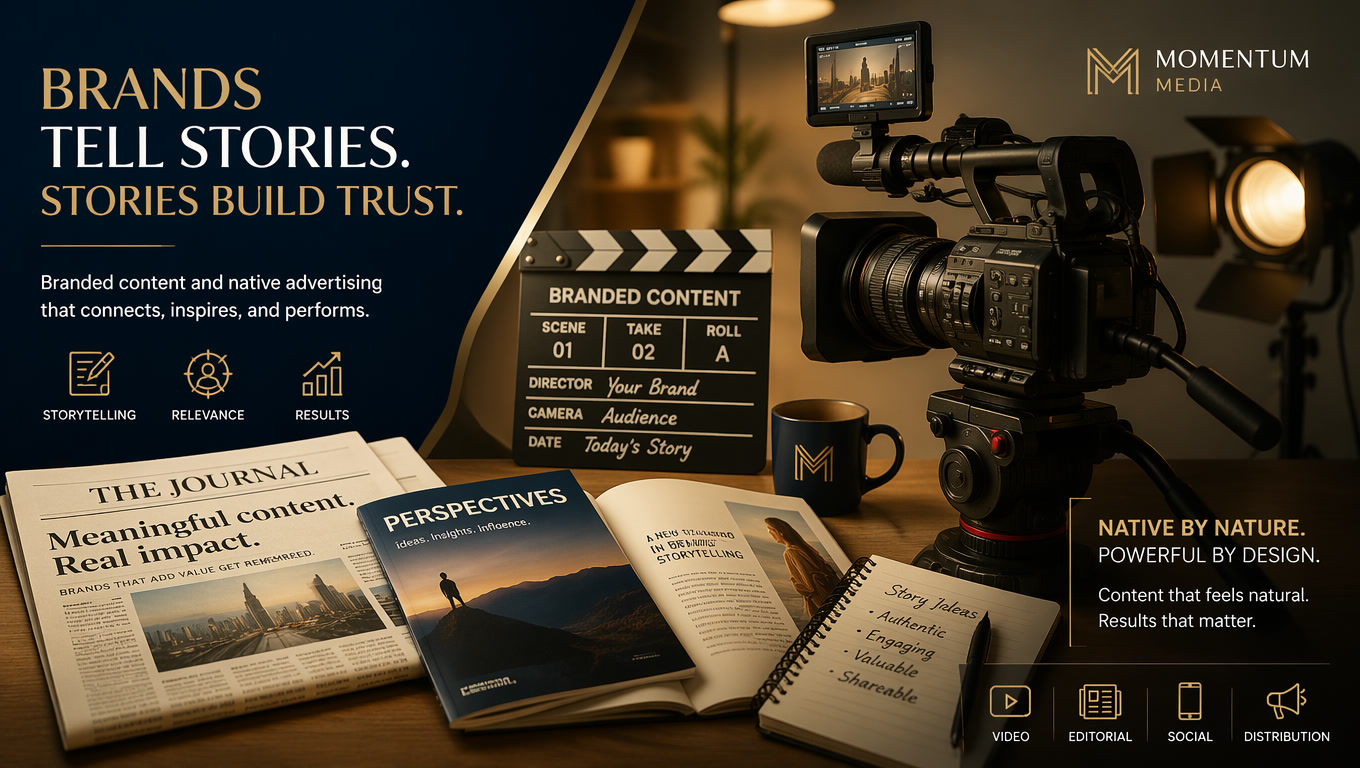
Branded Content: How Digital Agencies Win With Content That Doesn't Look Like Advertising
Branded content investment is growing at 17.6% annually. Global ad spend will surpass $1 trillion in 2026. But the brands winning aren't the ones spending the most — they are the ones who understand that non-advertising content drives more engagement, more trust, and better ROI. Strategy guide with current data.
Branded Content: How Digital Agencies Win With Content That Doesn't Look Like Advertising
If your entire content strategy is still writing blog posts and hoping someone reads them, you are falling behind. Branded content — content created by a brand that entertains, educates, or informs without pushing a product — is having its moment.
The 2026 numbers are hard to ignore. Branded content investment is growing at 17.6% annually, more than three times the rate of traditional display advertising, according to data compiled by AMRAandElma. The native advertising market — the primary vehicle for branded content — is growing at 21.7% CAGR, per Future Market Insights. And globally, Dentsu projects ad spend will surpass one trillion dollars for the first time in 2026.
But the interesting part is not how much is being spent. It is how it is being spent.
Why branded content is winning
The reason is straightforward: people stopped trusting traditional advertising years ago. Banners get ignored. Pre-rolls get skipped. Social media ads get scrolled past without a glance.
Branded content works because it does not look like an ad. A kitchen equipment brand producing a documentary series about emerging chefs is not selling blenders. It is building a mental association that, over time, means when you need a blender, you think of that brand.
A 2026 Sprout Social study — surveying 2,300 consumers and 1,200 marketers — found that episodic series are marketers' number one content priority this year. Ahead of AI-generated content. Ahead of short-form video. Ahead of newsletters.
People want stories. Brands that learn to tell them win.
The economic case for branded content
Let me break down why the economics work. Traditional display advertising has been in a race to the bottom for years. Click-through rates hover around 0.05% for banner ads. Cost per thousand impressions keeps climbing as inventory gets automated and programmatic margins compress.
Branded content flips the model. Instead of paying for attention you do not own (an impression on someone else's platform), you invest in an asset you own. A documentary series lives on your YouTube channel, your website, your social feeds. It accumulates views over time. It earns backlinks. It gets shared in contexts where display ads cannot reach.
The native advertising data backs this up. MarketingLTB's 2026 analysis shows that native ads paired with content landing pages drive significantly higher dwell time than standard display. Social native alone captures a large and growing share of native display spend. Brands allocate more budget to native when the goal is brand lift, storytelling, or engagement — not just last-click conversions.
There is also the view-through problem. A display ad that does not get clicked is invisible. But branded content that gets watched — even partially — registers in memory. The AMRAandElma study found branded content campaigns consistently outperform standard display on unprompted recall, purchase intent, and brand favorability. These are metrics that compound over time rather than decaying the moment the campaign ends.
The formats working in 2026
Branded content in 2026 is not a single format. It is an ecosystem of formats that combine.
Documentary series. The king format of branded content. A 4 to 6 episode series exploring a topic relevant to the brand's audience, barely mentioning the product. Red Bull, Patagonia, and LEGO have done this for years. Now B2B brands like Salesforce, HubSpot, and Snowflake are doing it too.
Interactive content. Calculators, configurators, quizzes, and tools that solve a real user problem. An accounting firm creating a tax calculator is not selling services — it is demonstrating that it understands the problem. And capturing qualified leads in the process.
Brand podcasts. Branded podcasts grew 40% in 2025-2026. A project management software company producing a podcast about productivity is not talking about its product. It is occupying space in its audience's ears for 30 minutes a week, building intimacy no banner can match.
Curated UGC. Not new, but in 2026 brands are perfecting the art of curating content created by their community. The authenticity of user-generated content is impossible to replicate with in-house production.
Long-form brand documentaries. An emerging format: 15-30 minute documentaries produced by brands, distributed on YouTube or as live events. Production quality matches independent professional work. The difference is the brand funds it and owns the association.
How agencies are capitalizing
For digital agencies, branded content represents an opportunity that did not exist five years ago.
Higher margins. Branded content is charged as content production, not media buying. Margins are higher, the projects are more interesting to produce, and clients perceive higher value.
Longer relationships. A display campaign runs for weeks. A branded content series can run for months, with multiple episodes, renewals, and expansions into other formats. That means longer contracts and less client churn.
Differentiation. Any agency can buy Google Ads. Few know how to produce content people actually want to consume. Agencies that master branded content have a clear competitive advantage.
Attribution maturity. One of the most common objections to branded content is that it is hard to measure. In 2026, that is changing. Native advertising platforms have increasingly sophisticated attribution models: view-through time, video completion rates, share of voice, brand lift studies. It is no longer "this builds awareness." You can measure full-funnel impact.
How to measure branded content (the right way)
Here is the part nobody wants to hear: branded content does not work with last-click attribution. If your client expects a documentary video to generate an immediate sale, you are setting the relationship up for failure.
The metrics that matter are different:
Watch time. Do people watch to the end? Do they stay past 30 seconds? Time spent is the currency of attention. More time with your content means more exposure to your brand.
Share of voice. How much of the conversation in your category is your content occupying? Not just on social media, but in mentions, backlinks, and organic references.
Brand lift. Surveys before and after the campaign measure whether brand perception changed. Do more people consider you? Would more people recommend you? This is especially important for B2B branded content campaigns.
Lead quality. Branded content attracts a different kind of lead: more informed, more engaged, closer to a purchase decision. Compare conversion rates of branded-content leads against other channels. The data usually speaks for itself.
Long-term CAC. Branded content is expensive to produce but cheap to distribute organically if it is good. CAC calculated over a 6 to 12 month horizon is usually lower than paid channels.
Common mistakes
Branded content is not a disguised ad. If your "brand content" mentions the product in the first minute, it is not branded content. It is an ad with better production values. The audience spots it instantly.
Not every brand should do branded content. If your client does not have the budget to do it well or the patience to wait for results, do not do it. Mediocre branded content damages the brand more than doing nothing.
Consistency beats peaks
A 6-episode weekly series generates more impact than a single 30-minute documentary. Frequency builds habit. Habit builds trust.
The distribution playbook
Here is the part that most agencies and brands get wrong. They spend 80% of their budget on production and 20% on distribution. That ratio should be inverted.
Branded content needs amplification. The best documentary in the world has zero impact if nobody sees it. In 2026, the distribution channels for branded content have matured into a reliable playbook.
Owned channels first. Your website, your email list, your social feeds. These are free and reach people who already know you. Launch your branded content series with a dedicated landing page, an email announcement to your list, and organic social posts. This baseline distribution costs nothing beyond the time to set it up.
Paid social amplification. Boost the best content to lookalike audiences. Facebook and LinkedIn both optimize for video watch time, which rewards longer content. A $500 test budget on a single episode tells you whether the format resonates before you scale.
Pitch to relevant newsletters and media. If your branded content is genuinely valuable — not an ad in disguise — relevant publications and newsletters will link to it. This earned distribution is the highest-value channel because it comes with third-party credibility.
Cross-promotion with partners. If your brand documentary features an industry expert, that expert will share it with their audience. If you interview five founders for a series, each one becomes a distribution node. This multiplies reach at near-zero marginal cost.
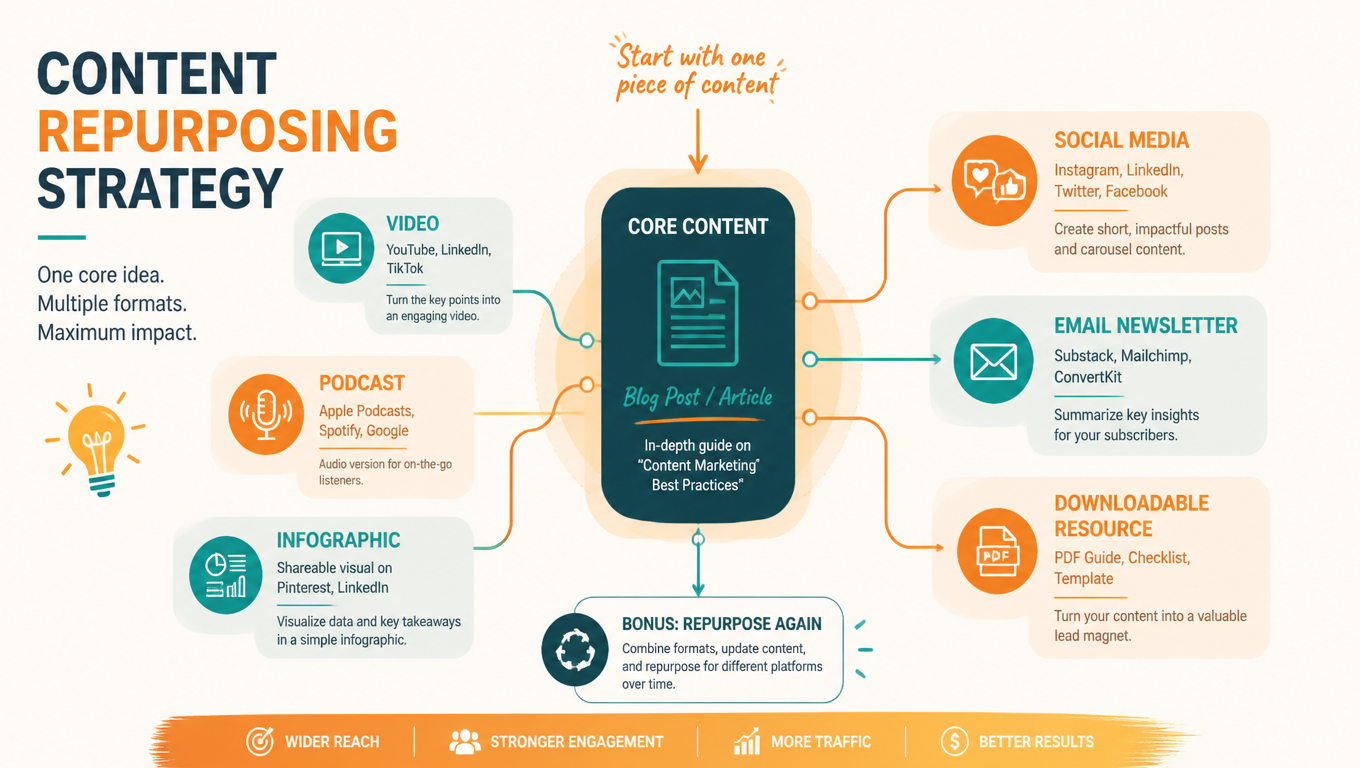
Repurposing. A 20-minute documentary can become five 3-minute clips for social, a blog post, an email sequence, a LinkedIn carousel, and an audio version for podcast platforms. Each repurposing extends the content's life and reaches a different audience segment.
The common thread: plan distribution before you start production. If you cannot answer "how will people find this?" before you shoot the first frame, do not start shooting.
Where this is headed
By 2027-2028, the line between editorial content and branded content will keep blurring. Brands are becoming publishers. This is not a metaphor anymore. Red Bull has a media studio. LEGO produces films. Patagonia publishes books.
Agencies that understand this are restructuring their teams: hiring journalists, documentary filmmakers, audio producers — not just copywriters and designers. The profile of a content agency in 2026 looks more like a production company than an advertising firm.
At Mintec, we produce content that builds brands without sounding like advertising. Our content creation and audiovisual production services cover everything from documentary series to interactive content. We have also written about the synthetic media revolution, AI video marketing, and content production pipelines — complementary topics every branded content team should know.
Related articles
- Content Repurposing: How to Turn One Article into 20 Assets Without Burning Out
- AI Content Detection: SynthID, C2PA, and What It Means for Your Content Strategy
- AI Podcasts and Synthetic Audio: The Content Frontier Nobody's Talking About Enough
References
- Top Branded Content Performance Statistics 2026 - AMRAandElma
- Native Advertising Statistics 2026 - MarketingLTB
- Global Ad Spend to Surpass $1 Trillion in 2026 - Dentsu
- Native Advertising Market Size 2026-2036 - Future Market Insights
- Why Brands Are Relearning How to Entertain First, Advertise Second - Digiday
- Sprout Social 2026 Content Strategy Report