
Content Repurposing: How to Turn One Article into 20 Assets Without Burning Out
72% of marketers produce more content than last year, but engagement is flat. The fix isn't producing more — it's getting more out of what you already have. A practical guide to content repurposing with data from CMI, SEMrush, and real teams multiplying their reach without duplicating hours.
Content Repurposing: How to Turn One Article into 20 Assets Without Burning Out
I keep having the same conversation with content teams. They say: "We are producing twice as much as last year and nobody is reading it. What are we doing wrong?"
The uncomfortable answer: probably nothing. The problem is not how much content they produce. It is that they publish it once and abandon it.
The Content Marketing Institute confirms it in their 2026 survey: 72% of B2B marketers produce more content than the previous year, but only 38% say their content generates meaningful results. The gap between production and outcomes is widening.
The fix is not creating more. It is making what you already have work harder. Content repurposing — taking one asset and reshaping it into multiple formats for different channels and audiences — is the most underrated content strategy in 2026.
And with today's AI tools, it has never been easier to do right.
Why repurposing matters more than ever
Three forces converging this year make repurposing a necessity, not an option.
Channel fragmentation. Your audience is not in one place. LinkedIn, Instagram, TikTok, YouTube, newsletters, podcasts, search. Publishing only on your blog is like shouting in an empty room. You need to be where your audience is, and that audience lives across multiple channels.
Content fatigue. There is too much content. Users are selective. They will not read your 2,000-word article even if it is brilliant. But they might watch a 3-minute video covering the key points, or listen to a podcast episode during their commute, or save a LinkedIn carousel to read later.
AI efficiency. Tools like Claude, ChatGPT, and Descript can turn an article into a video script, a newsletter summary, a series of social posts, and a podcast script in a fraction of the time it used to take. The technical barrier is nearly zero. The real barrier is strategic: knowing what to convert, for which channel, with what angle.
The repurposing model that works
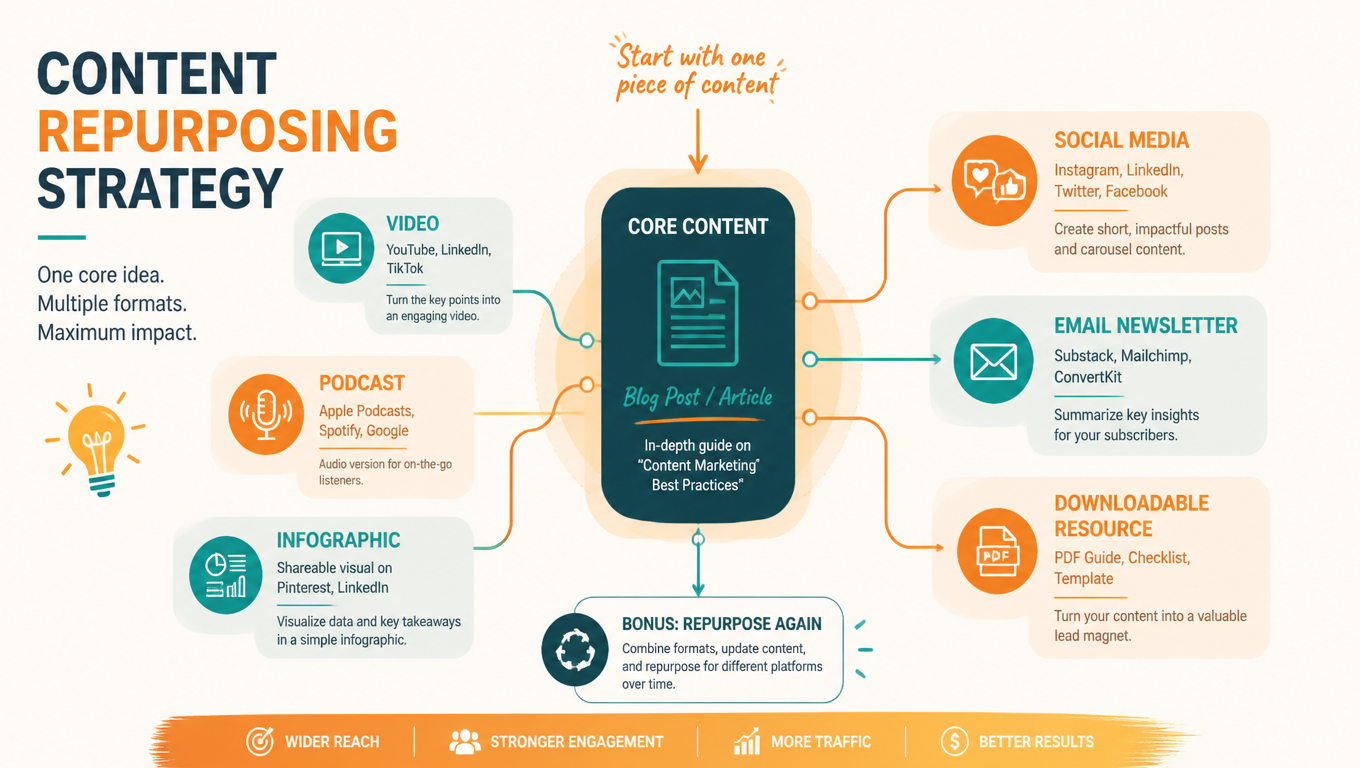
After testing several approaches, the one that works best is "one source, multiple formats." Instead of creating unique content for every channel, you create one solid base piece and strategically break it down.
The basic flow
Base piece. A 1,500-2,000 word blog article, a 30-minute podcast episode, or a 10-15 minute video. This is the piece containing all the research, data, and arguments. It is your source of truth.
Idea extraction. Identify the 5-7 key points, the 2-3 strongest quotes, the most surprising data points, and the main takeaway for the reader.
Channel adaptation. Each key point becomes a different format depending on the channel:
- LinkedIn: the point expressed as an opinion or personal take.
- Twitter/X: the data point in one line with a chart.
- Newsletter: the curated summary with additional context.
- YouTube: the point developed as a 3-5 minute video.
- Podcast: the topic expanded into a 25-minute conversation with a guest.
- Slideshare/PDF: the downloadable deck with key data.
Timed distribution. Do not publish everything on the same day. Space it out: the article on Monday, the LinkedIn post on Wednesday, the video next week, the newsletter two weeks later. Each piece acts as a reminder and reaches a different audience.
Concrete example
Suppose you write a 1,800-word article on "Digital Marketing Trends 2026."
From that single article you can extract:
- 1 blog article (base piece, 1,800 words)
- 5 LinkedIn posts (each trend as an individual 200-300 word post)
- 1 Twitter/X thread (summary of 7 trends in 15 tweets)
- 1 newsletter (edited-down article with additional editor commentary)
- 1 YouTube video (trends presentation in 8 minutes)
- 1 podcast episode (expanded 25-minute conversation with a colleague)
- 1 infographic (visualization of data and stats)
- 3 Instagram stories (each highlighting a surprising fact)
- 1 LinkedIn carousel (7 slides, one per trend)
- 1 downloadable PDF (executive summary)
That is 14 assets from one article. And every asset links to the others: the LinkedIn post links to the full article, the video mentions the downloadable PDF, the newsletter includes the podcast episode.
Not everything deserves repurposing
Here is a warning you do not see in most repurposing articles: not all content deserves to be repurposed. Before investing time in transforming a piece, ask yourself:
Does it have original data or proprietary research? That is what audiences value most. Content that only repeats known information does not deserve multiple formats.
Did it get traction the first time? If the original article did not get engagement, converting it to video will not revive it. The problem is not the format. It is the content.
Does it have a long shelf life? Evergreen content (guides, frameworks, research) is better for repurposing than news or trends that expire within a week.
Does it answer a real audience question? Content that solves a concrete problem for your ICP has more potential to be shared and consumed in multiple formats.
Tools making it possible in 2026
You do not need a big team to do repurposing well. Here are the tools small teams are using to multiply their content:
Descript — Take a long video or audio file and get auto-generated summaries, highlights, and social media scripts. Also lets you edit audio and video like text.
Claude / ChatGPT — Transform articles into scripts, summaries, LinkedIn posts, and tone variations. Key prompt: "Take this article and turn it into [format] for [channel] with a [formal/casual] tone." Specifying the channel changes everything.
Canva / Gamma — Create infographics, presentations, and LinkedIn carousels from article text. Canva's 2026 templates include platform-optimized designs.
Repurpose.io / Missinglettr — Automate content redistribution across platforms. Publish once and the system adapts and schedules for LinkedIn, Twitter, Facebook, and more.
HubSpot / WordPress — Many CMS platforms now include repurposing features: turning a post into an email, auto-generating a newsletter summary, creating an AMP version.
Common mistakes (and how to avoid them)
I have watched teams hit the same patterns over and over.
Translating, not adapting. Turning a long article into a video without changing the structure is a mistake. An 8-minute video is not a 2,000-word article read aloud. It needs visual rhythm, pauses, concrete examples, scene changes. Adapt to the medium.
Ignoring each platform's SEO. An optimized LinkedIn post uses a hook in the first lines, relevant hashtags, and a conversational tone. A newsletter has a subject line, preview text, and call to action. Every platform has its rules. Ignoring them wastes the effort.
Publishing everything the same day. Spacing out posts maximizes cumulative reach. Each piece acts as a fresh entry point for an audience that missed the first one.
Not measuring repurposing ROI. Publishing across channels is not enough. You need to measure which format works best for which audience. Does your audience prefer short video or long newsletter? The data will tell you.
How to start tomorrow
Do not try to do everything at once. Start here:
Pick your best article from the last 30 days. Turn its 3 main points into 3 LinkedIn posts. Schedule one for tomorrow, one for Thursday, one for next week.
That is it. Next week, check which got the most engagement. Next month, add a short video. In three months, you have a working system.
If you want to go deeper, we have guides on branded content for digital agencies and the state of AI content detection, two complementary topics. And if you need help building a content machine that actually works, we work with companies on content creation and brand storytelling.
Related articles
- Branded Content: How Digital Agencies Win With Content That Doesn't Look Like Advertising
- The Content Production Pipeline: From Idea to Distribution
- AI Content Detection: SynthID, C2PA, and What It Means for Your Content Strategy