

AI-Powered Growth Marketing: The Definitive Guide to Scale Your Business
The definitive guide to AI-powered growth marketing in 2026. Strategies, channels, automation, and case studies for scaling your business.
AI-Powered Growth Marketing: The Definitive Guide to Scale Your Business
Table of Contents
- Introduction: The New Growth Marketing Paradigm
- What Is Growth Marketing and How AI Has Transformed It
- The 2026 Growth Marketing Framework
- AI-Powered Growth Channels
- AI Tools for Growth Marketing
- Experimentation and A/B Testing with AI
- Measurement and The Growth Dashboard
- The Scaling Playbook: From Startup to Enterprise
- Case Studies and Industry References
- Conclusion and Next Steps
- Related Mintec Resources
1. Introduction: The New Growth Marketing Paradigm
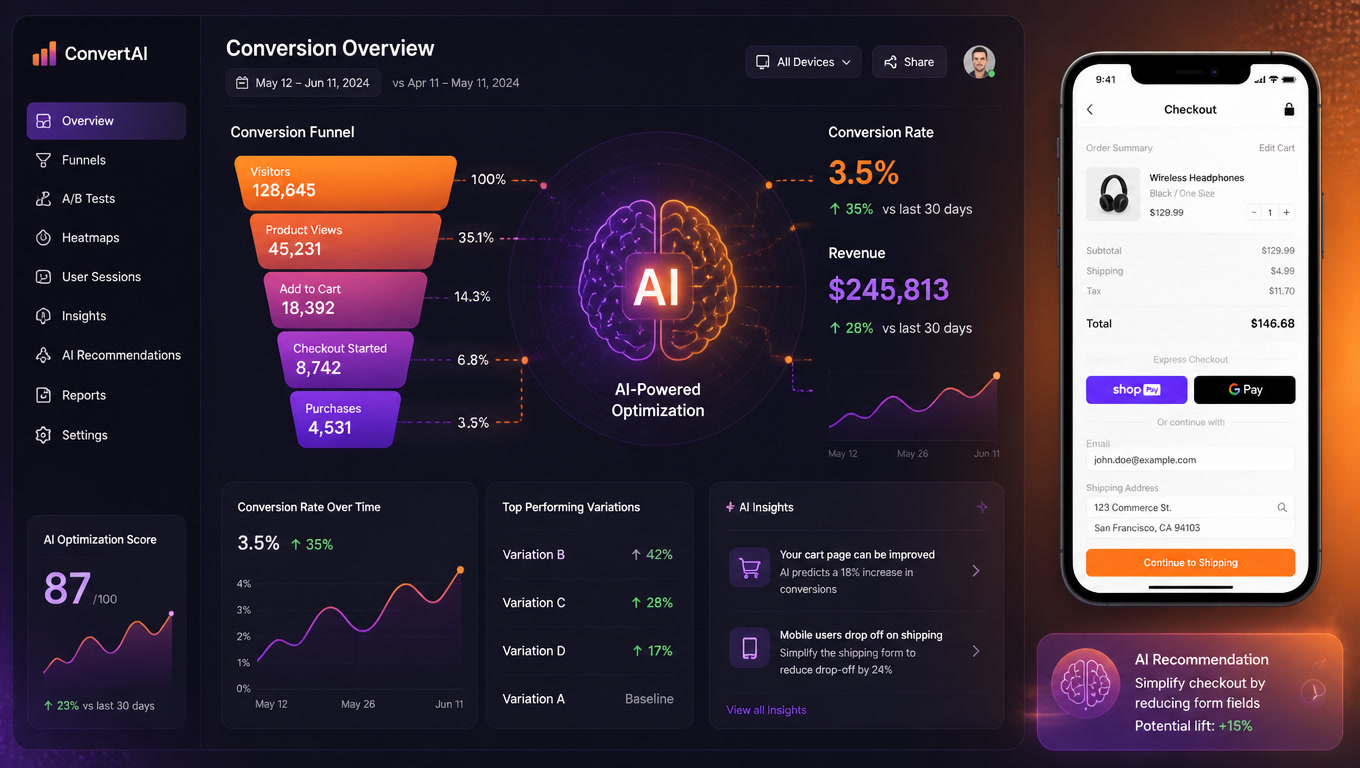
In 2026, growth marketing has evolved from a collection of isolated tactics into a comprehensive, AI-driven discipline. What once required teams of ten people and months of planning now executes in days with the help of autonomous agents, predictive models, and intelligent automations.
Modern growth marketing isn't just about "growing fast." It's about growing smart, sustainably, and data-driven. AI has democratized access to tools that were previously only available to large corporations: predictive campaign optimization, real-time personalization, content generation at scale, and advanced data analytics.
At Mintec, we've helped over 800 projects scale their marketing operations using precisely this approach. This guide captures everything you need to know to implement an AI-powered growth marketing strategy in 2026, from theoretical foundations to an actionable execution playbook.
Whether you're a founder, CMO, head of marketing, or growth lead, this document is your roadmap.
2. What Is Growth Marketing and How AI Has Transformed It
Classic vs. Modern Definition
Traditionally, growth marketing was defined as the application of rapid experimentation across marketing channels to identify the most effective ways to grow a business. It was built on Dave McClure's famous AARRR framework (Acquisition, Activation, Retention, Revenue, Referral).
In 2026, this definition has expanded dramatically. Growth marketing now integrates AI at every stage of the funnel:
| Stage | Traditional Approach | AI-Powered Approach 2026 |
|---|---|---|
| Acquisition | Manual SEO, generic ads | Predictive SEO, automated bidding, AI-generated content |
| Activation | Static onboarding | Personalized AI conversational onboarding |
| Retention | Segmented email campaigns | Predictive retention automation, memory-enabled chatbots |
| Revenue | Fixed pricing, manual upsells | Dynamic pricing, ML-powered recommendations |
| Referral | Manual referral programs | Automatic promoter detection, AI-optimized viral campaigns |
The Three Pillars of AI-Powered Growth Marketing
- Intelligent Automation: Processes that once required human intervention now run in the background — from content scheduling to real-time bid optimization.
- Personalization at Scale: AI creates unique experiences for every user without the cost of manual customization. Segments of one, not segments of thousands.
- Prediction and Anticipation: Machine learning models analyze historical patterns to predict future behavior — knowing which customer will buy, when, and through which channel.
Related article: To understand how AI is transforming acquisition channels, read our guide on Predictive SEO 2026.
3. The 2026 Growth Marketing Framework
At Mintec, we've developed a proprietary framework called "The Intelligent Growth Cycle." It consists of 5 iterative phases:
Phase 1: Diagnosis and Data Foundation
- Audit current channels and performance
- Implement unified tracking (UTMs, events, CRM integration)
- Build a marketing data warehouse
- Identify bottlenecks in the funnel
Phase 2: AI-Assisted Hypothesis Generation
We use large language models to generate hundreds of growth hypotheses based on:
- Historical campaign data
- Internal benchmarking vs. competitors
- Seasonal and market patterns
- Sentiment analysis and social trends
Phase 3: Parallel Experimentation
- Simultaneous testing of multiple variables
- Dynamic traffic allocation (Bayesian multi-armed bandits)
- Experiment duration determined by statistical power, not calendar dates
Phase 4: Automation Activation
- Workflow implementation with n8n, Zapier, or autonomous agents
- Behavior-triggered sequences
- Real-time personalization of content and offers
Phase 5: Scaling and Continuous Optimization
- Winning experiments are automatically scaled
- Losing experiments are archived with documented learnings
- The cycle repeats weekly
This framework isn't linear — it's circular. Each cycle feeds the next with more precise data.
4. AI-Powered Growth Channels
4.1 SEO and GEO (Generative Engine Optimization)
SEO in 2026 has evolved beyond Google. We now need to optimize for generative engines like ChatGPT Search, Perplexity, Gemini, and Claude. This is called GEO (Generative Engine Optimization).
Key Strategies for SEO/GEO in 2026:
- Structured content for direct answers: Generative AI extracts fragments from your content to answer queries. Use schema markup, lists, and tables that models can easily interpret.
- Voice search optimization: With voice assistants growing, conversational content and natural language queries dominate results.
- Topic authority (Entity SEO): Google and generative engines prioritize sources with demonstrated authority on a topic. Content clusters (like this one) are the best strategy.
- Predictive SEO: Use machine learning to anticipate algorithm changes and search trends before they happen.
Related article: Learn more in Predictive SEO 2026: How to Get Ahead of Algorithm Changes with Machine Learning.
Related article: Discover how Voice Search SEO with AI is changing the rules of search engine positioning.
4.2 AI-Driven Content Marketing
Content remains king, but its production is now AI-augmented. It's no longer about producing more — it's about producing better content with more intent.
Mintec's AI Content Production Pipeline:
Research → Strategy → Outline/Script → Generation → Human Review → Publication → Automated Distribution
Practical Use Cases:
- Cluster article generation: AI identifies topic gaps and generates content that covers them while maintaining semantic coherence.
- Multi-format content: A single topic becomes a blog post, short video, Twitter/X thread, newsletter, and podcast — all with AI assistance.
- Automated translation and localization: AI maintains multilingual versions of your content with brand consistency.
Related article: See how Short-Form Video Automation can multiply your content production.
4.3 Social Media and Video Marketing
Social media in 2026 is a landscape where AI determines what content gets seen and by whom. Recommendation algorithms are more sophisticated than ever.
Winning Strategies:
- AI video marketing: From AI-generated scripts to virtual avatars that present your content 24/7.
- AI-powered UGC (User Generated Content): Tools that analyze your existing content to identify which variations will perform best.
- Predictive scheduling: Post when your audience is most receptive, determined by engagement pattern analysis.
- NLP-powered social listening: Analyze millions of conversations to identify trends before they explode.
Related article: Check our AI Video Marketing Guide 2026 to master AI-powered video content.
Related article: Short-Form Video Automation is one of the most effective strategies for 2026.
4.4 Automated Email Marketing
Email marketing has experienced a resurgence thanks to hyper-realistic personalization enabled by AI.
Advanced Techniques:
- AI-generated subject lines: Models trained on your open history to predict which subject lines maximize open rates.
- Send time optimization: AI determines the best time to send each email to each individual subscriber.
- Dynamic content: Email body adapts in real-time based on the user's past behavior.
- Predictive churn scoring: Identifies subscribers at risk of unsubscribing and triggers automated re-engagement campaigns.
4.5 Paid Advertising and Programmatic Bidding
Paid advertising in 2026 is a battlefield where AI makes bidding decisions in milliseconds.
Key Innovations:
- Predictive programmatic bidding: Algorithms that anticipate the value of each impression and adjust bids in real-time.
- Creative automation: Mass generation and testing of ad variations (copy, images, CTAs) using generative AI.
- Deep learning lookalike audiences: Audience segments generated by neural networks that identify non-obvious patterns.
- Multi-touch attribution with ML: Models that correctly distribute conversion credit across all touchpoints.
Related article: Discover Predictive Programmatic Bidding and how to maximize your ROAS in 2026.
5. AI Tools for Growth Marketing
The AI tool ecosystem for growth marketing is vast. Here are the essential categories:
5.1 Autonomous Marketing Agents
AI agents are the evolution of traditional automations. Instead of following fixed rules, they make contextual decisions:
- Lead scoring agents: Analyze lead behavior and decide when to escalate to sales.
- Content agents: Research, write, optimize, and publish content autonomously.
- Support agents: Resolve queries, qualify leads, and update CRMs without human intervention.
5.2 Low-Code/No-Code Automation Platforms
- n8n: Open-source automation platform that connects any API and builds complex workflows without code.
- Zapier / Make: Traditional automations enhanced with AI capabilities.
- GoHighLevel: All-in-one CRM with agency-grade automations.
5.3 Content and Creative Tools
- Claude / ChatGPT: Content generation and optimization.
- Midjourney / DALL-E: Image generation for campaigns.
- Runway / Pika: Video editing and generation.
- ElevenLabs: Realistic synthetic voices for audio.
5.4 Predictive Analytics Platforms
- Mixpanel / Amplitude: Product analytics with predictive capabilities.
- Segment / RudderStack: Unified data capture to feed AI models.
- Looker / Metabase: Interactive dashboards with smart alerts.
5.5 Recommended Tech Stack by Mintec
| Purpose | Primary Tool | Alternative |
|---|---|---|
| CRM & Automation | GoHighLevel + n8n | HubSpot + Zapier |
| AI Content | Claude + ChatGPT | Gemini + Perplexity |
| Analytics | Mixpanel + Looker | Amplitude + Metabase |
| AI Video | Runway + ElevenLabs | Pika + Respeecher |
| SEO/GEO | Semrush + Clearscope | Ahrefs + SurferSEO |
5.6 How to Integrate Your Stack Without Creating Silos
One of the most common mistakes when adopting AI in growth marketing is accumulating tools that don't communicate with each other. A fragmented stack generates inconsistent data and suboptimal decisions.
Integration Principles:
- API-first: Choose tools with robust APIs. This lets you connect systems via n8n, Make, or custom workflows.
- Single Source of Truth: Designate one central system (CRM or data warehouse) as the official source of customer data.
- Unified events: Implement a tracking plan with standardized naming (e.g.,
user.signed_up,order.completed,trial.started). - Automated data pipeline: Every tool should feed the data warehouse automatically without manual intervention.
Recommended Architecture:
Data Sources (Web, App, Ads, Email)
        ↓
  Unified Capture (Segment / RudderStack / Snowplow)
        ↓
  Data Warehouse (BigQuery / Snowflake / Postgres)
        ↓
  Modeling Layer (dbt + ML models)
        ↓
  Activation (CRM, Email, Ads, Personalization)
        ↓
  Measurement (Dashboards + AI Alerts)
5.7 Autonomous Agents: The Future of Growth Marketing
Autonomous AI agents represent the next frontier. Unlike traditional automations that follow if/else rules, agents make contextual decisions based on objectives.
Growth Agent Examples:
Acquisition Agent: Monitors campaign performance across Meta, Google, and TikTok. When it detects a ROAS drop, it automatically reallocates budget between platforms and suggests new creatives.
Retention Agent: Analyzes product usage patterns. Identifies users at risk of churn and triggers personalized re-engagement sequences (email, push, SMS).
Content Agent: Researches trending topics, generates article drafts, optimizes for SEO/GEO, schedules publication in WordPress, and distributes across social media.
Revenue Agent: Detects high purchase-intent moments and offers dynamic discounts, upsells, or cross-sells in real-time.
How to Start with Agents:
Start with a simple agent for one specific task (e.g., lead classification). Once validated, scale to more complex tasks. We recommend using n8n + OpenAI/Claude to build agents without needing an engineering team.
6. Experimentation and A/B Testing with AI
Experimentation is the heart of growth marketing. In 2026, AI has transformed how we design, execute, and analyze experiments.
6.1 From A/B Tests to Multi-Armed Bandit Experimentation
Traditional A/B testing (two variants, 50/50 traffic split) is being replaced by multi-armed bandit experimentation:
- Multiple variants compete simultaneously
- Traffic is dynamically allocated to better-performing variants
- Opportunity cost from losing variants is minimized
- The system learns and adapts in real-time
6.2 AI-Generated Hypotheses
We use LLMs to generate experimentation hypotheses based on:
- Historical data from similar campaigns
- User behavior patterns
- Market trends and seasonality
- Industry best practices
6.3 Automated Results Analysis
Post-experiment analysis is also automated:
- Statistical significance calculated automatically
- Cohort-level result segmentation
- AI-generated recommendations based on data
- Automatic documentation of learnings
6.4 Experiment Prioritization Framework
Not every experiment deserves to be run. Use a prioritization system like ICE (Impact, Confidence, Ease) or RICE (Reach, Impact, Confidence, Effort), now AI-powered:
AI-Enhanced ICE Scoring:
- Impact: AI estimates potential impact based on historical data from similar experiments and predictive models.
- Confidence: Automatically calculated based on the quantity and quality of data supporting the hypothesis.
- Ease: The system evaluates required resources (development time, implementation cost, technical risks).
Recommended Prioritization Flow:
Hypothesis Bank (50+)
    → AI Filter (discards unviable hypotheses)
    → Automated ICE/RICE Scoring
    → Top 5 Weekly
    → Parallel Execution
    → Results feed back into the bank
6.5 Choosing the Right Experimentation Tool
| Tool | Best For | Built-in AI |
|---|---|---|
| Google Optimize | Simple website tests | Basic (Google Analytics integration) |
| VWO | Full experimentation | AI for automatic segmentation |
| Optimizely | Enterprise companies | ML for real-time personalization |
| Statsig | SaaS and digital products | Native Bayesian bandits |
| GrowthBook | Data-driven teams (open-source) | Custom model integration |
| Mintec Stack (n8n + custom) | Startups wanting full control | Fully customizable |
Key Metrics for Experimentation
| Metric | What It Measures | Recommended Tool |
|---|---|---|
| Conversion Rate | % of users completing desired action | Mixpanel / Google Analytics 4 |
| LTV (Lifetime Value) | Total customer value over time | CRM + Data Warehouse |
| CAC (Customer Acquisition Cost) | Cost of acquiring a customer | Attribution system |
| Retention Rate | % of returning users | Cohort analysis tools |
| NPS (Net Promoter Score) | Customer satisfaction and loyalty | AI-automated surveys |
7. Measurement and The Growth Dashboard
Without measurement, there is no growth. The modern growth dashboard integrates data from multiple sources into a unified view.
7.1 North Star Metric (NSM)
Every business needs a North Star Metric that reflects the value you deliver to customers. Examples:
- SaaS: Weekly Active Users
- E-commerce: Repeat orders per customer
- Marketplace: Successfully completed transactions
- Content: Meaningful reading time
6 Growth Metrics to Monitor in 2026
- CAC Payback Period: How long does it take to recover the cost of acquiring a customer?
- LTV:CAC Ratio: Are you generating more value than you spend on acquisition?
- Activation Rate: Are users experiencing the "Aha!" moment?
- Revenue per Channel: Which channels generate the most revenue?
- Stage-to-Stage Conversion Rate: Where is your funnel bottleneck?
- Predictive Churn Rate: Which customer segments are at risk of leaving?
7.3 Automated Reporting
Modern growth teams generate automated reports delivered to Slack, email, or Telegram weekly. AI handles:
- Consolidating data from all sources
- Identifying anomalies and patterns
- Generating executive summaries in natural language
- Recommending data-driven actions
8. The Scaling Playbook: From Startup to Enterprise
Scaling a business isn't just about spending more on advertising. It requires systems, processes, and automation.
Phase 1: Validation (0-50k MRR)
- Focus on a single acquisition channel
- Basic email automation and follow-up
- Manual metric tracking in Excel/Google Sheets
- Fundamental CRO (Conversion Rate Optimization)
AI Recommendation: Implement a simple chatbot to qualify leads 24/7. Use a low-code tool like n8n to connect your contact form with your CRM and send automated personalized responses.
Phase 2: Early Growth (50k-200k MRR)
- Diversify to 2-3 channels
- CRM implementation with automations
- Automated metric dashboard
- Systematic weekly experimentation
- AI applied: lead qualification chatbots, basic segmentation
AI Recommendation: Automate weekly report generation with AI that summarizes each channel's performance and recommends adjustments. Implement a basic retention agent that sends automated re-engagement sequences.
Phase 3: Scaling (200k-1M MRR)
- 4+ active channels with significant budget
- Autonomous marketing agents operating 24/7
- Multi-channel real-time personalization
- Unified data warehouse with predictive models
- AI applied: programmatic bidding, predictive SEO, AI-generated content
AI Recommendation: Implement an acquisition agent that automatically manages budget allocation across Meta, Google, and TikTok. Predictive SEO should anticipate algorithm changes and adjust your content strategy before traffic drops.
Phase 4: Maturity (1M+ MRR)
- Full AI and automation ecosystem
- Machine learning operations (MLOps) for marketing
- Continuous experimentation across all channels
- AI-accelerated international expansion
- AI applied: specialized autonomous agents, proprietary models
AI Recommendation: At this stage, your growth team should operate as an AI center of excellence. Autonomous agents handle day-to-day operations while your team focuses on strategy, innovation, and new market expansion.
Common Scaling Mistakes (and How to Avoid Them)
| Mistake | Consequence | Solution |
|---|---|---|
| Scaling unprofitable channels | CAC spikes | Implement predictive models to identify true LTV per channel before scaling |
| Automating unoptimized processes | You scale inefficiency | Optimize manually first, then automate |
| Ignoring data quality | AI models trained on bad data | Invest in data governance from day 1 |
| Hiring before automating | High fixed costs | Always ask: "Can an AI agent do this?" before hiring |
| Not documenting experiments | Loss of collective learning | Use AI to automatically document every experiment and its results |
The Growth Team's Role in the AI Era
Team composition changes dramatically with AI adoption:
Traditional growth team (2020-2024):
- 1 Growth Lead
- 2-3 Channel Marketers
- 1 Data Analyst
- 1 Engineer
- 1 Designer
AI-powered growth team (2026+):
- 1 Growth Lead (strategy-focused)
- 1 AI Operations Specialist (configures and supervises agents)
- 1 Data Scientist / ML Engineer
- AI agents handling: acquisition, content, retention, analytics
- Human team focuses on: creative strategy, experiment design, relationship building
Key insight: Companies that have integrated AI into their growth teams report teams that are 40% smaller and 60% more effective (source: 2026 sector benchmarks).
Scaling Checklist
- [ ] You have a unified data layer connecting all data sources
- [ ] Your ad campaigns are optimized in real-time with AI
- [ ] Your content is automatically generated, translated, and distributed
- [ ] AI agents handle support and lead qualification
- [ ] Your team operates with automated dashboards and smart alerts
- [ ] You continuously experiment with at least 3 hypotheses per week
- [ ] Your tech stack is integrated with no data silos
Related article: For e-commerce businesses, our guide on E-commerce Scaling with AI in 2026 dives deep into sector-specific strategies.
9. Case Studies and Industry References
Case 1: E-commerce Brand That Multiplied ROAS by 4x
An online fashion retailer implemented predictive programmatic bidding and AI-powered catalog personalization. Result: ROAS went from 2.8x to 11.2x in 90 days.
Case 2: SaaS Company That Reduced CAC by 60%
A B2B SaaS platform deployed AI agents for lead qualification and dynamic content on their website. Customer acquisition cost dropped from $1,200 to $480 per customer.
Case 3: Content Startup That Grew Organic Traffic 10x
By applying a content cluster strategy with AI-assisted generation and predictive SEO, a content startup grew from 15k to 150k monthly organic visits in 6 months.
Industry References
- Brian Balfour (Reforge): Growth frameworks that remain the gold standard
- Andrew Chen: Author of "The Cold Start Problem" on network dynamics
- Lenny Rachitsky (Lenny's Newsletter): Curated weekly growth experiments
- Christina Janzer (Slack): Product-led growth strategies
10. Conclusion and Next Steps
AI-powered growth marketing is not a passing trend. It is the new operating model for marketing in any business that wants to grow competitively in 2026 and beyond.
Key Takeaways
- AI doesn't replace marketers — it amplifies them. Strategic decisions, creativity, and customer empathy remain human.
- Start with data, not tools. The best AI tool is useless if your data is disorganized.
- Experiment constantly. Growth marketing is a continuous learning process.
- Automate the routine, humanize the important. Let AI handle repetitive tasks while your team focuses on strategy and creativity.
- Invest in systems, not tactics. A well-built growth system produces sustainable results.
Recommended Next Steps
- Audit your current marketing stack — identify which processes can immediately benefit from AI.
- Implement unified tracking — without clean data, no AI strategy will work.
- Start with one small experiment — pick one channel and test one AI-powered hypothesis.
- Build your content cluster — just as this article is part of an ecosystem, your content should be interconnected.
- Talk to an expert — at Mintec, we help businesses design and implement their AI-powered growth marketing strategies.
Related articles
- AI-Powered Conversion Rate Optimization: Beyond Traditional A/B Testing
- AI Video Marketing for Business: The Complete Guide
- Digital marketing in 2021: How to prepare your company for the changes?
11. Related Mintec Resources
Explore our complete collection of growth marketing and AI articles:
- 📹 AI Video Marketing Guide 2026 — Master AI-powered video production
- 🎬 Short-Form Video Automation — Create viral videos at scale
- 🔮 Predictive SEO 2026 — Get ahead of algorithm changes
- 🎙️ Voice Search SEO with AI — Optimize for the future of search
- 📊 Predictive Programmatic Bidding — Maximize your advertising ROAS
- 🛒 E-commerce Scaling with AI 2026 — Strategies for online stores
Ready to Scale Your Business with AI Growth Marketing?
At Mintec, we combine 15+ years of digital marketing expertise with the most advanced AI tools on the market. We've delivered over 800 projects helping businesses like yours grow intelligently and sustainably.
Book a Free Consultation → Discover how we can help you implement a customized AI-powered growth marketing strategy for your business.
© 2026 Mintec — Design. Development. Marketing. Growth. All with AI Superpowers.