
AI-Powered Conversion Rate Optimization: Beyond Traditional A/B Testing
AI-powered CRO tools deliver 15-25% conversion lifts. Mobile accounts for 70% of ecommerce traffic but converts at 1.8-2.8% vs 3.2-3.9% on desktop. Here is the real playbook for AI-driven experimentation in 2026, with tools, strategies, and data.
AI-Powered Conversion Rate Optimization: Beyond Traditional A/B Testing
Traditional A/B testing has a fundamental problem: it is slow. You launch a variant, wait two weeks to reach statistical significance, analyze the results, and by the time you have a solid conclusion, the market, seasonality, or user behavior has changed. AI-powered optimization in 2026 works completely differently, and the data is starting to show that the old approach is no longer sufficient.
What the 2026 data says
The figures are hard to ignore. According to FutureFactors.ai and multiple industry sources confirmed by DTC Systems and Loopex Digital, AI-powered CRO tools are delivering 15-25% conversion lifts on the surfaces where they are applied. Some platforms report 20-30% uplifts over non-AI-optimized controls.
The market context makes these numbers even more relevant. Per Stormy AI and Neal Schaffer's 2026 analysis, mobile traffic now accounts for 70% of all ecommerce traffic. Yet mobile conversion rates (1.8-2.8%) still lag significantly behind desktop (3.2-3.9%). That 1.4 percentage point gap is a massive opportunity — for a site doing $1M in annual revenue, closing half that gap would mean roughly $175,000 in additional revenue.
The VWO AI report from 2026 confirms AI is fundamentally changing how testing works. Rather than launching an experiment and passively waiting, multi-armed bandit algorithms dynamically allocate traffic to winning variants while the test is still running. Instead of wasting 50% of traffic on losing variants for two weeks (as in a classic A/B test), the system learns and optimizes in real time, minimizing opportunity cost.
How AI-driven CRO actually works
The idea is simpler than it sounds. Instead of a marketer deciding what to test and waiting weeks for results, an AI system orchestrates the entire cycle:
Analyzes user behavior in real time. Every click, scroll, mouse movement, and time-on-page feeds the model. Tools like Hotjar and FullStory already integrate AI layers that automatically identify friction patterns.
Generates hypotheses based on patterns. The AI detects that users arriving from Instagram who see a specific customer testimonial convert at twice the rate. It automatically proposes: "Try showing that testimonial higher on the page for social media traffic."
Creates variations automatically. You do not need a designer for every variant. The tool generates alternative versions of headlines, CTAs, forms, or layouts based on the hypotheses.
Runs continuous experiments with multi-armed bandit. You do not wait for one test to finish before starting the next. The system runs multiple experiments in parallel, learns from every interaction, and adjusts traffic allocation in real time.
Learns and adapts continuously. If a variant performs better on Monday than Tuesday, the system detects it and adjusts. If seasonal behavior shifts, the model retrains.
This is not theory. Tools like VWO AI, Optimizely Web Experimentation, and Abmatic AI already work this way. VWO AI, for instance, lets you automate complete workflows: analyze user behavior, identify improvement areas, generate hypotheses, create variations, and summarize reports automatically. The human team focuses on strategy and decisions, not the operational work of manually configuring tests.
A dev.to roundup of best AI tools for CRO in 2026 puts it well: "The AI tools that are actually moving conversion rate optimization in 2026 do not work at the pace of a quarterly testing cadence. They work continuously, running experiments in the background, personalizing in real-time, and surfacing insights before the next planning cycle."
Where it works best
Based on the data I have reviewed and real implementations, AI-driven CRO excels in three specific areas.
1. Real-time personalization. Instead of showing the same page to every visitor, AI adapts headlines, images, offers, and CTAs based on the user's past behavior, traffic source, device, and geographic location. A visitor arriving from an Instagram ad sees a different message than someone coming from organic search. A 2026 study cited by Loopex Digital shows companies implementing AI-driven personalization see 15-25% conversion lifts on personalized surfaces.
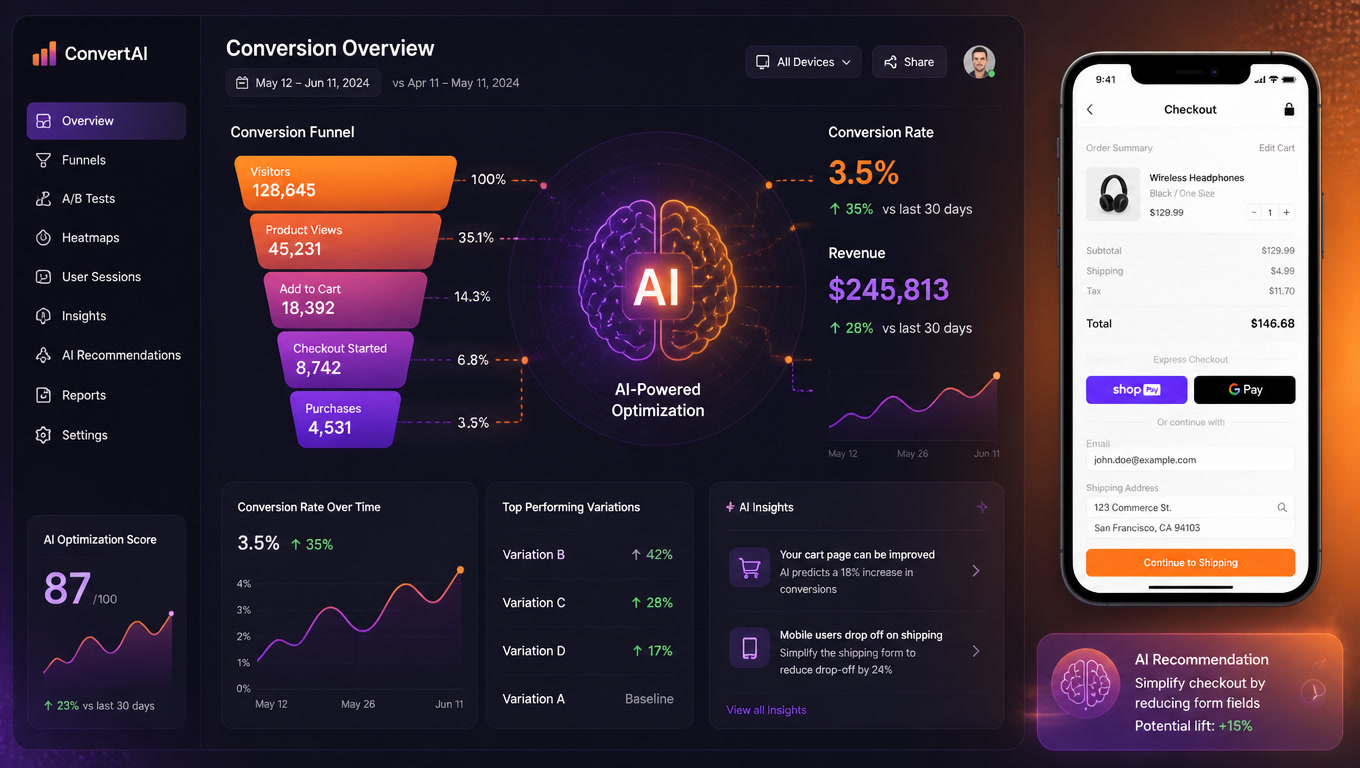
2. Checkout optimization. Cart abandonment remains ecommerce's biggest challenge, with rates around 70% according to industry studies. AI identifies specific abandonment patterns per user segment and adjusts the checkout flow accordingly: simplifies forms for mobile users, surfaces relevant payment methods for each market, shows trust signals at critical moments, and reduces friction where it hurts most.
3. Headline, CTA, and offer testing. Multi-armed bandit algorithms are particularly effective here. You can test 10 headlines, 5 CTAs, and 3 offers simultaneously, and the system allocates more traffic to winning combinations from day one. You do not need to wait two weeks to know what works — the system tells you in hours and acts on it.
Where AI does not replace human judgment
I have also seen the limits, and it is important to acknowledge them to avoid unrealistic expectations. AI is excellent at finding patterns in data, but it has clear limitations.
Cultural and emotional context. An offer that works in Mexico may be irrelevant or even offensive in Spain. AI detects the difference in the data — it sees that one variant converts worse — but it does not understand why. It does not know the problem is cultural, linguistic, or seasonal. You need a human interpreting the data.
Long-term brand impact. A variant that maximizes conversions today may erode brand perception if it is too aggressive, uses dark patterns, or misleads the user. AI optimizes for whatever metric you give it (immediate conversion), not for brand health at 12 months. If you do not explicitly measure brand impact, AI will choose the most aggressive option.
Data quality dependency. AI CRO is only as good as the data feeding it. If your analytics setup has gaps — no event tracking on key interactions, incomplete funnel data, low traffic volumes — the AI will make confident decisions based on incomplete information. Garbage in, garbage out applies to AI as much as any other system. Before investing in AI CRO tools, audit your data infrastructure. Make sure you are tracking the right events, that your funnel definitions are accurate, and that your traffic volumes are high enough for statistical significance on the segments you care about.
Qualitative research. Behavioral data tells you what people do, but not why. User interviews, usability testing, and brand perception studies are still essential to understand the motivations behind the numbers. AI can tell you that 23% of users abandon the checkout at the shipping field. It cannot tell you that they are abandoning because they are unsure about delivery times — that takes a conversation with actual users.
The approach that works best is hybrid: AI generates hypotheses and runs experiments at scale, but humans validate findings with qualitative research before rolling out major changes.
How to start with AI-driven CRO in 2026
If you have never worked with AI-driven optimization, here is a practical plan to start without getting overwhelmed.
Step 1: Measure your baseline. You need to know your current conversion rate by device, traffic source, and audience segment. Without a clear baseline, you will not know if AI is improving anything. Google Analytics 4, Mixpanel, or Amplitude can provide this data.
Step 2: Identify your most critical bottleneck. Review your conversion funnel. Where do you lose the most users? Landing page? Checkout? Registration form? Start at the point where friction hurts most.
Step 3: Pick one tool. VWO, Optimizely, or Abmatic AI offer free trials. You do not need to commit to an annual contract to try. Choose the one that best integrates with your current tech stack.
Step 4: Set up your first multi-armed bandit experiment. You do not need to be a statistician. Modern tools handle experimental design, significance calculation, and traffic allocation automatically. Start simple: test 3 different headlines on your main page.
Step 5: Measure and iterate weekly. AI's advantage is speed. Review results every week, not every month. If something works, scale it. If it does not, try something else.
Further reading
- Complete Growth Marketing Guide 2026 — growth strategies that complement AI-driven CRO
- Zero-Party Data Marketing 2026 — how first-hand data powers personalization
- AI Predictive Bidding in Programmatic 2026 — automated bid optimization driven by AI
At Mintec, we offer digital advertising and digital strategy services that integrate AI-driven optimization to maximize the return on every visit. We also work with ecommerce platforms and CRM implementation to ensure your data infrastructure can support AI-driven experimentation at scale.
Related articles
- AI-Powered Growth Marketing: The Definitive Guide to Scale Your Business
- Beyond Demographics: AI-Driven Content Personalization at Scale
- AI Video Marketing for Business: The Complete Guide
The bottom line
AI-driven CRO is not a passing trend. The 2026 data is clear: real 15-25% conversion improvements when implemented correctly, with tools that are already mature and accessible. But it does not work like a magic button — it works as a continuous process where AI handles the heavy lifting of analysis and experimentation, and humans make the strategic decisions. The mobile-desktop conversion gap is the best starting point. 70% of traffic is already on mobile. Optimizing that experience is where the biggest return sits.