
Meta's AI Creative Ecosystem: When to Let the Platform Build Your Ads — and When to Keep Control
Meta launched an end-to-end AI creative ecosystem at Cannes Lions 2026, anchored by Brand Memory. Here's what shipped vs. what's in testing, why governance is the real story, and a practical framework for deciding when AI should build your ads and when humans must stay in control.
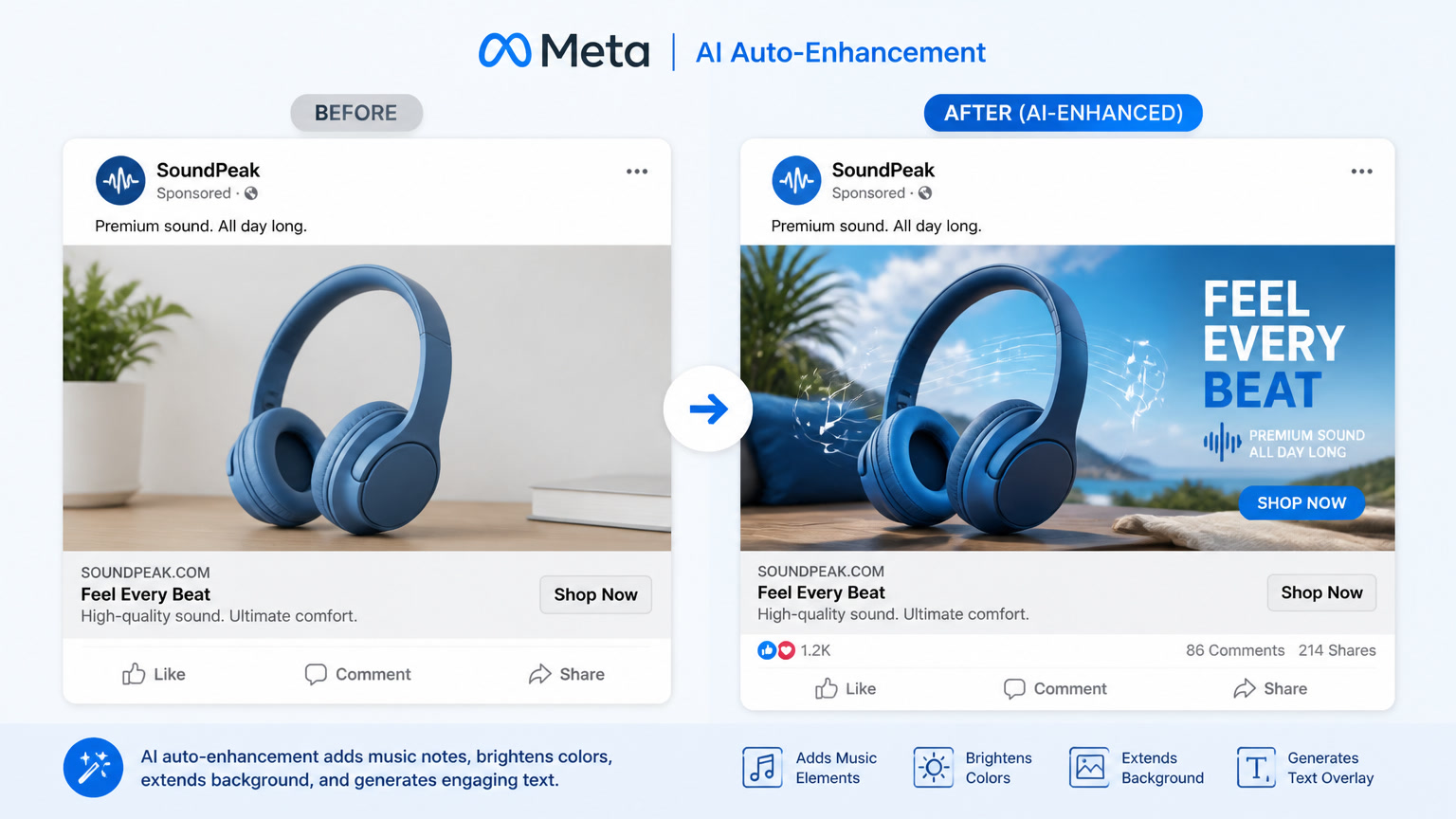
On June 23, 2026 at Cannes Lions, Meta announced what it calls its "complete end-to-end AI-powered ad ecosystem." The headline feature is Brand Memory: an AI layer that learns your brand's identity from your historical ads and applies those learnings to every new creative the platform generates.
On paper, it sounds like every marketer's dream — a machine that knows your brand, respects your tone, and produces ad variations without a creative director reviewing every line. The operational reality is more nuanced. As an agency running Meta Ads campaigns for clients across multiple industries, what matters most to us isn't what the AI can do — it's when it should and shouldn't.
This article breaks down what Meta actually launched (separating shipped from testing), why governance is the real story beneath the technology, and a practical decision framework for when to let AI build your ads and when to keep human control.
What Meta Launched at Cannes Lions 2026
Meta packaged three major announcements into a single rollout: an end-to-end creative workspace, Brand Memory as its flagship feature, and a unified Creator Marketing Hub. But not everything is available today.
The creative workspace unifies generation, testing, and translation in a single surface. Creative and media teams can review what's performing, generate new variations from those learnings, and test them — all within the same tool. Per Campaign US's coverage, the platform includes a built-in approval flow so feedback and sign-offs live next to the asset, not in a separate Google Doc.
Brand Memory operates in two stages. First, ingestion: the system reads your historical ad library — roughly the last 18 months — to learn your brand's tone, format, and creative style. Then, marketers refine that identity by defining what the brand stands for, giving the AI a tighter signal than historical data alone provides. The output is generative creative that stays on brand without an art director rewriting every line.
The Creator Marketing Hub merges Creator Marketplace and Partnership Ads Hub into a single surface, adding Facebook creators to the existing 5 million Instagram creators in the marketplace.
Meta states advertisers now see $4.13 in revenue for every $1 of ad spend, a 25% improvement since 2022. Per Digital Applied's analysis, this figure comes from a Meta-commissioned study (April 2026, 1M+ campaigns) using a published UC Berkeley / NBER academic framework. We attribute it — we don't repeat it as independent fact.
Shipped vs. Testing: What You Can Use Today
The single most important distinction for any advertiser is understanding what's live and what's on the roadmap:
| Feature | Status |
|---|---|
| Brand Memory | Limited testing with select advertisers |
| Creative workspace | Limited testing |
| Creative approval flow | Testing in Ads Manager |
| Enhanced text generation in Ads Manager | Available |
| Multilingual translation (5 on-image, 11 voiceover) | Available |
| Unified Creator Marketing Hub | Launching later in 2026 |
Meta announced WPP as the first agency partner piloting the creative solution, with plans to integrate it into WPP Open. Broader rollout is described as "coming months" with no firm date.
Why Governance Matters More Than the Technology
Here's the distinction most coverage skips, and the one that decides whether Brand Memory helps or hurts you: the model learns from ad history, which means it learns what performed, not what the brand stands for at a strategic level.
If your historical ads were weak, off-strategy, or built for a positioning you're about to leave behind, Brand Memory will replicate those weaknesses at scale and with conviction. It's an execution accelerant, not a strategy engine — and it's only as good as the library you feed it.
This creates a governance problem that didn't exist before. Under the traditional setup, every creative passed through human review before going live. With Brand Memory, the AI can generate dozens of variations that look and sound right at surface level but may be strategically misaligned.
Compounding this: Meta's AI features default to opt-out enrollment. If you don't actively audit your settings, the AI could be generating and publishing ad variations without your explicit knowledge.
The Decision Framework: When to Let AI Drive
Based on our experience managing Meta Ads campaigns for clients across ecommerce, SaaS, and education verticals, here's the framework we use to decide when Brand Memory should operate freely and when human control is essential:
✅ Brand Memory works best when:
- Scaling a proven campaign with consistent results
- Producing format variations (vertical to square, story to feed)
- Refreshing fatigued creative while maintaining the same message
- Localizing a working campaign across markets
❌ Brand Memory can backfire when:
- Launching a rebrand or new brand identity
- Entering a new market with different positioning
- Responding to a cultural moment or real-time news
- Launching a new product your audience doesn't know yet
- Your historical library has low-quality or off-strategy ads
The general rule: if the work is execution and volume (scaling what works), let Brand Memory operate. If the work is strategic direction (changing what the brand says or how it positions), keep it off and re-activate once the new direction is established.
For a more detailed implementation guide, Elevarus published an excellent 6-step agency rollout plan covering everything from ad library audit to productizing the workflow as a retainer line item.
Preparing Your Account for Brand Memory in 3 Steps
If you want to be ready when the broader rollout arrives, here's what we recommend doing now:
1. Audit your historical ad library
Before turning Brand Memory on, review every campaign from the last 18 months. Remove anything that didn't meet your brand's quality bar. Brand Memory learns from what's in the account — a library full of legacy A/B losers will train the system on the wrong signal.
2. Write a one-page brand definition
Meta lets you refine the learned identity with your own words. Write one page per account covering voice, audience, three things the brand always says, and three things it never says. Don't write forty pages — the system needs a sharp signal, not a corporate style guide.
3. Run a sandbox test
Don't let Brand Memory write live ads until you've eyeballed 50-100 variations. Set up a sandbox business account, point it at a copy of your client's product catalog, and ask the system to produce variations. Score them against your brand definition. If the system drifts, refine the Brand Memory field and run the batch again.
What This Means for Agencies
This launch accelerates a conversation that's been building for months: when the platform builds the ads, what value does the agency add?
Our answer is that agency value shifts from production volume to governance quality. The agency that once charged for designing 12 creative variations per month now charges for building the rule system, defining brand guardrails, auditing AI output quality, and deciding when the system needs human intervention.
This requires a different skill set. It's no longer just about knowing how to design a good ad — it's about knowing how to design a good decision system around AI. In our piece on Meta's unified safe zone changes, we covered how standard creative production already shifted in 2026 — Brand Memory is the next step.
Brand Memory also builds on top of Meta's Andromeda algorithm update, which already prioritizes creative quality in the auction. The combination of an algorithm that rewards good creative and an AI that can produce it at scale is what makes this moment different for advertisers. For a deeper look at how creative diversity interacts with Andromeda's scoring, see our analysis of creative fatigue detection under Andromeda.
Conclusion
Meta's AI creative ecosystem isn't a threat to agencies that understand their new role. It's a powerful tool for scaling what works — as long as you know exactly where to set the boundaries.
The right question isn't "Will Brand Memory replace human creatives?" It's "What creative decisions should a human still make, and which ones can the brand delegate to AI?"
At Mintec, we believe the answer is clear: AI for execution at scale, humans for strategic direction. And the bridge between them is a well-designed governance system.
Frequently Asked Questions
What is Meta's Brand Memory feature?
Brand Memory is an AI capability that learns your brand's identity and tone from historical ad library data, then applies those learnings to every new creative the platform generates — maintaining brand consistency without manual oversight on every variation.
Does Meta's AI creative ecosystem replace human creatives?
No. Brand Memory accelerates execution of proven campaigns but requires human oversight for strategic pivots, new product launches, rebrands, and real-time cultural moments. Agency value shifts from production volume to governance quality.
When will Meta's Brand Memory be widely available?
Brand Memory and the creative workspace entered limited testing with select advertisers on June 23, 2026. Meta has stated broader rollout will happen in 'coming months' with no firm date confirmed. WPP is the first agency partner piloting the system.