Zero-Party Data: The Privacy-First Marketing Strategy That Actually Works
Third-party cookies are nearly gone. Zero-party data — information customers share willingly — is the new competitive advantage. We cover the data, the tools, and the strategies that deliver results.
Zero-Party Data: The Privacy-First Marketing Strategy That Actually Works
For about twenty years, digital marketing ran on a simple bargain. Track users across the web, build audiences, serve ads. The user got free content; the advertiser got targeting data. The system worked, in the sense that it powered the economics of the internet, but it was also built on a fundamentally weird premise: collecting information about people without their explicit knowledge or consent.
That era is ending. Third-party cookie deprecation in Chrome — already rolled out for 100% of users as of early 2026 — was the final nail, not the whole coffin. Privacy regulations (GDPR, CCPA, and newer state-level laws) have been tightening the screws for years. And consumers themselves have shifted: according to a 2025 survey covered by Marketing Tech News, 8 in 10 Americans are concerned about online data privacy, and 48% now trust zero-party data collection specifically — data they choose to share.
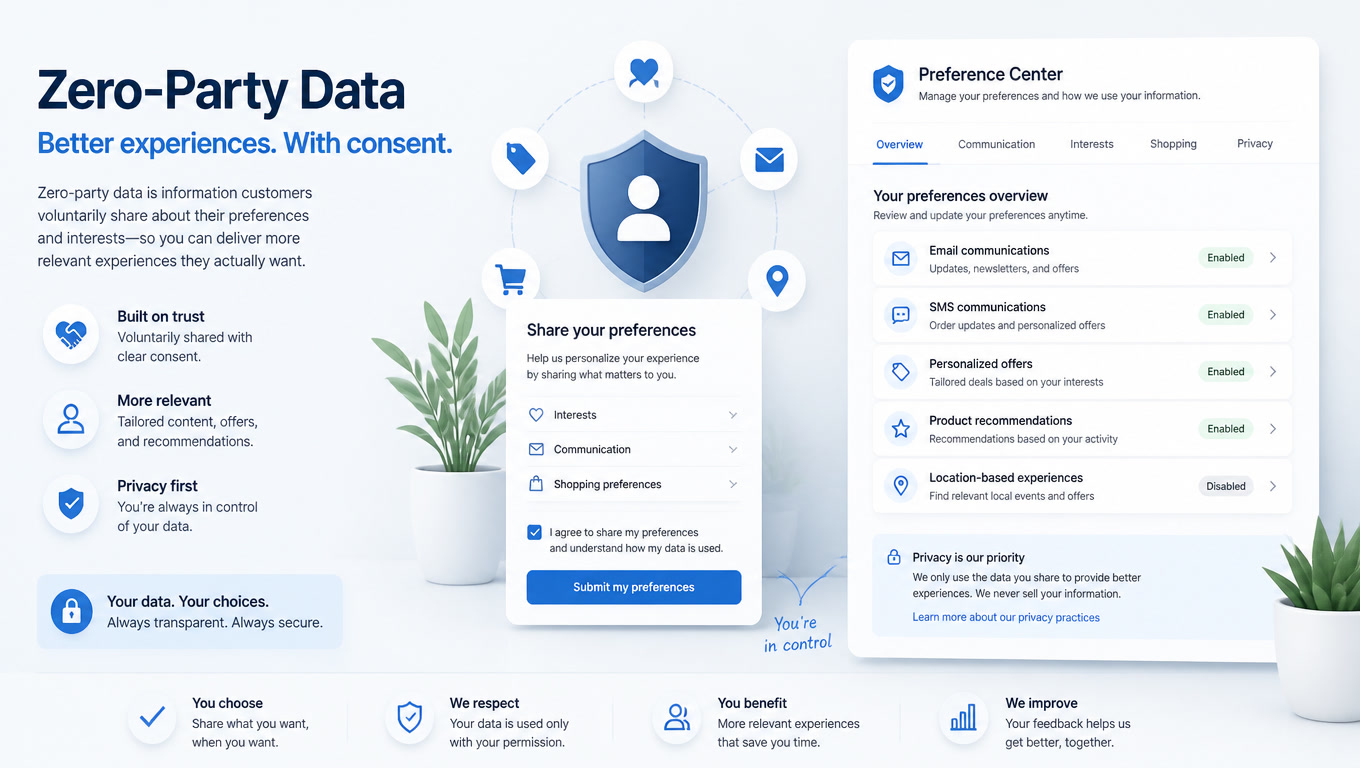
Enter zero-party data. It's the data a customer intentionally and proactively shares with a brand: preferences, purchase intentions, personal context. Not inferred. Not tracked. Given.
And it turns out, when you ask people what they want instead of guessing, the marketing works better.
What Zero-Party Data Is (and Isn't)
The terminology around data types has gotten muddy, so let's be precise.
- First-party data: Behavioral data you collect from your own channels. Purchase history, page views, email clicks. Observational.
- Zero-party data: Intentional data a customer shares with you. Product preferences, budget range, content interests, communication frequency preferences. Explicit.
- Second-party data: Someone else's first-party data that you buy or trade.
- Third-party data: Aggregated data from sources you don't have a direct relationship with. This is the category that's collapsing.
The distinction between first-party and zero-party is important. Knowing a customer bought running shoes from your store is first-party. Knowing they're training for a marathon and prefer cushioning over stability is zero-party. The first tells you what they did. The second tells you what they want.
According to Adobe research cited by Envive.ai, 60% of consumers will share personal information in exchange for tailored recommendations. The value exchange is clear: better input equals better output. The same research shows 52% of consumers share data for better recommendations, and 48% feel more comfortable with brands that use zero-party data specifically.
Why the Shift Is Happening Now
Three forces converged to make zero-party data not just ethical but strategically necessary.
1. Third-party data is dying. Google's phased deprecation of third-party cookies in Chrome completed in early 2026. Apple's Intelligent Tracking Prevention and Mozilla's Enhanced Tracking Protection had already neutered cross-site tracking on their browsers. The remaining third-party data market is fragmented, less accurate, and increasingly regulated. Deloitte reports that over 75% of marketing leaders expect the cookieless shift to disrupt their operations.
2. AI makes personalization more powerful — and more dependent on quality data. Here's the thing about AI-powered personalization: it needs signal. Real signal, not probabilistic guesses. An LLM trained on inferred demographics will produce generic recommendations. An LLM that knows a customer's stated preferences, budget, and buying stage can produce genuinely useful output. According to CDP.com's April 2026 analysis, AI agents can now use zero-party data to autonomously personalize customer interactions in real time — but only if the data is there to feed them.
3. Consumer expectations have changed. People know their data has value. They're increasingly unwilling to trade it for nothing. The marketing playbook that worked in 2019 — collect everything, sort it out later, target aggressively — now actively damages brand trust.
How to Collect Zero-Party Data
The methods are straightforward but require a shift in how you think about data collection.
Interactive content. Quizzes, preference centers, style finders, product matchers. These work because the user gets immediate value. A skincare brand's "find your routine" quiz collects skin type, concerns, and preferences — and the user gets a personalized product recommendation. Everyone wins.
Progressive profiling. Instead of asking for everything at once, collect data incrementally over multiple interactions. First visit: email and main interest. Second: budget range. Third: specific preferences. Each interaction is a small ask tied to clear value.
Post-purchase surveys. The best time to ask about preferences is right after a positive transaction. The customer is engaged, satisfied, and more likely to share.
Preference centers. Give users a dashboard where they can set their own communication frequency, content preferences, and product interests. The data is high quality because it's self-managed.
The common thread: every data request must be paired with explicit value. "Tell us your favorite genre so we can recommend books you'll actually like." Not "Tell us your favorite genre so we can add it to our database."
Measurement in a Cookieless World
This is where the practical anxiety lives. If you can't track users across sessions and sites, how do you measure campaign effectiveness?
The answer is incrementality testing and aggregated measurement.
Incrementality testing measures the lift caused by your marketing by comparing exposed groups to holdout groups. No user-level tracking required. You measure at the cohort level. According to Jasmine Directory's 2025 analysis, incrementality testing "doesn't require individual user tracking. You measure aggregate outcomes for groups, not individual conversion paths."
Contextual targeting has also made a comeback. Research from DoubleVerify and IAS, published in 2025, showed contextual ads performing within 5-8% of behavioral targeting on click-through rates and within 10-12% on conversion quality — while outperforming behavioral targeting on brand safety scores.
And server-side tracking — where you send first-party data from your own server rather than through a third-party tag — gives you cleaner, more reliable conversion data. It's harder to set up than dropping a pixel. But it works consistently, regardless of browser cookie policies.
The Role of AI in Zero-Party Data
This is the part I find genuinely interesting. Zero-party data and AI reinforce each other.
AI models need training data and real-time signal. Zero-party data provides both — and crucially, it provides the kind of signal that makes AI outputs feel personalized rather than generic. A chatbot that knows the customer's preferred communication channel, budget range, and purchase timeline can have a much more useful conversation than one guessing based on browsing behavior.
Tools like Mintec's AI personalization engine use zero-party data to adjust content, product recommendations, and messaging in real time. The data feeds the AI, the AI improves the experience, the improved experience encourages more data sharing. It's a virtuous cycle — but only if you have the zero-party data pipeline in place first.
Related articles
- The 8 digital marketing trends for 2021 (that you should know)
- What are metrics in digital marketing? Here are the 10 that you should always measure
- AI Video Marketing for Business: The Complete Guide
Building Your Zero-Party Data Strategy
Here's a practical starting point.
- Audit your current data sources. What are you collecting? Who owns it? Where is it stored? Be honest about how much of your current data is third-party or inferred.
- Identify the first high-value ask. What's the one piece of information that would most improve your marketing? Start there. Don't build a fifteen-question preference center on day one.
- Create the value exchange. The ask must be paired with a clear benefit. "Tell us your budget and we'll show you products in your price range."
- Connect data to activation. Zero-party data is useless if it sits in a spreadsheet. It needs to feed your CRM, your email platform, your personalization engine.
- Test incrementality. If you can't prove your cookieless marketing is working, you can't optimize it. Set up incrementality tests before you need them.
At Mintec, we help businesses build data strategies that work without third-party cookies. We design zero-party data collection flows, set up privacy-compliant tracking infrastructure, and connect the data to AI-powered personalization systems.
Explore our digital marketing services →
For more on privacy-first marketing, check out our guide to AI-driven content personalization at scale, our complete guide to AI-powered growth marketing, and our take on generative AI for unique brand assets.
Sources
- Marketing Tech News, "8 in 10 Americans concerned about online data privacy, but 48% trust zero-party data collection" (https://www.marketingtechnews.net/news/8-in-10-americans-concerned-about-online-data-privacy-but-48-trust-zero-party-data-collection/)
- Demand Local, "35 Zero-Party Data Collection Statistics in Marketing" (https://www.demandlocal.com/blog/zero-party-data-collection-statistics/)
- OneData Software, "Zero-Party Data: The Future of Digital Marketing After Cookie Death" (https://www.onedatasoftware.com/blog/zero-party-data-future-of-digital-marketing)
- CDP.com, "Zero-Party Data: The Next Frontier in Brand Loyalty" (https://cdp.com/articles/zero-party-data/)
- Envive.ai, "26 Zero-Party Data Collection Statistics for Ecommerce" (https://www.envive.ai/post/zero-party-data-collection-statistics)