AI Search Converts at 4x the Rate of Google — And Almost Nobody's Optimized for It
AI-referred visitors convert at 14.2% vs 2.8% from Google, per Q1 2026 data. Here's why the gap is so wide and a 4-step framework to capture AI search traffic before your competitors do.
AI Search Converts at 4x the Rate of Google — And Almost Nobody's Optimized for It
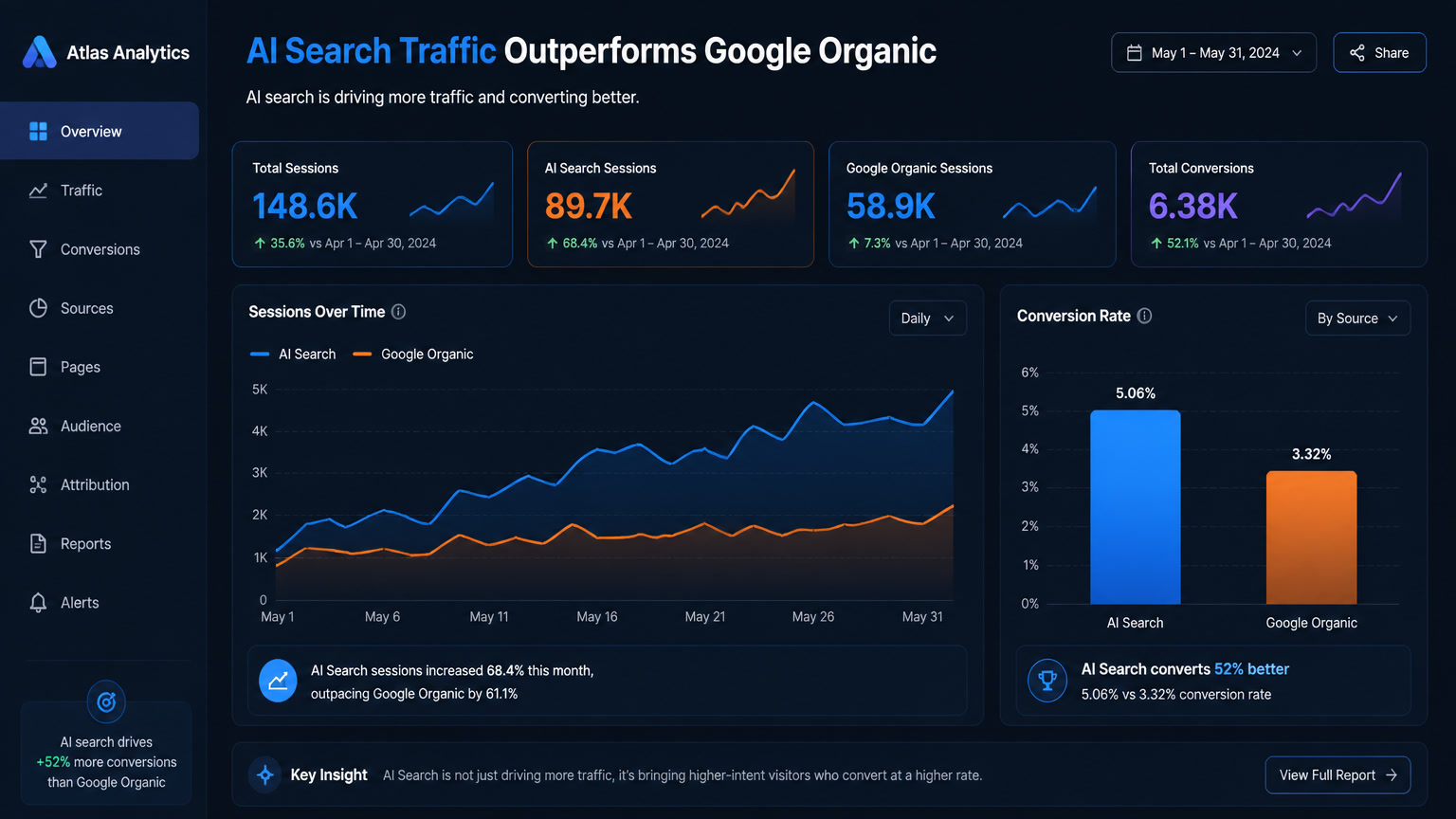
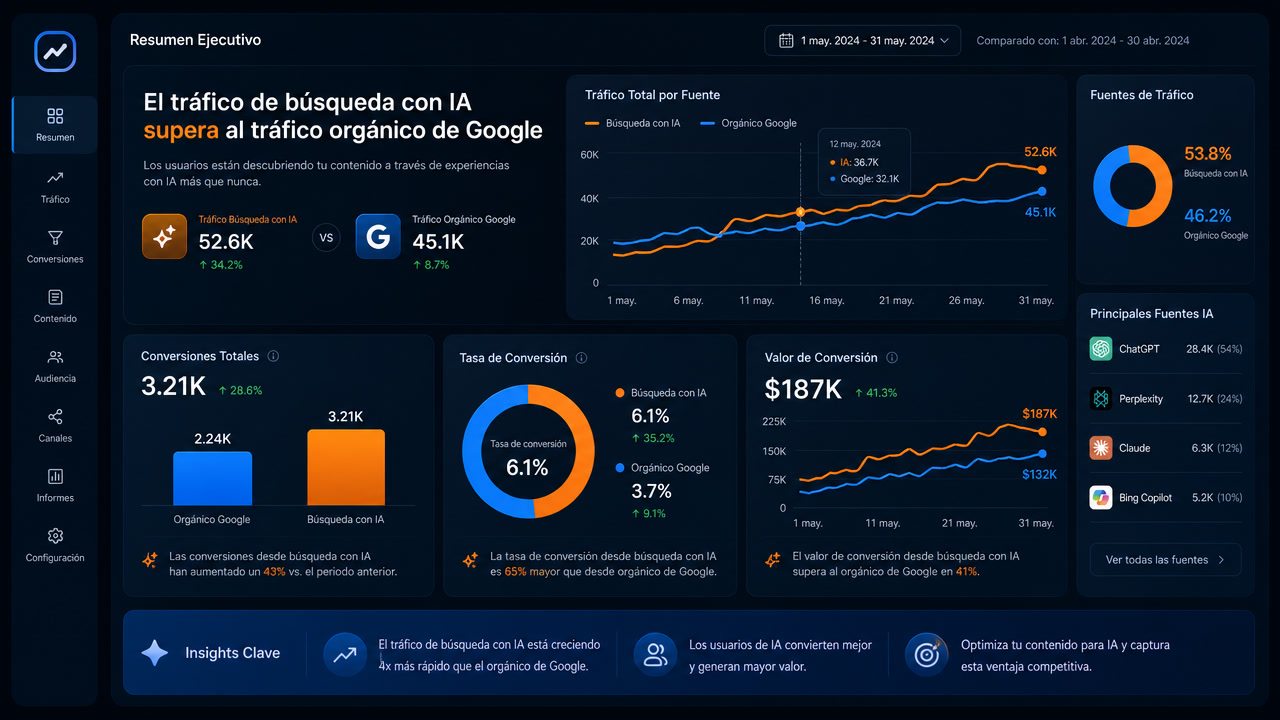
14.2% vs 2.8%. I keep coming back to these numbers.
Exposure Ninja published them in February 2026 comparing AI search referral conversion rates against Google organic traffic. AI visitors convert at five times the rate. Knotch, via Conductor's AEO/GEO Benchmarks Report, found the same pattern at 2x across a much larger panel of 13,770 domains. The multiplier varies by study — 2x, 4x, 5x — but the direction doesn't. It's consistent and getting stronger.
Volume is still tiny. AI referral traffic accounts for roughly 1.08% of total web traffic (Conductor, Q1 2026). IT and tech companies lead at 2.8%. But that number grew 300% year-over-year. 98% of CMOs are now investing in answer engine optimization.
Most brands treat AI search like a future problem. The data says it's already here — just distributed unevenly.
Why AI Traffic Converts Higher
The usual explanation is that AI users are "high intent." True, but that's too vague to be useful.
What actually happens: AI search users arrive pre-educated. They've already had their question answered, compared your offering against competitors, and narrowed their options inside the AI interface. By the time they click through to your site, they're past learning mode.
Google users click to learn. AI users click to do. That's the whole gap.
A B2B buyer searches "best marketing automation platform for mid-market companies" on Google, lands on a comparison page, reads for 4 minutes, bounces to check another result. The same buyer on ChatGPT gets a synthesized answer naming three platforms with specific pros and cons. When they click through to your pricing page, they already know why they're there.
The dark funnel gets darker. But the traffic that escapes it converts harder.
The AI Citation Catch-22
Here's the problem: the platforms that send the most traffic are the worst at citing sources.
ChatGPT accounts for 87.4% of all AI referral traffic (Conductor Q1 2026). But ChatGPT's citation rate is just 0.7% — it almost never links to source URLs. Perplexity, at 13.8% citation rate, and Google AI Mode, at 9.5%, are much better for driving actual clicks. But they account for a fraction of the traffic.
So you're stuck. The platform with all the volume doesn't send clicks. The platforms that send clicks don't have the volume. Yet.
This is why GEO can't just be about link building or chasing citations. It has to be a multi-platform visibility strategy where you optimize for being mentioned (ChatGPT) and being clicked (Perplexity, AI Mode) simultaneously.
The 4-Step Framework for Capturing AI Search Traffic
Based on what we've seen working at Mintec across client implementations and our own site, here's the playbook:
1. Audit Your Current AI Visibility Baseline
Before you optimize, know where you stand. Run queries related to your core topics across ChatGPT, Perplexity, Gemini, and Google AI Mode. Check whether your brand or content gets mentioned.
Tools like Superlines, Conductor, and Semrush's AI Visibility Index can automate this. But manual sampling — 20 queries across 3 platforms — will tell you 80% of what you need to know. Record whether you're cited, in what context, and whether the citation includes a link.
2. Structure Content for AI Extraction
AI models don't "read" your content the way humans do. They extract structured signals. The factors that correlate most strongly with AI citation:
- Direct answers within the first 100 words. Put your conclusion or answer at the top, not buried in paragraph four.
- Clear heading hierarchy (H1→H2→H3). AI parsers use heading structure to understand what a section covers.
- Specific data with attribution. Research reports with original data see 340% higher citation rates (Superlines Q1 2026). Statistics, benchmarks, and methodology transparency all boost trust signals.
- Comparison frameworks. Product comparisons see 156% higher citation rates. Pros/cons tables, feature matrices, and pricing comparisons are AI favorites.
- FAQ schema. If your topic naturally generates questions, add 2-3 FAQ entries. These directly feed AI response generation.
3. Optimize for Multiple AI Surfaces
Each AI platform favors different content characteristics. ChatGPT prioritizes authoritative, well-cited sources with high domain trust. Perplexity favors recent content with clear attribution and academic or data-backed claims. Google AI Mode pulls from structured data, featured snippets, and pages with strong heading hierarchy. And Gemini (which is growing fast) tends to favor visual content with strong alt text and image metadata.
The overlap is significant — good content performs well across platforms — but the emphasis differs. Lead with data for ChatGPT, structure for AI Mode, and timeliness for Perplexity.
4. Monitor and Refresh Monthly
40-60% of cited sources in AI responses rotate month over month (Semrush AI Visibility Index). Being cited once means nothing if you don't maintain it.
Set a monthly cycle: check citation status for your top 20 target queries, update content that's lost citations, add new data to pages that are still cited. Brands that stop updating lose AI citations within one to two months.
This is tedious. It's also the barrier to entry. Most brands aren't doing any of this yet, so the ones who build the habit now will be hard to dislodge later.
What This Means for Your Content Strategy
The standard content playbook — write for keywords, optimize for clicks, measure by traffic — is missing the point of where search is headed.
AI search changes the economics:
- You can generate value from being cited even when you don't get clicked (brand awareness, consideration, final decision influence)
- A single well-structured page can generate citations across multiple AI platforms
- The conversion rate on AI-referred traffic makes every click disproportionately valuable
- GEO is not a replacement for SEO. It's a new distribution layer that sits alongside it
If you're publishing 2026 content with 2020 SEO assumptions, you're leaving value on the table.
The Real Bet
I think the AI referral paradox is simpler than most GEO content makes it. AI users convert better because they arrive pre-educated. The click isn't the start of their journey — it's the end of one phase and the beginning of another. If your content answers questions clearly and structures information for extraction, you'll get cited. If you get cited enough, across enough platforms, you'll get clicks. And those clicks will convert at a rate that makes your Google traffic look like surface-level browsing.
The volume is still low. At 300% year-over-year growth, that changes fast. The brands building visibility now are betting on a distribution channel that barely existed 18 months ago. Early bets tend to pay off.
Frequently Asked Questions
How much more does AI search traffic convert versus Google?
Multiple Q1 2026 studies show AI-referred traffic converts at 2-5x the rate of traditional organic Google traffic. Exposure Ninja reported 14.2% for AI vs 2.8% for Google. Knotch (via Conductor) found 2x higher conversion rates. The range varies by industry, but the pattern is consistent: AI users convert at a significantly higher rate.
Why does AI search traffic convert better than Google traffic?
AI search users arrive pre-educated. They've already had their question answered, compared options, and narrowed their decision in the AI interface itself. By the time they click through, they're past the research phase and closer to taking action. Google users typically click to learn — AI users click to do.
How much AI referral traffic do websites actually get?
In Q1 2026, AI referral traffic accounted for 1.08% of total web traffic across 10 industries, according to Conductor's analysis of 13,770 domains. IT and technology companies lead at 2.8%. While the volume is small, it's growing at 300% year-over-year, and the conversion rates make it disproportionately valuable.