Testing Threads Ads at Scale: The API Pipeline Most Advertisers Skip
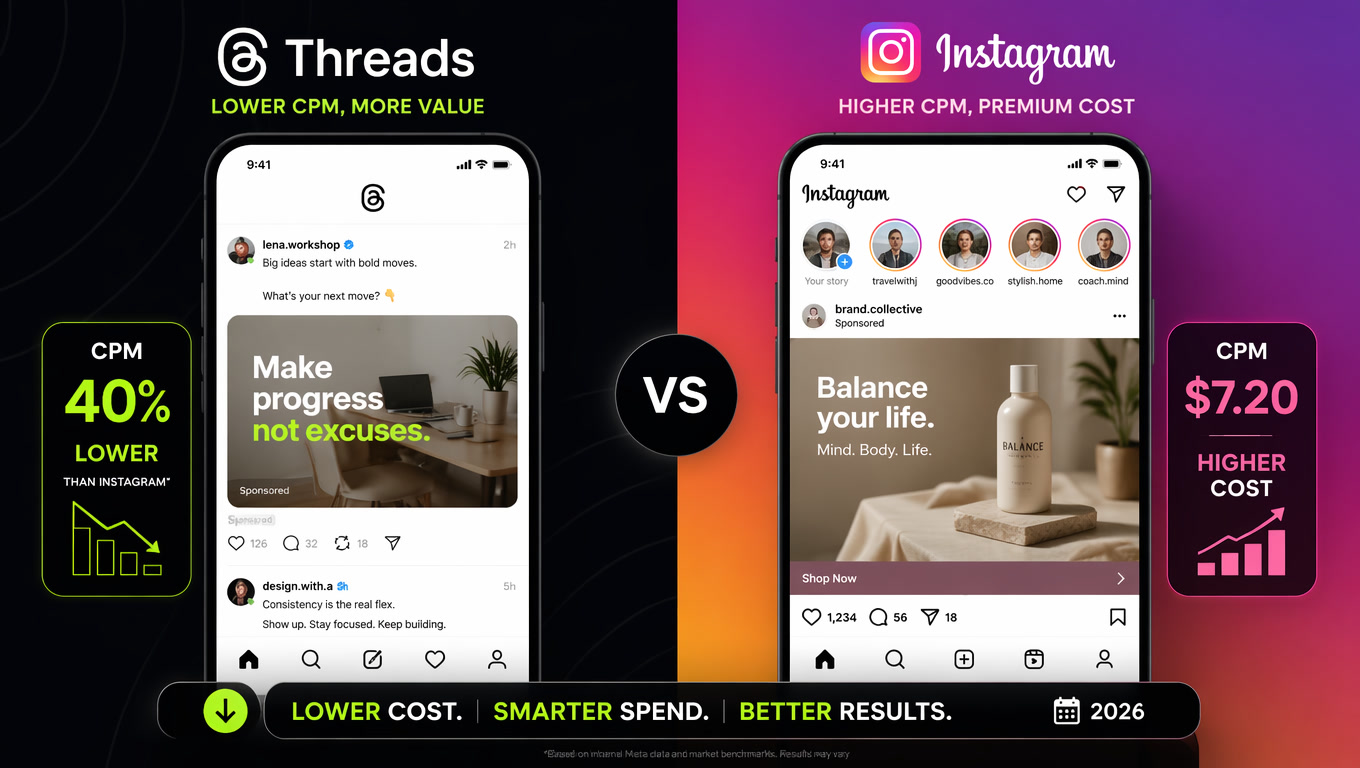
Threads Ads are the cheapest placement inside Meta's ecosystem — CPMs 30-40% below Instagram Feed, double the CTR, and only 0.04% of Meta's total ad spend. But the reason most advertisers fail on Threads isn't budget or creative quality: it's operations. The Threads API, expanded in 2026 with bulk scheduling, publishing and analytics, is the automation layer that makes Threads-native creative testing viable at scale. This is the three-stage pipeline we use at Mintec to test Threads ads before the arbitrage window closes.
Testing Threads Ads at Scale: The API Pipeline Most Advertisers Skip
Threads Ads are the cheapest placement inside Meta's ecosystem right now — CPMs 30-40% below Instagram Feed, click-through rates roughly double, and only 0.04% of Meta's total ad spend landing on the platform. But after six months of running Threads-only pilots for clients, we've concluded the reason most advertisers fail there isn't budget, targeting, or even creative quality: it's operations. Threads rewards a testing cadence that manual publishing cannot sustain, and the Threads API — expanded through 2026 with bulk scheduling, publishing and analytics — is the missing automation layer. Most advertisers don't use it, and that's exactly why the arbitrage window still exists.
We've written before about the numbers behind this window — the CPM arbitrage on Threads and the B2B lead-gen playbook — but this article is about the piece everyone skips: the operational pipeline that makes Threads testing viable at the volume the platform actually rewards. This is how we structure it at Mintec, with the API as the backbone.
The arbitrage everyone quotes and the ops nobody builds
The data is consistent across roughly 140 agency-managed accounts tracked since Threads Ads launched globally on January 21, 2026: ecommerce campaigns run at $8.20 CPM on Threads versus $13.40 on Instagram Feed, with 2.3% CTR versus 1.1%, and CPCs dropping from $1.22 to $0.36. For B2B SaaS, the pattern holds: $11.40 CPM versus $18.60, 1.7% CTR versus 0.8%, $0.67 CPC versus $2.33.
But here's the part the benchmark tables don't show: those numbers only materialize when the creative matches the platform. Run your Instagram creative on Threads and it underperforms; write for the feed and the same offer can triple its CTR. We've measured this inside our own accounts — an image-led ad at 0.8% CTR climbed to 2.5% after a text-first rewrite. The format is the same. The approach is not.
That mismatch creates a self-reinforcing loop that keeps the placement cheap: most advertisers ship Instagram-style creative → it underperforms → Meta's algorithm down-weights it → delivery drops → the advertiser concludes "Threads doesn't work" → demand stays artificially low → CPMs stay cheap. The window is real, but it's being kept open by a creative failure, not by a lack of audience.
And the creative failure is really an ops failure. Threads-native advertising is text-first and conversational: question hooks, contrarian statements, stats that read like a post, not a billboard. That style of creative dies fast — a hook that works for three days goes stale because the feed moves at the speed of conversation. To find winners you need to ship variants at a cadence most in-house teams and agencies simply can't sustain manually. One image ad per week, refreshed when someone remembers, is not a testing strategy. It's a coin flip.
What the Threads API actually does in 2026
The Threads API is part of Meta's Graph API family, which means if you've worked with Instagram or Facebook APIs, the shape is familiar: REST endpoints, JSON responses, OAuth 2.0 authentication, and scoped permissions. Publishing requires the threads_publishing_content scope; reading profile, posts and analytics uses threads_basic. The core endpoints cover /threads for publishing and /threads_replies for managing replies, with rate limits applied at the app level.
What changed through 2026 is that Meta has been steadily expanding the API from a bare-bones publishing interface into a real operations tool. Meta's own developer blog detailed the updates in April 2026, and the coverage since has been consistent: more content formats, deeper discovery, moderation workflows, and — most importantly for brands — proper scheduling and engagement management. Third-party schedulers have been shipping Threads support off the back of this expansion, which tells you the capability is now mainstream enough to build on.
There are still sharp edges worth knowing before you plan around it:
- No post editing. Once published via the API, a post cannot be edited. Your QA process has to happen before publishing, not after.
- No reply threading through the publishing endpoint. You can't programmatically create multi-post threads, which matters if your content engine generates thread-style hooks.
- It doesn't manage ads. The Threads API is for organic publishing, analytics and replies. Threads ads live in Meta Ads Manager like any other placement.
That last point is the one most people get wrong. The API isn't an ads tool — it's the content engine that feeds the ads. And in 2026, with the arbitrage window still open, the combination is what separates teams that can exploit Threads from teams that just talk about it.
The three-stage pipeline we use at Mintec
Here's the structure we've landed on after running Threads tests across accounts since February. It's not exotic — it's the same discipline as creative testing under Andromeda, applied to a placement that needs higher volume and faster iteration:
| Stage | What happens | Tooling | Signal to watch |
|---|---|---|---|
| 1. Content engine | Generate text-first hook variants (question, stat, contrarian opinion) — 5 to 10 per campaign, scheduled in batches | Threads API + a simple content calendar or scheduler | Variant diversity, not polish |
| 2. Placement test | Threads-only manual placement campaign, $30-50/day, 30 days, single offer | Meta Ads Manager | CTR by hook format, not by image |
| 3. Signal loop | Pull analytics weekly, kill underperformers, feed winners back into the rotation | Threads API analytics + Ads Manager reporting | Hook formats that beat the account CTR baseline |
Stage 1 is where the API earns its keep. A content engine means hooks are generated in batches, reviewed once, and queued through the API with a week of runway. The cadence we aim for is five to ten text-first variants per campaign, refreshed twice a week — a volume that's simply not realistic with manual publishing. One warning from the Andromeda era applies directly here: don't ship near-duplicate variants. Meta's creative similarity systems treat near-identical hooks as the same ad, which collapses your effective variant count. Each hook needs a genuinely different angle.
Stage 2 keeps the test clean. We run Threads as a manual, Threads-only placement rather than burying it inside an Advantage+ campaign, because the whole point is isolating placement-level signal. If you're not ready for a dedicated pilot, the Advantage+ decision framework tells you when inclusion is the right call — but for learning, isolation wins. The $30-50/day pilot budget is enough because CPMs are roughly 40% lower than Instagram: you get the same impression volume at half the price, which is precisely why the window is worth exploiting now.
Stage 3 closes the loop. Weekly, we pull engagement and delivery analytics, compare hook formats against the account's CTR baseline, kill anything below it for two consecutive weeks, and promote winners into broader rotation. The winners then get repurposed — the same insight applies on TikTok, where single-ad accounts die from creative starvation. Threads is the same game with a cheaper entry ticket.
Who should build this now
The window math hasn't changed since we first mapped it: Threads launched ads in January 2026, and historical precedents — Instagram Stories in 2018, Reels in 2022 — suggest 9 to 15 months before CPMs normalize. That puts the closing somewhere between late 2026 and early 2027. Every month you wait, you're spending the cheapest months of the window on preparation instead of learning.
- Build the pipeline now if: your brand is verbal — B2B, SaaS, media, professional services, or anything with a strong point of view. These are the accounts where text-first creative wins fastest and the ops investment pays back in the first month.
- Wait if: you're a purely visual brand (fashion, decor, art) or running on a budget so tight that a $30-50/day pilot would cannibalize an active campaign. The window will still be open in Q4 — but don't expect to catch it without the pipeline.
The teams that win this arbitrage won't be the ones with the best hooks. They'll be the ones who built the publishing, testing and measurement loop while everyone else was still deciding whether Threads "counts." The API turned Threads from a placement into a pipeline — use it like one.
Frequently Asked Questions
Can you schedule Threads posts through the Threads API?
Yes. The Threads API supports scheduling and bulk publishing through the Meta Graph API with OAuth 2.0 authentication. Meta expanded these capabilities in 2026, so third-party scheduling tools and custom integrations can queue Threads posts in batches and publish them automatically.
Does the Threads API let you manage Threads ads?
No. Threads ads run inside Meta Ads Manager like any other placement. The Threads API covers organic publishing, scheduling, analytics and reply management. The winning setup combines both: use the API as the content engine that produces and schedules Threads-native creative, and Ads Manager as the distribution layer that tests it.
Is the Threads API free to use?
Access to the Threads API is free through Meta's Graph API, with standard rate limits and app review requirements. You need the threads_basic scope to read profile and post data and threads_publishing_content to publish text, images, video and carousels.