
Social Commerce 2026: Why Creator-Powered Commerce Is Growing 4x Faster Than E-Commerce
Social commerce driven by creator partnerships is growing four times faster than traditional e-commerce. Data from the Shop Social report, real brand case studies, and a 4-phase framework to launch your TikTok Shop or Instagram Shopping strategy.
Social Commerce 2026: Why Creator-Powered Commerce Is Growing 4x Faster Than E-Commerce
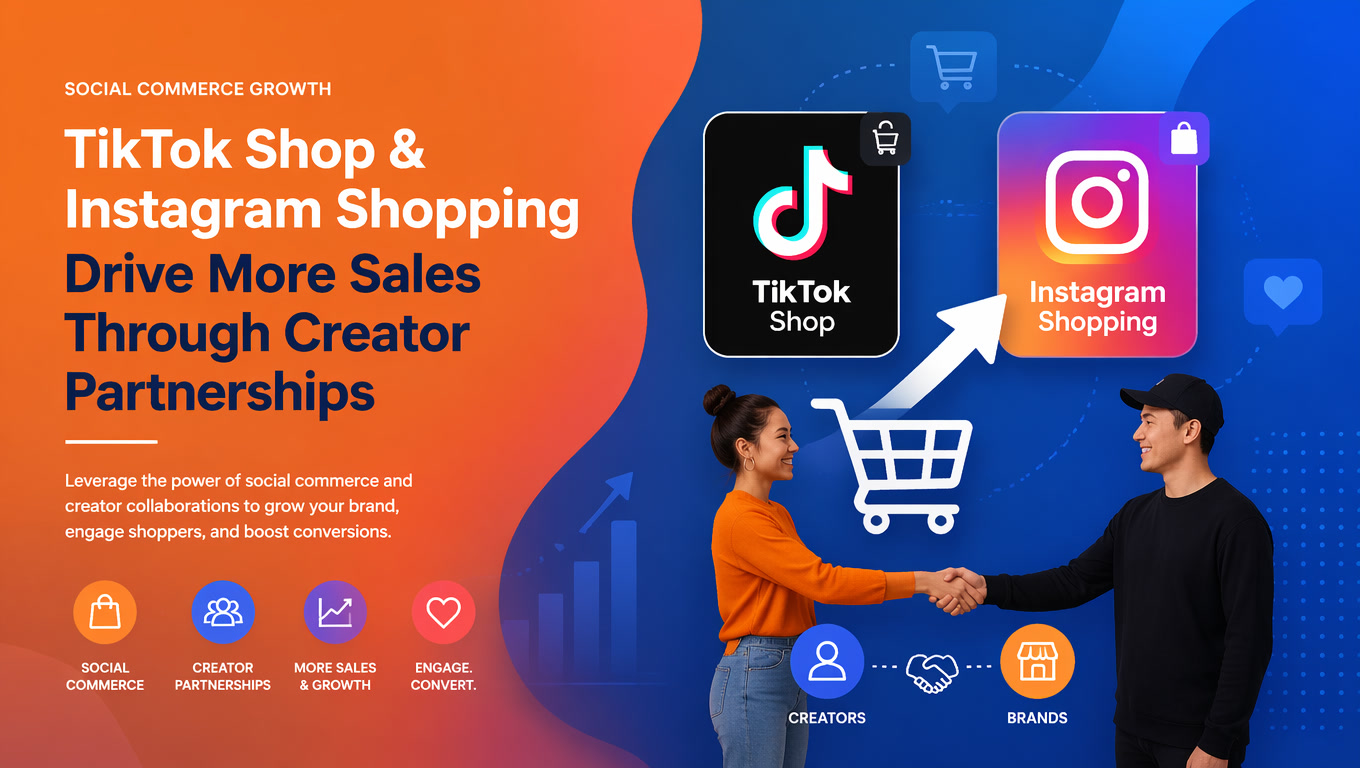
If your digital strategy still treats marketing and sales as separate functions — publish on social to drive traffic, convert on your website — you're missing the biggest structural shift in commerce in a decade. Social commerce (direct purchases inside platforms like TikTok Shop, Instagram Shopping, and Facebook Shop) is growing four times faster than traditional e-commerce, according to the Shop Social report published by Influencer in June 2026.
This isn't a distant projection: global social commerce is on track to reach $8.5 trillion by 2030, with a 29% compound annual growth rate. To put that in perspective, TikTok Shop alone will generate $23.41 billion in US sales this year, a 48% increase over 2025, per EMARKETER.
But the number that matters most isn't the market size — it's how the brands already winning are growing.
What's driving it: creator partnerships are the engine
The Shop Social report draws on data from Sprout Social, Impact.com, GWI, Bazaarvoice, and the platforms themselves to understand the growth mechanics. The finding is unambiguous: creator partnerships are the fuel of social commerce.
Key consumer data from the report:
- 49% of consumers make purchases at least once a month as a direct result of creator posts.
- 88% of TikTok Shop users have discovered brands they want to buy on the platform — the highest rate of any social network surveyed.
- 54% of consumers say influencers directly affect their purchase decisions.
- 46% prefer short-form video for product discovery and evaluation, far ahead of any other format.
What these numbers reveal isn't just that social commerce works — it's that discovery and purchase are converging in the same digital environment, a shift we explored in our analysis of top social media platforms in 2026. Consumers no longer need to leave TikTok or Instagram to find, evaluate, and buy a product. Brands that understand this are rewriting their sales funnels.
The three-tier creator framework
One of the most actionable findings in the Shop Social report is the three-tier creator model that brands are using to structure their social commerce programs:
1. Ambassadors (top of funnel)
VIP or macro creators, compensated via flat fees. Their job is demand creation and brand elevation at scale. They're not measured on direct conversions but on making your brand part of the cultural conversation.
2. Tastemakers (middle of funnel)
The middle tier: a reduced flat fee plus commission. They convert brand awareness into purchase intent. They are the bridge between visibility and transaction.
3. Accelerators (always-on)
Micro and nano creators running commission-only programs. Their strength is continuous product discovery and recurring sales. The report notes that a creator with 15,000 followers generating $10,000 in monthly sales represents more commercial value at this tier than a creator with ten times that audience but lower conversion rates.
What makes this framework work? The key is running all three tiers as a single connected engine, not independent programs. Brands that activate influencer and affiliate programs simultaneously see a 46% sales uplift compared with either channel alone (Impact.com, 2025).
Real cases: from framework to revenue
Resident (NectarSleep, DreamCloud)
In a head-to-head test, a traditionally produced brand spot scored 0.89 on Resident's return on ad spend index. An ad built from creator-generated content — with no production cost beyond a gifted mattress — scored 1.08. Resident's VP of Affiliates, Influencers, and Partnerships, Jennifer Bentz, reported that integrating both channels doubled the value of each post and video.
Garnier (Vitamin C Line)
Their 2025 TikTok Shop campaign hit 286% of GMV target across 50 hours of live shopping content, using a layered creator strategy spanning celebrity talent, mid-tier creators, and community creators.
OLIPOP (Prebiotic Soda)
Built a program with nearly 1,900 creators, including 82 registered dietitians. By 2024, the creator channel contributed 12% of OLIPOP's total sales, with an average ROAS of 982% across the program. The highest single-campaign ROAS reached 1,200%. These results align with what we cover in our AI video marketing guide: creator-generated content combined with scalable production is redefining ad ROAS.
"Brands need to build a three-tier creator system: Ambassadors for demand creation, Tastemakers for conversion, Accelerators for always-on sales, and run them as a single connected engine." — Hayden Bowler, VP of Commerce, North America at Influencer
TikTok Shop's LATAM opportunity
For brands operating in Latin America, social commerce is not a distant trend. TikTok Shop is actively restructuring Latin American commerce through social engagement, instant purchases, and personalized financial experiences, according to a Galileo analysis.
Key insight: 34.5% of TikTok Shop beauty buyers are 55 or older. This shatters the myth that social commerce is Gen Z only. Adoption is cutting across every age group in LATAM.
At Mintec, we're seeing retail and beauty brands in Mexico, Colombia, and Argentina begin to structure their creator programs not as isolated campaigns but as permanent sales channels. The difference between those who scale and those who stall isn't budget — it's the decision to treat social commerce as a content channel, not a sales channel.
How to start: a 4-phase playbook
Based on the report's findings and our work with clients across LATAM and the US, here's the framework we recommend:
Phase 1: Platform audit Determine where your audience actually shops. Not every brand needs to be on TikTok Shop, Instagram Shopping, and Facebook Shop simultaneously. Audit your current audience data and pick the platform where your category has the most traction.
Phase 2: Tiered creator recruitment Start with 5–10 creators at the Accelerator level (pure commission) to validate your model. Once you have data on which products convert and which formats work, scale to the Tastemaker tier with reduced flat fees plus commission.
Phase 3: Data integration The biggest mistake we see is treating creator programs as separate from paid media strategy — especially now that Meta's Andromeda algorithm prioritizes creative quality over audience targeting. Connect your creator partnership data with your Meta Ads and Google Ads campaigns. Brands that integrate these datasets see the value of every content asset double.
Phase 4: Continuous optimization Measure not just direct sales, but the impact of creator content on your brand metrics: product searches, site visits, organic social engagement. Creator content is an asset that appreciates over time.
The gap brands need to close now
The Shop Social report identifies a structural gap: 72% of creators want long-term brand partnerships, but only 54% currently have them. That's 18% of creators ready to commit who brands are leaving unaddressed.
Emily Eldridge, Director of Commerce, EMEA at Influencer, sums it up: "The challenge is operational: it requires alignment across merchandising, content, partnerships, and data. This isn't a budget problem — it's a coordination problem."
Social commerce isn't the future of digital commerce. It's the present. And the brands that start building their creator partnership programs today — with a clear framework, integrated metrics, and a long-term view — will be the ones dominating the next five years.
At Mintec, we help brands design and implement social commerce strategies powered by creator partnerships. Contact us for a free audit of your current program.
Sources: Shop Social Report by Influencer (June 2026), EMARKETER FAQ on Social Commerce (Jan 2026), Bain & Company — Is Your Brand Ready for TikTok Shop?