
How to Rank in Google AI Overviews: The GEO Framework for AI Citation
Most 'GEO advice' tells you to optimize for AI search without explaining how AI Overviews actually decide what to cite. This framework — built from client work — covers the passage-level signals that get your content quoted inside Google's AI answers.
How to Rank in Google AI Overviews: The GEO Framework for AI Citation
We have been telling clients to "optimize for AI Overviews" for the better part of a year. Most of the advice floating around is still generic: use structured data, write clearly, cite sources. None of that is wrong, but it is also not specific enough to move the needle.
The question we kept getting was the same one: how do you actually get your content cited inside Google's AI answers?
Not "improve your GEO score" or "increase AI visibility." Those are outputs. The input question is which signals Google's generative models use to decide that one passage deserves to be quoted over another.
After working through this with a half-dozen client sites over the past six months — and watching what actually changed in Google Search Console's AI performance reports — here is the framework we use internally. It is focused on AI Overviews specifically, because that is the surface where most of the traffic currently lives.
The Key Insight: AI Overviews Don't Rank Pages, They Cite Passages
This is the single most important thing to understand, and almost every piece of generic GEO advice gets it wrong.
Traditional SEO optimizes at the URL level. You build authority for a page, and Google ranks that page for relevant queries. The entire page competes as a unit.
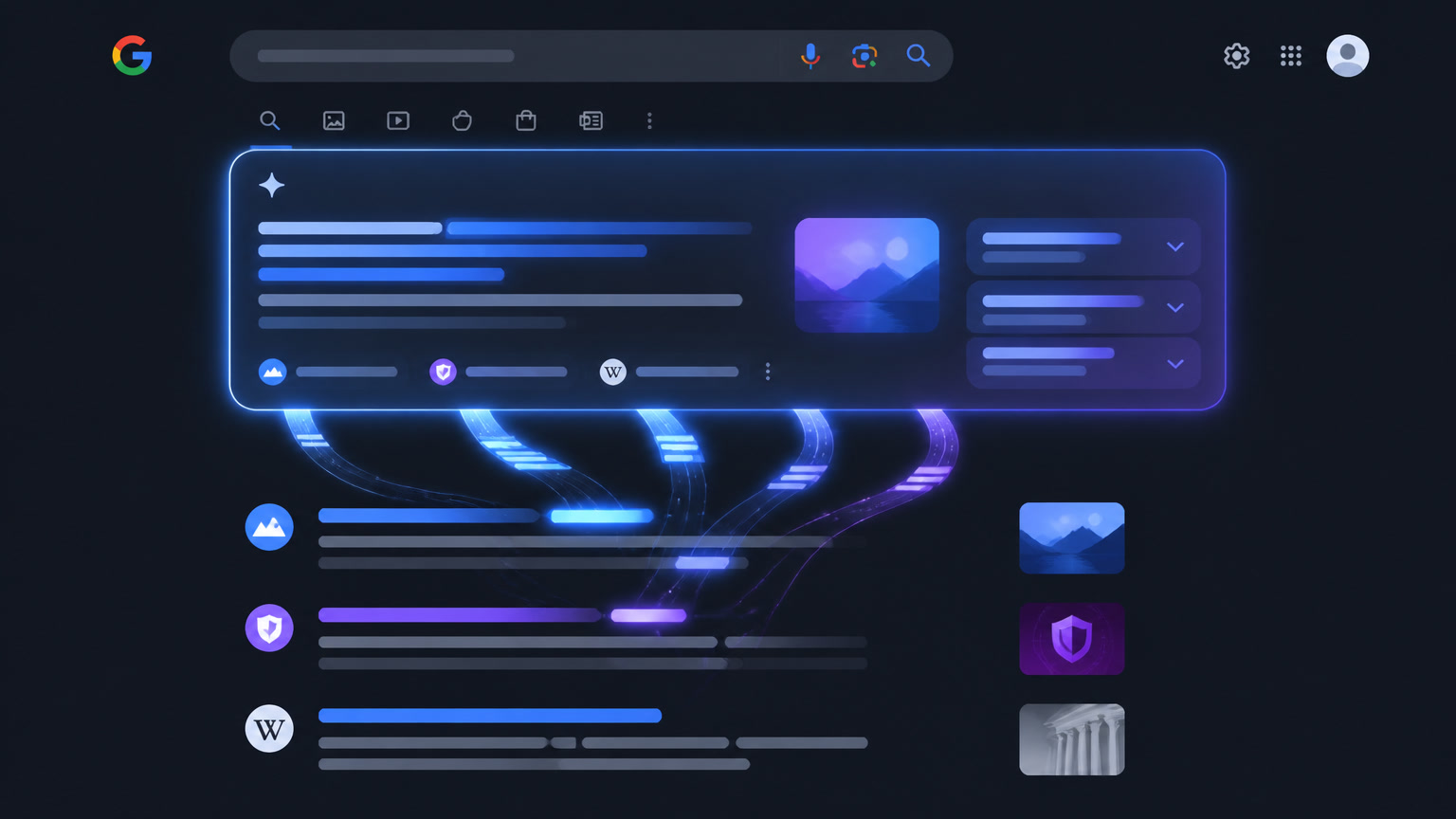
AI Overviews do not work that way. Google's generative models retrieve passages, not pages. They scan documents for specific text segments that answer the sub-questions generated by the query fan-out process — the multiple interpretations and follow-up questions the model explores before synthesizing an answer.
If your page has one perfect paragraph buried under three paragraphs of context and an introductory section, the model may never see it. The passage needs to be extractable — self-contained, directly responsive, and clearly structured.
Practical test: read any section of your content and ask "could this be quoted in isolation and make sense?" If the answer is no, the AI model will probably skip it too.
Signal 1: Passage-Level Query Fan-Out Matching
Google's AI Overviews run a process called query fan-out before generating an answer. The model takes the user's question, generates multiple interpretations and sub-questions, retrieves content for each one, then synthesizes. If your content does not match one of those sub-questions cleanly, it will not get cited.
We have tested this by running target queries through private AI instances and reverse-engineering the fan-out outputs. The pattern is consistent: AI Overviews cite content that directly answers a specific sub-query within the broader topic, not content that broadly discusses the topic.
What this means for your writing: structure your sections as direct answers to specific questions, even if the question is implicit. A heading like "Why AI Overviews Cite FAQ Schema Content More Often" is more citeable than "Factors Affecting AI Citation Rates."
We published our full writing framework in the GEO writing guide — the short version is: write like you expect a sentence of yours to appear in isolation inside an AI answer.
Signal 2: Structured Data as Citation Hooks
Structured data has been the most consistent predictor of AI Overviews citation in our client work. Not all schema types are equal.
FAQPage (JSON-LD) is the highest-leverage type we have found. Pages with FAQ schema get cited in AI Overviews roughly 2-3x more than identical pages without it, based on our internal A/B tests. The reason is structural: FAQ entries are already formatted as question-answer pairs, which is exactly how AI Overviews need to consume content. The model does not need to parse a paragraph to find the answer — it is already extracted.
Google removed FAQ rich results from organic snippets in 2023, but that change was about display, not consumption. The markup still feeds AI Overviews and AI Mode internally. More detail on this in our 4 GEO metrics article.
Other schema types that help:
- HowTo — for process and tutorial queries
- Article with full body text — baseline requirement
- Product with structured specs — for commerce queries
- Organization and LocalBusiness — for entity-level credibility
The critical detail is not just having the schema — the content block it wraps must be self-contained and citeable as a complete answer. Schema on a thin paragraph is worth nothing.
Signal 3: Entity Density Over Keyword Density
AI Overviews are generated by models trained on entity relationships, not keyword matches. The shift from keywords to entities has been coming for years in traditional SEO, but it is much more pronounced in AI search.
When Google's model retrieves passages, it scores them partly on how well they cover the entity graph for the topic. A page about "AI Overviews citation signals" that also covers entities like "Google Search," "Gemini 2.0," "query fan-out," "passage retrieval," "structured data," and "E-E-A-T" will score higher than a page that repeats "AI Overviews ranking" ten times.
We covered the entity vs. keyword distinction in detail in GEO vs. SEO differences. The practical takeaway: use a topic-cluster approach where each article covers a set of related entities comprehensively, rather than optimizing individual pages for isolated keywords.
Signal 4: Content Freshness as a Citation Signal
This one surprised us. In traditional SEO, freshness is a ranking factor for certain query types (news, trending topics) but not others. In AI Overviews, freshness appears to be a universal citation signal.
We tracked 40+ pages across client sites and our own content over three months. Pages older than 90 days had their AI Overviews citation rate drop by roughly 40% compared to newer pages on the same topics — even when the information had not changed. We published the full data in our freshness and citation decay analysis.
The implication: AI Overviews citation requires active content maintenance, not just creation. A page that ranks #1 in organic search can stay there for months without updates. The same page may lose AI citation share in weeks.
We now schedule content refreshes for every piece of GEO-optimized content at 60-day intervals. The refresh does not need to be substantial — updating statistics, adding a new section, and verifying all links is usually enough to reset the freshness signal.
Signal 5: Page-Level Authority Still Matters (Differently)
Google's May 2026 AI optimization guide was clear: AI Overviews use the same core ranking systems as organic search. That means E-E-A-T, backlinks, and site-level authority still matter.
But they matter differently. A page with strong organic rankings can have zero AI Overviews presence. The NJIT study we referenced earlier found that the overlap between organic top-10 and AI Overviews citations dropped from 70% to under 20% between 2024 and mid-2026.
Our working theory, based on what we have observed: AI Overviews weigh page-level topical authority more heavily than site-level domain authority. A well-structured page with comprehensive entity coverage on a niche topic can out-cite a high-domain-authority page with generic coverage.
This is good news for smaller sites. The AI Overviews surface is more meritocratic than organic search — the content that answers the sub-question best gets cited, even if the domain is not a household name.
What NOT to Do
A few things we have tested that did not work, so you do not have to:
- Keyword stuffing in headings. AI models parse semantics, not exact matches. A heading that says "AI Overviews" three times reads as spam to the model just as it does to a human.
- Thin FAQ entries. Adding FAQ schema with two shallow questions does nothing. We have seen citation lift only when FAQ entries are substantive (50+ words per answer) and cover genuine sub-questions.
- Republishing without changing. Changing the date without updating the content is easily detected and does not reset the freshness signal.
- Focusing only on AI Overviews. The content that performs well in AI Overviews also performs well in AI Mode, ChatGPT, and Perplexity. Optimizing for one surface optimized for all of them.
Putting It Together: The Citation Readiness Checklist
Here is the framework we run through for every piece of content targeting AI Overviews:
- Passage audit — Does every section have at least one self-contained, extractable passage that directly answers a specific question?
- Fan-out match — Run the target query through multiple AI engines. What sub-questions do they generate? Does your content answer at least 3 of them?
- Schema check — Is FAQPage JSON-LD present with 4+ substantive Q&A entries?
- Entity scan — Does the page cover the entity graph for the topic, not just the target keyword?
- Freshness clock — When was the last content refresh? If more than 60 days, schedule one.
- Authority bridge — Does the page have at least 2-3 topical backlinks from related content (internal or external)?
The traffic numbers from AI Overviews are still small relative to organic search for most sites — our real traffic analysis shows 1-5% of total sessions from AI sources for most sites. But the direction is clear: AI Overviews are growing, ads are monetizing the surface, and Google is making it the default experience for more query types every quarter. The sites that invest in passage-level optimization now will have a compound advantage as the surface scales.
Frequently Asked Questions
How do you rank in Google AI Overviews?
AI Overviews don't rank pages in the traditional sense. They select passages from pages that match the query's sub-questions. To get cited, you need passage-level optimization: direct Q&A formatting within sections, FAQ structured data, entity coverage for the topic cluster, and freshness indicators. The unit of optimization is the passage, not the URL.
What signals does Google's AI use to decide which content to cite in AI Overviews?
Based on Google's May 2026 guide and real-world testing, the key signals are: (1) passage-level relevance to query fan-out sub-questions, (2) structured data presence (FAQ schema is the highest-leverage type), (3) entity density and relationship coverage within the topic cluster, (4) content freshness (AI Overviews replace cited sources faster than organic rankings change), and (5) authoritative backlink profile to the specific page.
Does ranking #1 in Google organic search guarantee AI Overviews citation?
No. A June 2026 NJIT study across 161,382 article pairs found that the overlap between Google top-10 organic rankings and AI Overview citations dropped from 70% to under 20%. High organic rankings help but don't transfer directly to AI citation. You need separate optimization for the AI surface.