
B2B Lead Generation: Strategies That Actually Convert
Traditional B2B lead costs have doubled in three years. Buyers do 70% of their research before talking to sales. Here's a data-driven look at multi-channel funnels, AI-assisted prospecting, and nurturing automation — with data from Gartner, HubSpot, and real deployments.
B2B Lead Generation: Strategies That Actually Convert
B2B lead generation is in an awkward spot right now. The channels that worked two years ago — LinkedIn Ads, Google Ads on commercial terms, virtual trade shows — deliver less and less for every dollar spent. Buyers are more skeptical, better informed, and harder to reach.
And yet some companies are filling their pipeline without breaking a sweat. They are not bigger. They do not have bigger budgets. They just changed how they think about prospecting.
The core problem
The Gartner data point that stayed with me this year: B2B buyers spend only 17% of their total purchase time meeting with potential suppliers. The rest they spend researching independently — reading reviews, asking peers, evaluating options on their own.
Translation: by the time a prospect books a call with you, they have already decided whether your solution interests them. You are not competing on the call. You are competing in the 30 days before it, when you have no control over what they read or who they talk to.
Another number worth sitting with: according to LinkedIn, 77% of B2B buyers describe their last purchase as "very complex or difficult." It is not that they need more information. They need someone to help them navigate the complexity.
B2B lead gen strategy in 2026 is not about more volume. It is about being present at the right moment, with the right message, when the buyer is ready to move.
The funnel is not linear anymore
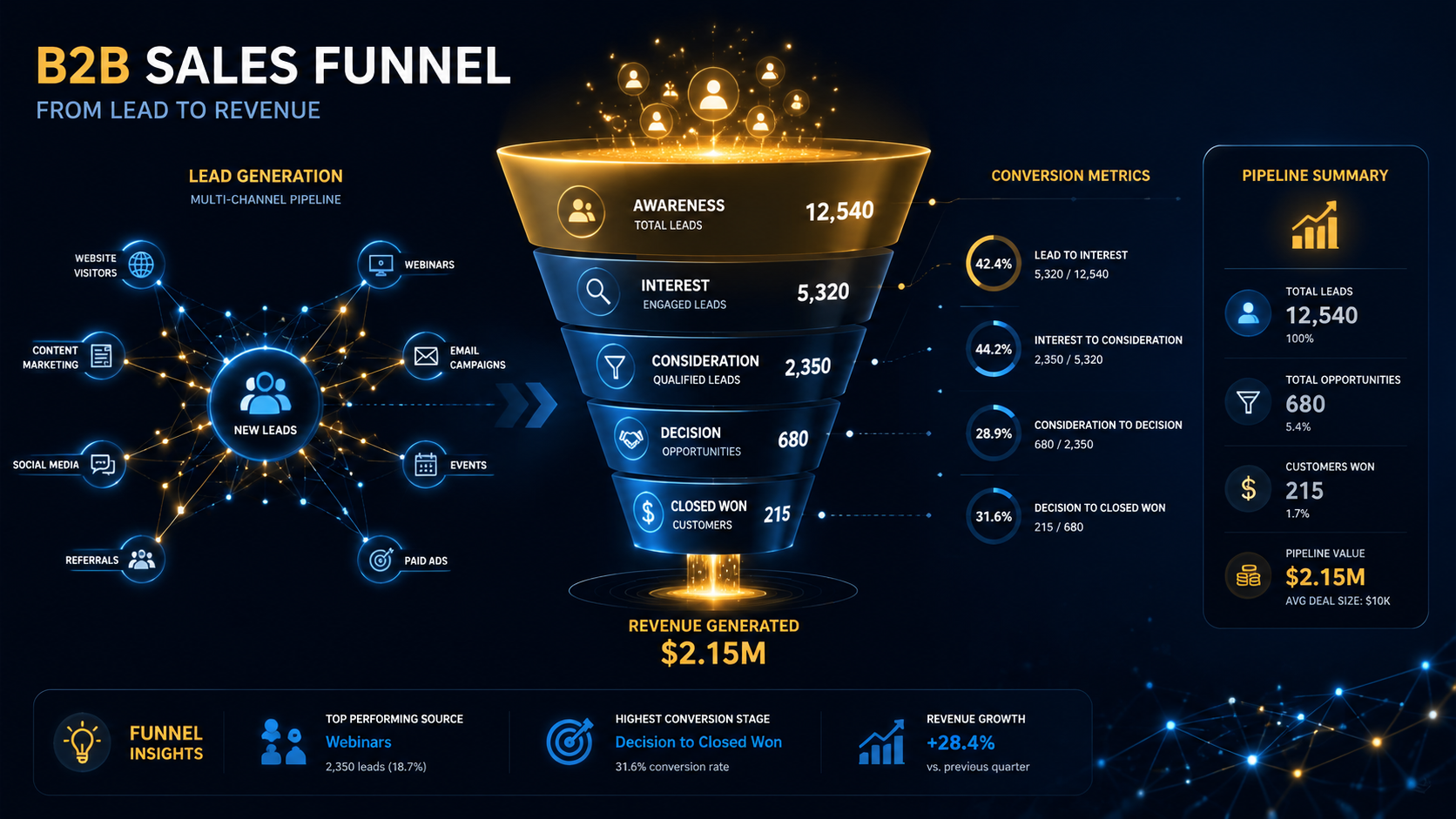
Let me say something that might annoy some people: the traditional B2B marketing funnel (awareness → consideration → decision) no longer describes how real companies buy.
Buyers enter and exit the process. They research, get distracted, come back three weeks later, compare another option, ask a colleague, read a case study at 11 PM on a Sunday. It is not a funnel. It is a mess.
In 2026, the companies that generate leads best understand three key moments where they can intervene.
Internal diagnosis phase. Before looking for solutions, the buyer is validating whether they have a problem worth solving. Here they do not want a demo. They want frameworks, benchmarks, ROI calculators.
Shortlist building phase. The buyer knows they have a problem and is evaluating options. Here they want case studies with real numbers, honest comparisons, social proof.
Internal validation phase. The buyer has chosen an option (maybe yours) and needs to justify it internally. Here they want ROI calculators, business case templates, whitepapers they can forward to their boss.
Most companies put all their budget into phase two. The ones winning in 2026 are also investing in phases one and three.
What works today: three main channels
After looking at dozens of strategies and benchmark reports, here are the channels delivering consistent results in 2026.
1. AI-assisted prospecting
Traditional B2B outbound is dead. Sending generic emails to purchased lists stopped working — response rates are scraping the floor and spam filters keep getting tighter.
What works is AI-assisted hyper-personalized prospecting. Tools like Clay, Apollo, and Salesloft let you research prospects at scale, identify buying signals (job changes, funding rounds, job postings), and personalize outreach based on public data.
Here is a concrete example. An agency we worked with built a flow that identifies B2B SaaS startups that just closed a Series A, pulls the CRO's LinkedIn profile, and sends a personalized analysis of their go-to-market strategy based on data from their website and social presence. Response rate went from 3% to 22%.
It is not magic. It is investing in research before contact.
2. Content that answers real questions
Traditional B2B content — the 40-page ebook nobody reads — is on its way out. What works in 2026 is short, specific, actionable content that answers questions buyers are already searching for.
HubSpot confirms it in their State of Marketing 2026: companies that publish content based on real customer questions generate 3x more qualified leads than those publishing generic "best practices" content.
The trick is not guessing what questions your audience asks. The questions are in your CRM, your support tickets, your sales calls. You just have to extract them and answer them one by one.
One format that works especially well: honest comparison guides. "Platform A vs Platform B for logistics companies." If you are objective and useful, the buyer remembers you when they are ready to buy.
3. Multi-channel nurturing automation
The lead that does not convert today may convert in three months. Problem is, most companies drop the follow-up after the first interaction.
Marketo data shows that companies that automate lead nurturing generate 50% more sales-ready leads at 33% lower cost. But nurturing in 2026 is not just email. It is multi-channel: email, LinkedIn, SMS, WhatsApp, retargeting.
A sequence I have seen work: lead downloads a resource → follow-up email with a related case study → 48 hours later, a LinkedIn message from the account executive offering an additional perspective → 5 days later, retargeting with a video testimonial → 10 days in, an email with a personalized webcast invitation.
Not every lead deserves this sequence. Qualified leads — with budget, authority, and need — do. Everyone else stays on an education sequence until they show buying signals.
Mistakes I keep seeing
I have watched B2B marketing teams make the same mistakes for years. Here are the most common ones.
Generating leads nobody follows up on. I know companies that celebrate generating 500 leads in a month, and sales did not call a single one. If marketing and sales are not aligned on what a qualified lead is, the pipeline is broken from day one.
Asking for too much information too soon. An 8-field form in 2026 is an invitation to close the tab. Ask for the email. Get everything else through data enrichment (Clearbit, Apollo) and subsequent interactions.
Ignoring the partner channel. Referral and partner channels consistently have the highest conversion rates in B2B, and almost nobody manages them actively. If you have happy customers, build a simple referral program — you do not need expensive software, you need to ask.
Treating all leads the same. A CTO at a 500-person company does not need the same content as a marketing manager at a 10-person startup. Segment by role, industry, company size, and buying stage.
How to build a lead generation machine in 2026
You do not need a massive budget. You need a process.
Define your ICP with precision. Not "B2B SaaS companies." "CTOs at VC-backed B2B SaaS startups with 20-100 employees based in LATAM or Spain." The more specific, the better your messaging works.
Build your tech stack. I recommend: a CRM (HubSpot or Salesforce), a data enrichment tool (Apollo or Clay), an outreach orchestrator (Salesloft or Lemlist), and an analytics system. You do not need the whole martech universe. You need these four pieces working together.
Create content for each journey phase. Phase one: benchmarks and ROI calculators. Phase two: case studies and comparisons. Phase three: business case templates and whitepapers.
Measure the right metrics. Not lead count. Cost per qualified lead, conversion rate to opportunity, sales cycle time, and ROI by channel. If you cannot attribute a closed lead to a specific channel, you do not know what is working.
Iterate on data, not gut feel. Every month, review which channels generate the best leads, which messages resonate most, which content accelerates the buying cycle. Double down on what works. Cut what does not.
The near future
B2B lead generation in 2026 is less about individual techniques and more about integrated systems. The company that wins is not the one with the best LinkedIn ad or the most downloaded whitepaper. It is the one that orchestrates all channels — inbound, outbound, referrals, automation — into a coherent system that works even when the founder is not personally pushing.
If you want to go deeper, we have guides on AI-powered conversion optimization and Community-Led Growth B2B, two approaches that pair well with a strong lead gen strategy. We also work directly with companies on digital strategy and automated sales pipelines.
Related articles
- Community-Led Growth: How B2B Companies Build Communities That Actually Drive Revenue
- 3 types of target audiences that will help you convert more on Facebook Ads
- Zero-Party Data: The Privacy-First Marketing Strategy That Actually Works